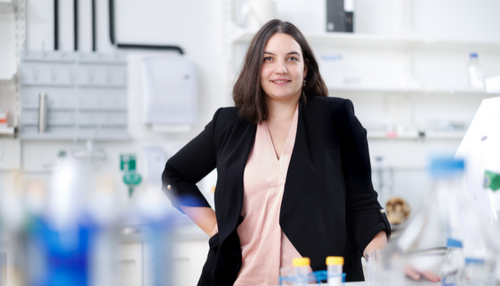
professor profile picture

Katerina Douka

Associate Professor at University of Vienna

Universität Wien

Country flag

Austria

This profile is automatically generated from trusted academic sources.

Google Scholar

.

ORCID

.

LinkedIn

Social connections

How do Bangladeshi students reach out?

Sign in for free to see their profile details and contact information.

Meet Kite AI

Contact this professor

Send an email
LinkedIn
ORCID
Google Scholar
Academic Page

Research Interests

Bioarchaeology

100%

Paleontology

50%

Paleoanthropology

90%

Archaeology

50%

Paleogenomics

50%

Evolutionary Anthropology

40%

Anthropology

30%

Ask ApplyKite AI

Start chatting
How can you help me contact this professor?
What are this professor's research interests?
How should I write an email to this professor?

Recent Grants

Grant: Close

Pigs, dogs and chickens and the quest for status and prestige in the Pacific past.

Open Date: 2021-01-01

Close Date: 2024-01-01

Grant: Close

Calibrating environmental tipping point impacts from global climate reorganisations with swamp kauri

Open Date: 2019-01-01

Close Date: 2022-01-01

Grant: Close

Fossil Fingerprinting and Identification of New Denisovan remains from Pleistocene Asia

Open Date: 2017-06-01

Close Date: 2022-05-31

Positions2

Publisher
source

Katerina Douka

University Name
.

University of Vienna

PhD Student in Evolutionary Anthropology (Palaeoproteomics Focus)

The University of Vienna invites applications for a PhD Student position in Evolutionary Anthropology, with a focus on palaeoproteomics, within the Faculty of Life Sciences. This opportunity is part of the ERC-funded RIFT-TO-RIM Consolidator project (2025-2030), which aims to advance our understanding of modern human dispersals from Africa into Eurasia and Sahul by ~60,000 years ago. The successful candidate will join the Department of Evolutionary Anthropology, working closely with Associate Professor Katerina Douka and an international team of researchers specializing in Human Evolution, Ancient DNA, and Archaeological Science. The project centers on the discovery and analysis of new modern human fossils from under-researched regions in East and South Africa. State-of-the-art biomolecular techniques, including palaeoproteomics, chronometric and isotopic methods, and ancient DNA analysis, will be employed to study fragmentary bones and sediments from archaeological sites across South Africa, Lesotho, Namibia, Kenya, and Ethiopia, dating from 200,000 to 10,000 years ago. The PhD student will develop and apply improved methodologies for palaeoproteomic analyses of bones, teeth, and sediments from Middle and Later Stone Age sites. Additional scientific methods such as radiocarbon dating, stable isotope geochemistry, and ancient genomics will be used to address questions about the presence and dispersal of modern humans. The role involves organizing local research teams, conducting small-scale laboratory work, and collaborating with field-based teams in Africa. Responsibilities include recording and sampling archaeological material, performing analyses (ZooMS, dating), writing scientific reports and journal articles, presenting at conferences, and representing the research group at external meetings. Applicants should possess a relevant Bachelor and Masters degree in archaeology, prehistoric archaeology, zooarchaeology, or biomolecular archaeology. Essential qualities include a strong interest in biomolecular archaeology (especially ZooMS, radiocarbon, and stable isotope analyses), willingness to travel for fieldwork and laboratory work, and excellent communication skills in English. Experience in fieldwork, museum settings, collaborations with African institutions, and database/IT skills are desirable. Training in palaeoproteomics, radiocarbon dating, and pretreatment chemistry will be provided. The University of Vienna offers a supportive and inspiring working environment, flexible working hours, remote/hybrid options, and access to over 600 internal training courses. The position is a non-renewable, fixed-term contract for 3 years, with a basic salary of EUR 3,714.80 (full-time), which may increase based on credited professional experience. The university is committed to equal opportunities, diversity, and the advancement of women, with preference given to female candidates in case of equal qualifications. To apply, submit your curriculum vitae, a short motivation letter in English (max. 2 pages), previous degrees, and contact details for referees via the University of Vienna job portal. For content-related questions, contact Associate Professor Katerina Douka at [email protected]. The application deadline is December 20, 2025.

2 months ago

Publisher
source

Katerina Douka

University Name
.

University of Vienna

PhD Student in Evolutionary Anthropology (Palaeoproteomics Focus) – University of Vienna

The University of Vienna invites applications for a PhD Student position in Evolutionary Anthropology, with a focus on palaeoproteomics, within the Faculty of Life Sciences. This opportunity is part of the ERC-funded RIFT-TO-RIM Consolidator project (2025-2030), which aims to advance our understanding of modern human dispersals from Africa into Eurasia and Sahul by ~60,000 years ago. The project will utilize state-of-the-art biomolecular techniques, including palaeoproteomics, chronometric and isotopic methods, and ancient DNA analysis, to study fragmentary bones and sediments from archaeological sites in East and South Africa. The successful candidate will join the Department of Evolutionary Anthropology and work closely with Associate Professor Katerina Douka ( doukalab.univie.ac.at ). The research will involve developing and applying improved methodologies for palaeoproteomic analyses of bones, teeth, and sediments from Middle and Later Stone Age sites. Additional scientific methods such as radiocarbon dating, stable isotope geochemistry, and ancient genomics will be employed to address questions about the presence of modern humans at each site. The position offers the chance to collaborate with an international team, organize local research teams, and conduct small-scale laboratory work for in-situ analyses. Applicants should have a relevant Bachelor and Masters degree in archaeology, prehistoric archaeology, zooarchaeology, or biomolecular archaeology. Essential skills include a strong interest in biomolecular archaeology (especially ZooMS, radiocarbon, and stable isotope analyses), the ability to travel and work in field/museum/laboratory settings, and excellent communication skills in English. Experience in fieldwork, museum work, collaborations with African institutions, and database/IT use are desirable. Training in palaeoproteomics, radiocarbon dating, and pretreatment chemistry will be provided, but prior experience is advantageous. The position is a non-renewable 3-year contract, starting on 01.03.2026 and ending on 28.02.2029. The basic salary is EUR 3,714.80 per month (full-time), with increases for credited professional experience. The University of Vienna offers a supportive and international academic environment, flexible working hours, remote/hybrid options, and access to over 600 internal training courses. The workplace is centrally located in Vienna with excellent public transport connections. To apply, submit your curriculum vitae, a short motivation letter (max 2 pages, in English), previous degrees, and contact details for references via the University of Vienna job portal. The application deadline is 01/09/2026. For content-related questions, contact Associate Professor Katerina Douka at [email protected]. The University of Vienna is committed to equal opportunities, diversity, and the advancement of women, and encourages qualified female candidates to apply.

just-published

Articles14

Collaborators15

Marie SORESSI

Professor

Leiden University

NETHERLANDS

Àfrica Pitarch Martí

Professora Serra Húnter

Universitat de Barcelona Facultat d'Educació

SPAIN

Gregory Hodgins

Research Scientist, Research Professor

University of Arizona

UNITED STATES

Taylor Hermes

Max Planck Institute for Evolutionary Anthropology

GERMANY

François-Xavier Le Bourdonnec

Associate professor

Université Bordeaux Montaigne

FRANCE

Ian Barnes

Research Leader and Head of Division (Vertebrates and Anthropology)

Natural History Museum

UNITED KINGDOM

Stuart Bedford

-

AUSTRALIA

Rebecca Hamilton

Lecturer in Physical Geography

University of Sydney

AUSTRALIA

Ludovic Orlando

University Paul Sabatier

FRANCE

Marine Frouin

Assistant Professor

Stony Brook University

UNITED STATES

Diyendo Massilani

Assistant Professor of Genetics

Yale University

UNITED STATES

Laure Metz

Aix-Marseille University

FRANCE

Choongwon Jeong

Assistant Professor

Seoul National University

SOUTH KOREA

Alain Queffelec

CNRS Délégation Aquitaine-Limousin

FRANCE

María Martinón‐Torres

-

UNITED KINGDOM