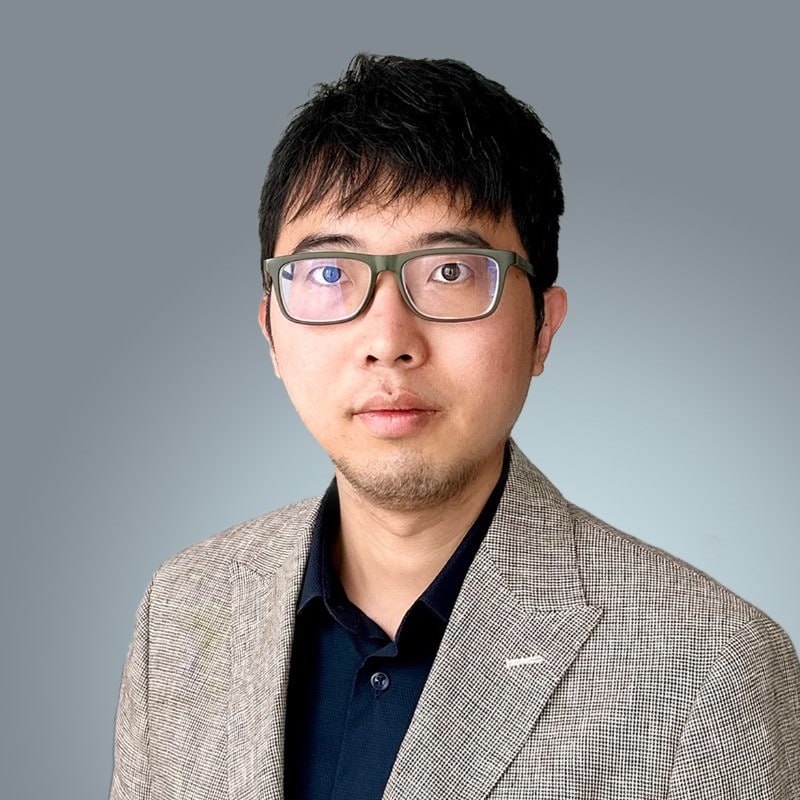
professor profile picture

Kai Wang

Assistant Professor and Canada Research Chair

McGill University

Country flag

Canada

This profile is automatically generated from trusted academic sources.

Google Scholar

.

ORCID

.

LinkedIn

Social connections

How do Indian students reach out?

Sign in for free to see their profile details and contact information.

Meet Kite AI

Contact this professor

Research Interests

Condensed Matter Physics

80%

Quantum Physics

50%

Photonic

80%

Optical Physics

70%

Topological Insulator

40%

Photonic Crystal

40%

Non-hermitian Physics

30%

Ask ApplyKite AI

Start chatting
How can you help me contact this professor?
What are this professor's research interests?
How should I write an email to this professor?

Positions2

Publisher
source

Kai Wang

University Name
.

McGill University

PhD and Postdoc Positions in Quantum Photonics at McGill University (Canada Impact+ Research Training Awards)

Professor Kai Wang, Assistant Professor and Canada Research Chair at McGill University, is seeking strong postdoctoral and PhD candidates for positions in quantum photonics. These opportunities are part of the Canada Impact+ Research Training Awards, a new initiative designed to attract top international research talent to Canada in priority research areas, including advanced digital technologies such as quantum and photonics. The Wang Lab at McGill University merges hands-on optical physics with a cross-disciplinary approach, building advanced optical and photonic systems and developing theoretical frameworks to understand their principles. The lab is committed to training researchers who can both create and understand in the emerging quantum era. Research interests include quantum photonics, optical physics, and related advanced technologies. The Canada Impact+ Research Training Awards are administered by the Canadian Institutes of Health Research (CIHR), the Natural Sciences and Engineering Research Council of Canada (NSERC), and the Social Sciences and Humanities Research Council (SSHRC). The awards provide 600 doctoral scholarships (valued at $40,000/year for three years) and 400 postdoctoral research awards (valued at $70,000/year for two years) to international candidates, including Canadian citizens currently abroad. These are fully funded awards covering stipend and are targeted at candidates in priority research areas such as quantum technologies, clean technology, environment, and advanced materials. Eligibility requirements specify that candidates must be currently studying or working outside Canada and not currently affiliated with a Canadian institution. Strong research background in quantum photonics, optical physics, or related fields is expected. The application process involves emailing Professor Kai Wang by January 10, 2026, to allow time for internal pre-screening and nomination preparation ahead of McGill’s internal nomination deadline. Further details and official information can be found on the lab website and the Canada Impact+ Research Training Awards page. For more information, visit the Wang Lab website and the official award announcement .

1 month ago

Publisher
source

Kai Wang

University Name
.

McGill University

Postdoctoral and PhD Positions in Quantum Photonics at McGill University (Canada Impact+ Research Training Awards)

Prof. Kai Wang, Assistant Professor and Tier 2 Canada Research Chair in Quantum Photonics at McGill University, is seeking strong postdoctoral and PhD candidates for Fall 2026 entry in the field of quantum photonics. These positions are for McGill nominations under the prestigious Canada Impact+ Research Training Awards, a new initiative designed to attract top international research talent to Canada in priority research areas such as advanced digital technologies, including quantum and photonics research. The Canada Impact+ Research Training Awards are highly competitive and fully funded, offering postdoctoral research awards of $70,000 per year for two years and doctoral scholarships of $40,000 per year for three years. The awards are open to candidates currently studying or working outside Canada who are not currently affiliated with a Canadian institution. Both international applicants and Canadian citizens abroad are eligible to apply. The research focus is on quantum photonics, a cutting-edge area at the intersection of physics, quantum technologies, and photonics, with applications in advanced digital technologies and quantum information science. Applicants should have a strong background in physics, photonics, or closely related fields. Postdoctoral candidates must hold a doctoral degree, while PhD applicants should have a relevant undergraduate or master's degree. Interested candidates are encouraged to email Prof. Wang ([email protected]) with a CV, publication list, and (if applicable) expected start date by January 10, 2026, to allow time for internal pre-screening and nomination preparation ahead of McGill’s internal nomination deadline of January 16, 2026. Early contact is recommended due to the competitive nature of the awards and the internal selection process. For more information about the lab and research environment, visit the Kai Wang Lab website . Official details about the Canada Impact+ Research Training Awards can be found on the NSERC announcement page . This is an excellent opportunity for talented researchers to join a leading Canadian institution and contribute to innovative research in quantum photonics. Key academic keywords: quantum photonics, photonics, quantum technologies, physics, advanced digital technologies, postdoctoral research, doctoral research, Canada Impact+ Research Training Awards.
1 month ago

Articles14

Collaborators7

Shanhui Fan

Professor

Stanford University

UNITED STATES

Jiahui Wang

Stanford University

UNITED STATES

Andrey A. Sukhorukov

Australian National University

AUSTRALIA

Avik Dutt

Assistant Professor

University of Maryland at College Park

UNITED STATES

Lingling Fan

PhD student in Prof. Shanhui Fan's group

Stanford University

UNITED STATES

Kiyoul Yang

Harvard University

UNITED STATES

Viktar Asadchy

Aalto University

FINLAND