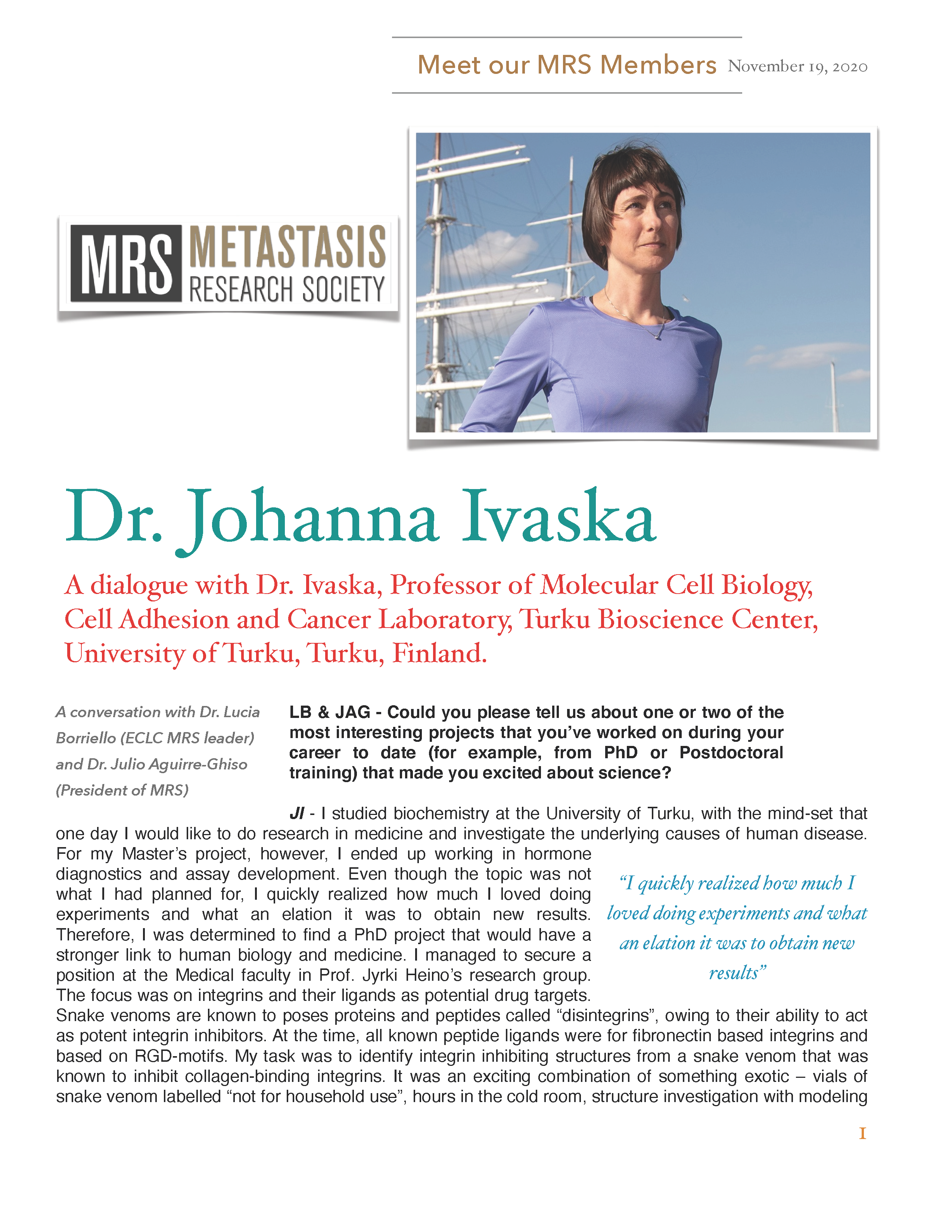
professor profile picture

Johanna Ivaska

Professor at University of Turku

University of Turku

Country flag

Finland

Has grant

This profile is automatically generated from trusted academic sources.

Google Scholar

.

ORCID

.

LinkedIn

Social connections

How do Korean students reach out?

Sign in for free to see their profile details and contact information.

Meet Kite AI

Contact this professor

Send an email
LinkedIn
ORCID
Google Scholar
Academic Page

Research Interests

Cell Biology

80%

Biochemistry

30%

Integrin Biology

40%

Cancer Biology

30%

Bioinformatic

20%

Inflammatory Biology

20%

Membrane Trafficking

20%

Ask ApplyKite AI

Start chatting
How can you help me contact this professor?
What are this professor's research interests?
How should I write an email to this professor?

Recent Grants

Grant: Open

Cancer metastasis – new biological paradigms as drug targets

Open Date: 2023-01-01

Close Date: 2026-12-01

Grant: Open

Biological Barrier Mechanics and Disease: From molecular-scale to tissue-level understanding of signal integration and forces (BarrierForce)

Open Date: 2022-01-01

Close Date: 2029-12-01

Grant: Close

Nucleomechanical regulation of cell states – from pluripotency to cancer / Consortium: NucleoMech

Open Date: 2020-01-01

Close Date: 2023-12-01

Grant: Close

Receptor sorting and cytoskeletal regulation in breast cancer

Open Date: 2019-12-01

Close Date: 2023-12-01

Grant: Close

Adhesion dynamics and mechanobiological pathways as determinants of oncogenic properties

Open Date: 2019-09-01

Close Date: 2023-08-01

Positions2

Publisher
source

Johanna Ivaska

University Name
.

University of Turku

Postdoctoral and Bioinformatician Positions in Cancer Research and Cell Adhesion at University of Turku

The Cell Adhesion and Cancer Group (Ivaska Lab) at the Turku Bioscience Centre, University of Turku, Finland, is recruiting talented researchers for postdoctoral and bioinformatician positions. The group focuses on uncovering the mechanisms of cancer invasion and tissue barrier function using advanced biological and computational approaches. The bioinformatician role involves working at the interface of computation and biology, analyzing large multi-omics and imaging datasets, developing analytical pipelines, and collaborating with experimental scientists. This position is funded by an ERC Advanced Grant, ensuring a fully funded research environment. Two postdoctoral researcher positions are available to explore tissue barriers under normal and disease conditions. The research utilizes organoids, in vivo models, biophysics, and cutting-edge imaging to investigate cancer invasion and tissue barrier function. The Ivaska Lab offers a collaborative, international culture and access to state-of-the-art tools and methodologies. Applicants should hold a PhD in biology, biomedical sciences, bioinformatics, or a related field. Experience with multi-omics data, imaging, analytical pipeline development, and experimental collaboration is preferred. For postdoctoral roles, expertise in organoids, in vivo models, biophysics, and advanced imaging is desirable. The University of Turku provides competitive salary and benefits, with funding secured for these positions. To apply, candidates should submit their application online via the University of Turku vacancies portal by February 20, 2025. The anticipated start date is April 2026, with flexibility. For further information, applicants can contact Professor Johanna Ivaska at [email protected] and review the lab website at ivaskalab.utu.fi. This opportunity is ideal for researchers interested in cancer biology, cell adhesion, bioinformatics, and computational biology, seeking to join a world-class research team in Finland.

1 year ago

Publisher
source

Johanna Ivaska

University Name
.

University of Turku

Postdoctoral Researcher in Bioinformatics – Cell Adhesion and Cancer Group, Turku Bioscience Centre

The University of Turku invites applications for a postdoctoral researcher position in bioinformatics within the Cell Adhesion and Cancer Group at Turku Bioscience Centre. This interdisciplinary group, led by Professor Johanna Ivaska, is renowned for its innovative cancer research and collaborative environment. The successful candidate will play a pivotal role in analysing and integrating omics-based biological datasets, translating complex data into actionable biological insights, and developing analytical pipelines accessible to biologists. The group comprises 18 international researchers, including postdocs, PhD and Master’s students, technicians, and support staff, fostering skill development, cross-disciplinary learning, and scientific independence. The position is part of the ERC Advanced Grant project 'BorderControl', which aims to elucidate the molecular signals enabling cancer cells to cross tissue borders. Research focuses on spatial profiling of the tumour–stroma interface to identify receptor–ligand interactions regulating invasion, using advanced techniques such as microfluidics-based imaging, single-cell and spatial profiling (scRNA-seq, mass cytometry, spatial transcriptomics), synthetic biology, high-throughput screening, and multicellular migration platforms. Clinical relevance is assessed through patient material and designer tissue microarrays, with close collaboration with clinicians and external experts. Key responsibilities include developing and applying machine learning methods to biomedical questions, analysing and modelling diverse omics datasets, integrating data from spatial transcriptomics, scRNA-seq, bulk RNA-seq, proteomics, and immunohistochemistry, and analysing patient cohort samples including microscopy images. The role requires keeping abreast of rapidly evolving methods, collaborating with biomedical researchers, publishing in international journals, and participating in national and international networks. Applicants must have a doctoral degree in bioinformatics, computer science, data science, or a related field; biologists trained in bioinformatics are also eligible. Candidates nearing completion of their doctoral studies may be considered as project researchers. Essential skills include experience with biological datasets, programming (R, Python), independent and collaborative work, initiative, self-direction, and excellent English communication. Advantageous skills include machine learning, deep learning, method development, cell biology, relevant publications, and advanced microscopy/image analysis. The position offers a fixed-term contract from 1 April 2026 to 31 March 2028, with possible extension. Salary ranges from 3600–3800 €/month for postdoctoral researchers and 2800–3200 €/month for project researchers, determined by the Finnish university collective agreement. The University of Turku provides a top-level research environment, access to cutting-edge technologies, flexible working hours, support for professional development, and excellent networking opportunities. The institution values equality and diversity and encourages applicants from all backgrounds. Applications must be submitted as a single PDF in English, including a motivation letter, CV, degree certificates, contact details of three referees, and any other relevant documents. Apply via the online application link. Applications are reviewed on a rolling basis, so early submission is recommended. For further information, contact Professor Johanna Ivaska or HR Specialist Paula Luoma.

2 weeks ago

Articles10

Collaborators15

Guillaume Jacquemet

-

FINLAND

Harri Sihto

University of Helsinki

FINLAND

Tuomas Mirtti

University of Helsinki

FINLAND

Sanford J. Shattil

University of California

UNITED STATES

Fatemeh Hassani Nia

Université libre de Bruxelles (ULB)

BELGIUM

Anne Jokilammi

University lecturer

University of Turku

FINLAND

Hans-Jürgen Kreienkamp

University Medical Center Hamburg-Eppendorf

GERMANY

Jan Lammerding

Professor

Cornell University

UNITED STATES

Kari Salokas

University of Helsinki

FINLAND

Roosa Kallionpää

University of Turku

FINLAND

Sara Zanivan

Professor

University of Glasgow

UNITED KINGDOM

Pauliina M. Munne

-

FINLAND

Konstantin Kogan

University of Helsinki

FINLAND

Antti Rannikko

University of Helsinki

FINLAND

Klaus Elenius

professor of medical biochemistry

University of Turku

FINLAND