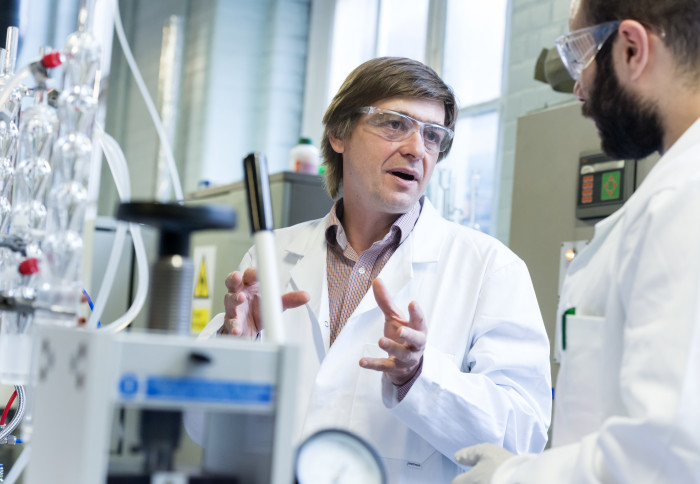
professor profile picture

Anthony Kucernak

Professor

Imperial College London

Country flag

United Kingdom

Has grant

This profile is automatically generated from trusted academic sources.

Google Scholar

.

ORCID

.

LinkedIn

Social connections

How do Nigerian students reach out?

Sign in for free to see their profile details and contact information.

Meet Kite AI

Contact this professor

Send an email
LinkedIn
ORCID
Google Scholar
Academic Page

Research Interests

Materials Chemistry

50%

Biochemical Engineering

20%

Electrochemistry

70%

Fuel Cell

30%

Chemistry

30%

Microreactor Technology

20%

Ion Transport

20%

Ask ApplyKite AI

Start chatting
How can you help me contact this professor?
What are this professor's research interests?
How should I write an email to this professor?

Recent Grants

Grant: Close

Hydrogen and Fuel Cell Supergen Hub

Open Date: 2012-04-30

Close Date: 2017-04-29

Grant: Close

"Mind the Gap" - jumping the hurdles limiting polymer fuel cell performance and commercialisation

Open Date: 2011-11-30

Close Date: 2015-02-28

Grant: Close

Development of novel mesoporous Pd based electrocatalysts for methanol tolerant oxygen reduction

Open Date: 2011-07-31

Close Date: 2014-07-30

Grant: Close

Collaborative Research Opportunities in Energy with South Africa: Ab-Initio development and testing of fuel cell catalysts

Open Date: 2009-10-04

Close Date: 2013-10-03

Grant: Close

The Flexible Fuel Cell

Open Date: 2009-09-30

Close Date: 2013-03-31

Positions2

Publisher
source

Anthony Kucernak

University Name
.

Imperial College London

In-operando Detection and Quantification of Reactive Intermediates in Electrolysers and Fuel Cells

This PhD project at Imperial College London focuses on the in-operando detection and quantification of reactive intermediates in electrolysers and fuel cells. The research aims to advance understanding of electrocatalysis and the formation of reactive species during the operation of these devices, which is crucial for addressing degradation processes that limit their lifespan. Two positions are available: one involves testing electrocatalysts and recombination catalysts in aqueous electrochemical environments using ultramicroelectrode and floating electrode techniques; the other centers on developing in-operando approaches to measure the formation of reactive species within fuel cells and electrolysers under real operating conditions. Both positions will require experimental work on electrocatalysis, optimizing conditions such as reactant concentration, temperature, and pH. Candidates will also develop and utilize microkinetic electrochemical models to extract kinetic parameters, which will be integrated into three-dimensional multiphysics simulations using software like Comsol. The project is ideal for candidates with backgrounds in chemistry, physics, chemical engineering, or related fields, especially those interested in electrochemical kinetics, instrumentation development, and simulation. Prior experience with electrochemical systems (electrolysers, fuel cells, batteries) is advantageous. The successful candidate will primarily work within the Department of Chemistry at Imperial College London and will also spend time at the Johnson Matthey Technical Research Centre in Sonning Common, near Reading. This collaboration offers exposure to both academic and industrial research environments. The application deadline is January 25, 2026. For further details and to request an application pack, contact Professor Anthony Kucernak at [email protected], using 'Imperial-JM Studentship' in the subject line. The application pack includes the application form, relevant papers, details of the appointment process, and information about the research group. This opportunity is ideal for students seeking to develop expertise in advanced electrochemical techniques, kinetic modeling, and the practical application of research in both academic and industrial settings. Funding details are not specified in the announcement.

1 month ago

Publisher
source

Oriol Planas

University Name
.

Imperial College London

PhD Studentships in Chemistry (Catalysis, Organometallics, Materials, Chemical Biology) at Imperial College London

Imperial College London’s Department of Chemistry is inviting applications for multiple PhD studentships in areas including catalysis, organometallic chemistry, materials for energy, chemical biology, and computational chemistry. The department typically admits 50-60 PhD students annually, with funding from sources such as the EPSRC, industry, and departmental scholarships. Projects span fundamental and applied research, including catalysis using earth-abundant elements, computational discovery of energy materials, chemical biology, and machine learning for materials design. Key research areas include: Catalysis and Organometallic Chemistry: Projects in the Planas Lab focus on catalysis and organometallics, especially using earth-abundant elements. Materials for Energy: Dr. Alex Ganose leads a fully funded project on defect-tolerant materials for energy applications, combining computational chemistry and AI. Electrochemistry: Prof. Anthony Kucernak’s group investigates electrocatalysis in electrolysers and fuel cells, with a focus on in-operando detection of reactive intermediates. Chemical Biology and Machine Learning: Assoc. Prof. Jarvist Moore Frost offers projects on antimicrobial peptides and quantum mechanical models using machine learning. Funding: Departmental PhD Scholarships are available for home students, covering full fees and a stipend (£22,780 for 2025-26) for 3.5 years. Some projects are fully funded for both UK and international students. Other scholarships may offer partial fee waivers or require self-funding for part of the duration. Eligibility: Applicants should hold a strong MSci or MRes First-Class degree in Chemistry or a related field. Some studentships are open only to UK home students, while others are open to international applicants. Desirable backgrounds include catalysis, organometallic chemistry, computational chemistry, materials science, machine learning, and chemical engineering. Academic excellence, research potential, and extracurricular activities are considered. Application Process: Prospective students should contact a potential supervisor in the Chemistry Department to discuss research interests and projects. After discussion, candidates complete the departmental scholarship application form, which the supervisor submits for consideration. For specific projects, applicants should email the listed supervisor with a CV and statement of interest. The deadline for departmental scholarships is 1 December 2025. Imperial College London is committed to diversity and equality, encouraging applications from underrepresented backgrounds. The department is an Athena SWAN gold Award winner and a Stonewall Diversity Champion. For more information, visit planaslab.com or the Chemistry PhD Studentships page .

3 months ago

Articles10

Collaborators7

Emile S. Greenhalgh

Imperial College London

UNITED KINGDOM

David Anthony

Imperial College London

UNITED KINGDOM

Qilei Song

Lecturer

Imperial College London

UNITED KINGDOM

Stefan Guldin

Associate Professor

University College London

UNITED KINGDOM

Kyung-Wan Nam

Associate Professor

Dongguk University

SOUTH KOREA

Chee Tong John Low

Assistant Professor, Energy for Low Carbon Vehicles

University of Warwick

UNITED KINGDOM

Barun Chakrabarti

Imperial College London

UNITED KINGDOM