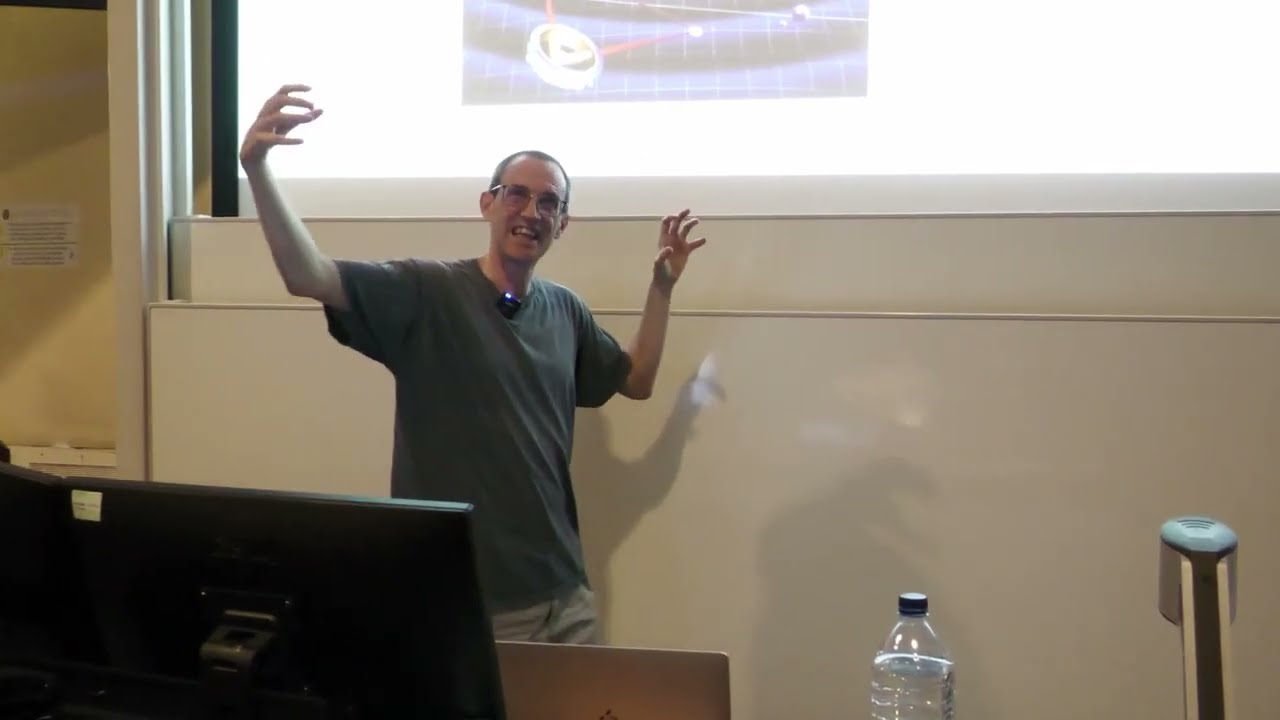

Gianmassimo Tasinato
2 weeks ago
STFC
PhD Studentship in Gravitational Wave Cosmology: From Theory to Experiments Swansea University in United Kingdom
Degree Level
PhD
Field of study
Experimental Physics
Funding
Full funding availableDeadline
December 31, 2026
Country
United Kingdom
University
Swansea University

How do I apply for this?
Sign in for free to reveal details, requirements, and source links.
Where to contact
Keywords
About this position
This PhD studentship at Swansea University offers a unique opportunity to engage in cutting-edge research at the intersection of gravitational wave physics and cosmology. The project is designed for motivated students eager to explore fundamental questions about the Early Universe and the dark sector, which together shape most of the cosmos we observe today. The research will involve developing and testing theoretical models, making quantitative predictions for gravitational-wave signals, and connecting theory with observational data from major international collaborations.
Students will work closely with experienced supervisors, Professor Gianmassimo Tasinato and Dr. Azadeh Maleknejad, and will have the chance to collaborate with international teams involved in projects such as the Laser Interferometer Space Antenna (LISA), Einstein Telescope, Square Kilometre Array Observatory (SKAO), and NANOGrav. This involvement will allow the student to compare theoretical predictions directly with real data and become part of vibrant, international research teams at the forefront of discovery.
The studentship is funded by STFC and covers full tuition fees and an annual stipend at the UKRI rate (£21,805 for 2026/27). The programme is open to both UK and international applicants. Applicants must hold an undergraduate degree at 2.1 level or a master’s degree with a minimum overall grade at ‘Merit’ (or Non-UK equivalent as defined by Swansea University). English language proficiency is required: IELTS 6.5 overall (with no individual component below 6.0) or Swansea University recognised equivalent. Some applicants may need ATAS clearance, but this is not required for the scholarship application process.
The project start date is October 2026, with the possibility of a short deferral in exceptional circumstances. The research areas include data analysis, astronomy, astrophysics, computational physics, particle physics, space science, and theoretical physics. The successful candidate will gain high-level research training and build an international scientific profile in a rapidly advancing field.
To apply, candidates should submit their application online via the provided FindAPhD link. For questions about eligibility, applicants can email [email protected] with the scholarship web-link. Successful award winners will receive instructions for ATAS clearance if required. Full details of English language policy and country-specific entry requirements are available on the Swansea University website.
Funding details
Full funding including tuition fees and living expenses is available for this position. The scholarship covers all educational costs and provides a monthly stipend.
How to apply
Please submit your application including a cover letter, CV, academic transcripts, and contact information for two references. Applications should be sent via the online portal before the deadline.
Ask ApplyKite AI
Professors
How do I apply for this?
Sign in for free to reveal details, requirements, and source links.