

Sousa JavanNikkhah
5 months ago
This scholarship has expired. You can find similar scholarships from the section below or browse our scholarships listing pages.
Research Ireland Pathways Doctoral Scholarship
Fully Funded PhD in Polymer-Hybrid Anion-Exchange Membranes for Electrochemical Energy Applications at Maynooth University Maynooth University in Ireland
Degree Level
PhD
Field of study
Machine Learning
Funding
Fully funded PhD for up to 4 years with a €25,000 annual stipend, annual tuition fee support, and contribution to research/travel costs. The project is funded through Research Ireland Pathways and includes research/travel support.
Deadline
Expired

Country
Ireland
University
Maynooth University

How do I apply for this?
Sign in for free to reveal details, requirements, and source links.
Meet Kite AI
 Ongoing program
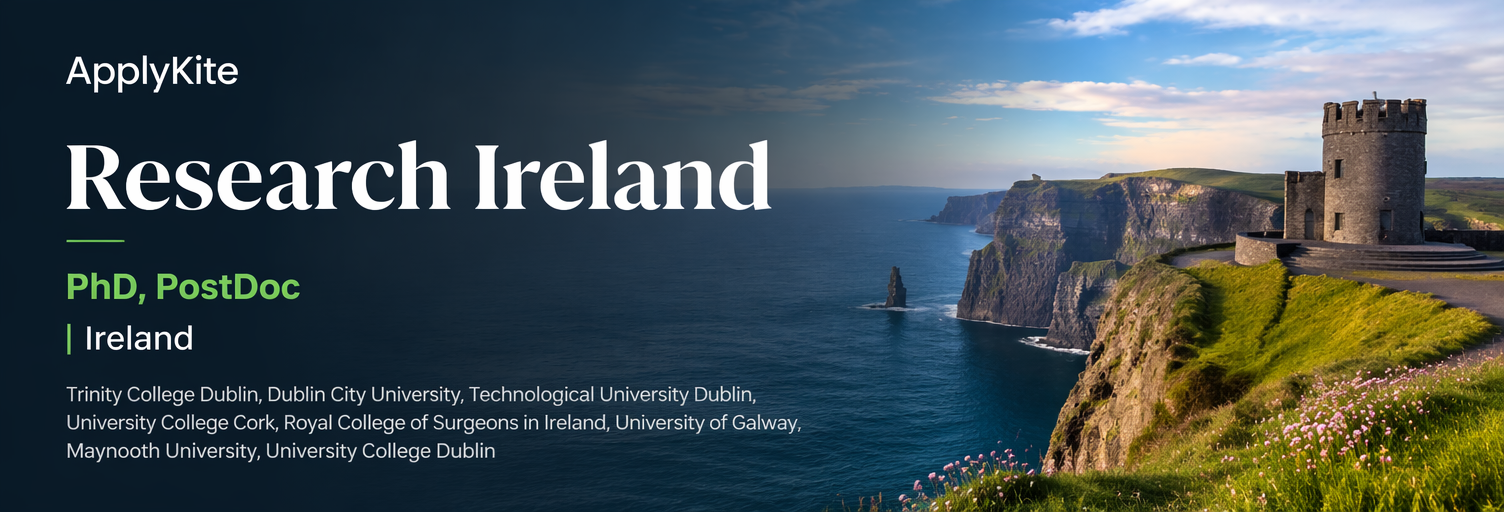
Research Ireland
by Research Ireland
Research Ireland funds research scholarships and studentships in Ireland, especially at PhD level, across a wide range of disciplines and university-based projects.
Explore the programSuggested scholarships





Keywords
About this position
Maynooth University’s Department of Chemistry is advertising a fully funded PhD position in the SUSAS group under the supervision of Sousa JavanNikkhah and co-supervision of Professor Carmel Breslin. The project is part of a Research Ireland-funded doctoral scholarship and starts in September 2026.
The research focuses on the experimental development of advanced polymer-hybrid anion-exchange membranes for electrochemical energy applications. Core research areas include membrane fabrication, porous materials, physicochemical characterisation, and electrochemical characterisation. The broader project also mentions membrane synthesis, surface processing, validation of computational predictions, and data-driven optimisation, with opportunities to work in a collaborative research team and contribute to publications and conference presentations.
Funding includes a €25,000 annual stipend, tuition fee support, and research/travel costs for up to 4 years. This is a PhD scholarship rather than a postdoctoral or master’s opening.
Eligibility highlights: applicants should have a Bachelor’s or Master’s degree in Chemistry, Materials Science, Chemical Engineering, Electrochemistry, Polymer Science, or a closely related field, with at least a First Class or high 2.1 equivalent. Relevant lab experience, numerical analysis, materials characterisation, and strong English communication/writing skills are expected. Desirable experience includes polymer synthesis, membrane fabrication, electrochemistry, impedance spectroscopy, cyclic voltammetry, conductivity measurements, Python/MATLAB, machine learning, and research outputs.
Application deadline: 26 June 2026 at 5pm. Applicants should submit a single PDF including a personal statement, CV, short research proposal (up to 1000 words), transcripts, and two referees’ contact details. Applications are to be submitted directly to [email protected] and via the university application process/MUApply as instructed.
Funding details
Fully funded PhD for up to 4 years with a €25,000 annual stipend, annual tuition fee support, and contribution to research/travel costs. The project is funded through Research Ireland Pathways and includes research/travel support.
What's required
Applicants must hold a Bachelor’s or Master’s degree in Chemistry, Materials Science, Chemical Engineering, Electrochemistry, Polymer Science, or a closely related discipline, with at least a First Class or high Second Class Honours (2.1) degree or equivalent international qualification. They should have a strong academic background in at least one relevant area such as materials science, electrochemistry, polymer science, membrane science, computational modelling, or chemical engineering. Experience with laboratory research, numerical analysis, or materials characterization is required, and strong independent and collaborative working ability, good organisational skills, communication skills, and scientific writing skills in English are expected. Desirable experience includes polymer synthesis, membrane fabrication, electrochemistry, impedance spectroscopy, cyclic voltammetry, conductivity measurements, computational tools, data analysis, scientific programming (e.g. Python, MATLAB), machine learning, and evidence of research output. Non-native English speakers must provide evidence of English proficiency.
Ask ApplyKite AI
Professors
How do I apply for this?
Sign in for free to reveal details, requirements, and source links.