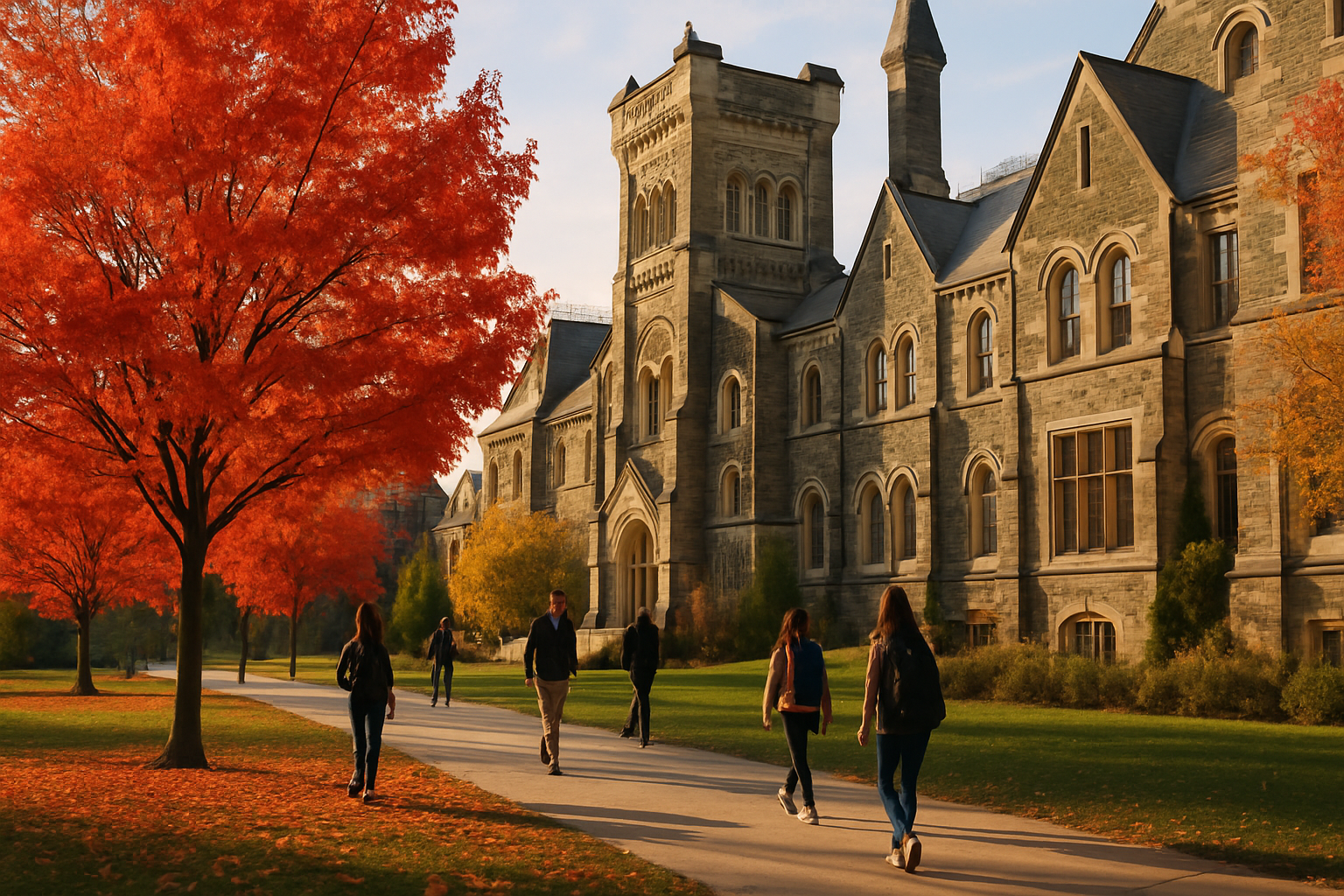
The University of Toronto alone enrolled 7,847 doctoral students in 2024 — more than the entire graduate population of many countries.
Canada has quietly positioned itself as the world's second-most popular destination for international PhD students, trailing only the United States. With programs that cost a fraction of American alternatives and immigration pathways that actually work, it's not hard to see why.
This guide covers everything you need to know about pursuing a PhD in Canada: from the $50,000/year Vanier scholarships to the study permit process that leads to permanent residency.

Why Choose Canada for Your PhD?
Three numbers tell the story: Canada ranks 4th globally in research output per capita, offers the fastest PhD-to-permanent-residence pathway among major destinations, and maintains a 94% student satisfaction rate according to the 2024 International Student Survey.
But there's more to it than statistics.
Research Excellence: Canadian universities produced 4.1% of the world's most-cited research papers in 2023, despite having just 0.5% of global population. Fields like AI, clean energy, and healthcare dominate — largely thanks to government funding that reached CAD $15.3 billion in 2024.
Quality of Life: Toronto, Vancouver, and Montreal consistently rank in the world's top 20 most livable cities. Universal healthcare covers PhD students. Winter exists, but so do ski resorts within driving distance of most universities.
The immigration angle seals the deal for many students. Unlike other countries where PhD graduates face uncertain visa renewals, Canada actively recruits doctoral graduates through Express Entry. PhD holders receive 30 bonus points — often enough to guarantee permanent residency.
PhD Funding in Canada: The Complete Breakdown
Canadian PhD funding operates on two levels: prestigious national scholarships and university-specific packages. The good news? Most PhD students receive some form of funding. The better news? The amounts are liveable.
National Scholarships
Vanier Canada Graduate Scholarships (CGS): The flagship program awards $50,000 annually for three years. Just 166 scholarships available across all fields — competition is fierce but not impossible. Recipients need exceptional research potential and leadership experience.
Trudeau Foundation Scholarships: Social sciences and humanities students can access $40,000/year plus $20,000 for research and travel. Only 15 awards annually, but the network access is unparalleled.
Government Research Council Awards:
NSERC (Sciences/Engineering): $21,000-$35,000/year
SSHRC (Social Sciences): $20,000-$35,000/year
CIHR (Health Sciences): $17,500-$35,000/year
These tri-council awards form the backbone of Canadian PhD funding. Application deadlines typically fall in September-October for the following year.
University-Specific Funding
Most universities guarantee funding packages to accepted PhD students. Here's what to expect:
University | Typical Package | Additional Benefits |
University of Toronto | $25,000-$30,000 | Health/dental coverage |
UBC | $22,000-$28,000 | Transit pass, gym access |
McGill | $21,000-$25,000 | Quebec tuition rates |
University of Waterloo | $23,000-$32,000 | Co-op opportunities |
These packages typically combine teaching assistantships, research assistantships, and fellowships. International students pay higher tuition (CAD $7,000-$25,000 annually), but funding often covers most or all costs.
Pro Tip: Apply for external funding even if your university guarantees support. Tri-council awards are prestigious and can increase your total funding significantly.
Looking for fully funded?
Discover PhD, Master's, and Postdoc positions tailored to your goals with ApplyKite's smart AI tools.
Top Canadian Universities for PhD Studies
Canada's university system punches above its weight class. Five Canadian institutions rank in the global top 50 for research impact, and the quality remains remarkably consistent across the system.
Tier 1: Research Powerhouses
University of Toronto: Canada's largest research university with a $1.43 billion research budget. Strongest in medicine, engineering, and business. The downtown campus puts you in Canada's financial center — internship and industry collaboration opportunities abound.
University of British Columbia: Vancouver's natural beauty meets world-class research. Leading in forestry, oceanography, and sustainable technology. The campus literally borders the Pacific Ocean.
McGill University: Montreal's English-language flagship with French-Quebec charm. Medical programs are legendary, but the university excels across disciplines. Living costs are 30% lower than Toronto or Vancouver.
Tier 2: Specialized Excellence
University of Waterloo: The MIT of Canada for computer science and engineering. Co-op programs integrate industry experience into PhD studies. BlackBerry was founded here — the entrepreneurial culture persists.
University of Alberta: Energy research headquarters with the world's largest per-capita oil sands research program. Strong in petroleum engineering, environmental science, and Indigenous studies.
McMaster University: Hamilton-based powerhouse known for health sciences and materials research. The medical school pioneered problem-based learning — innovation culture extends throughout the university.
Each university operates differently. UofT emphasizes independence and research breadth. Waterloo prioritizes practical application. McGill blends European-style academics with North American resources. Research fit matters more than rankings.
Application Timeline and Requirements
Canadian PhD applications follow predictable patterns. Most programs have December-February deadlines for September entry, though some engineering programs accept applications for January start dates.
12-Month Application Timeline
January-March (Year Before): Research programs and professors. Identify 5-8 potential supervisors and read their recent publications. Start reaching out to gauge interest — you can read our how to email professors guide for templates.
April-August: Prepare application materials. Order transcripts (allow 6-8 weeks for international documents). Schedule English proficiency tests if needed. Draft research proposals.
September-November: Submit applications. Apply for Vanier and tri-council scholarships simultaneously. Most scholarship deadlines precede university application deadlines by several weeks.
December-February: University application deadlines. Submit final applications and wait for responses.
March-May: Admission decisions arrive. Most programs notify students by April 15. Accept offers and begin visa applications.
Required Documents
Academic Transcripts: Official copies from all post-secondary institutions. International transcripts require credential evaluation through WES or ICES.
Letters of Recommendation: Three academic references, preferably from research supervisors or professors who know your work intimately.
Research Proposal: 2-3 pages outlining your research interests, methodology, and how they align with departmental strengths.
Personal Statement: Academic background, research experience, and career goals. Tailor to each program.
English Proficiency: IELTS (minimum 6.5 overall, 6.0 per band) or TOEFL (minimum 93 iBT). Some programs require higher scores.
Quebec universities also accept French proficiency instead of English. The Test de français international (TFI) or DELF/DALF suffice for Francophone programs.
English and French Language Requirements
Language requirements vary significantly across Canadian universities. English-language institutions dominate, but Quebec offers unique opportunities for Francophone students.
English Requirements
Most Canadian universities require minimum IELTS 6.5 (no band below 6.0) or TOEFL iBT 93. Top-tier programs often demand higher scores:
University | IELTS Minimum | TOEFL iBT Minimum |
University of Toronto | 7.0 overall | 93 (22 per section) |
UBC | 6.5 overall | 90 overall |
McGill | 6.5 overall | 86 overall |
Exemptions apply for students who completed undergraduate or master's degrees at English-language institutions. Some universities waive requirements for citizens of English-speaking countries.
French Language Options
Quebec universities operate primarily in French, opening doors for Francophone students. Université de Montréal, Université Laval, and UQAM offer PhD programs with French instruction.
Benefits include lower international tuition rates (Quebec treats French citizens equally to Canadian students) and access to unique Quebec research funding. The Test de français international (TFI) with a minimum score of 785 typically satisfies language requirements.
Bilingual programs exist at McGill and Concordia (Montreal) where coursework might be in English but research supervision is available in French.
Study Permit Process and Requirements
Canada's study permit process is straightforward compared to other major destinations. Processing times average 6-8 weeks, though applications from certain countries take longer.
Required Documents
Letter of Acceptance: From a designated learning institution (DLI). All major Canadian universities have DLI status.
Proof of Financial Support: CAD $30,000-$40,000 per year depending on province. Scholarship letters count as financial proof.
Statement of Purpose: Explain your study plans and how they align with your background and future goals.
Passport and Photos: Valid passport with at least 18 months remaining validity.
Medical Exam: Required for students from certain countries or programs exceeding six months.
The Student Direct Stream (SDS) expedites applications for citizens of 14 countries including India, China, Philippines, and Vietnam. SDS applications process in 20 calendar days with guaranteed outcome.
Biometrics and Interview
All study permit applicants must provide biometrics at a Visa Application Centre (VAC). The fee is CAD $85. Schedule biometrics appointments immediately after submitting your application.
Interviews are rare for PhD applications, especially with strong funding packages. If requested, prepare to discuss your research plans, ties to your home country, and post-graduation intentions.
Pro Tip: Apply for your study permit immediately after receiving your letter of acceptance. Processing delays can affect your start date, and deferrals aren't guaranteed.
Post-PhD Immigration Pathways
Here's where Canada shines: the country actively wants PhD graduates to stay permanently. Multiple immigration streams specifically target doctoral students and graduates.
Post-Graduation Work Permit (PGWP)
PhD graduates receive three-year open work permits regardless of program length. This applies even if your PhD duration was less than three years — a unique Canadian advantage.
PGWP holders can work for any employer in any field. Many PhD graduates use this flexibility to gain industry experience before deciding on permanent residency.
Express Entry System
Canadian PhD graduates receive 30 bonus points in the Comprehensive Ranking System (CRS). With Canadian education (15-30 points) and work experience (up to 80 points), most PhD holders easily qualify for permanent residency.
Recent Express Entry draws have had CRS cutoffs around 480-500 points. A PhD graduate with one year of Canadian work experience and strong English scores typically scores 500+ points.
Provincial Nominee Programs (PNP)
Each province operates nomination programs targeting skilled workers. PhD graduates in fields aligned with provincial priorities receive preferential treatment:
Ontario: PhD Graduate Stream for graduates of Ontario universities
British Columbia: International Post-Graduate category with expedited processing
Alberta: Strategic Recruitment Stream for technology and healthcare PhDs
PNP nomination adds 600 CRS points, virtually guaranteeing Express Entry selection in the next draw.
The part most guides miss: Canada's immigration system favors PhD holders more than any other major destination. Unlike the US H1-B lottery or UK's point system, Canadian pathways are predictable and accessible.
Cost of Living and Budgeting
Canadian living costs vary dramatically by city. Toronto and Vancouver rival major US metropolitan areas, while smaller university towns offer European-level affordability.
Monthly Living Expenses
City | Rent (1BR) | Total Monthly Cost |
Toronto | $1,800-$2,500 | $2,800-$3,500 |
Vancouver | $1,600-$2,200 | $2,600-$3,200 |
Montreal | $1,000-$1,500 | $2,000-$2,500 |
Waterloo | $1,200-$1,600 | $2,200-$2,800 |
Graduate housing options help reduce costs. Most universities offer subsidized housing for PhD students, with wait times of 6-12 months for popular locations.
Healthcare coverage through provincial programs begins after a 90-day waiting period for most provinces (no waiting period in Ontario). University health plans bridge the gap and cover additional services like dental and vision care.
Transportation costs vary by city. Toronto's TTC offers student discounts, while smaller cities are often bikeable. Car ownership isn't necessary in major metropolitan areas.
Application Strategy and Pro Tips
Successful Canadian PhD applications require strategy beyond strong academics. The system rewards students who understand Canadian academic culture and demonstrate clear research fit.
Choose Your Universities Strategically
Apply to 6-8 programs across different tiers. Include 2-3 reach schools (UofT, UBC, McGill), 3-4 target schools where your profile matches well, and 1-2 safety options with strong programs in your field.
Research fit trumps university rankings. A perfect supervisor match at University of Calgary beats a loose fit at UofT. Canadian professors have significant autonomy in admissions decisions.
Master the Research Proposal
Canadian PhD programs expect specific research proposals, not vague statements of interest. Your proposal should:
Identify a clear research gap in the literature
Propose methodology to address the gap
Demonstrate knowledge of the supervisor's work
Show awareness of available resources and facilities
Keep proposals to 2-3 pages. Longer proposals suggest you don't understand scope or can't communicate concisely — both red flags for PhD readiness.
Contact Supervisors Early
Most Canadian PhD programs require supervisor approval before admission. Cold applications without prior contact rarely succeed.
Email potential supervisors 6-9 months before application deadlines. Include a concise research proposal (1 page max) and your CV. Follow up once after 2-3 weeks if you don't receive a response.
Successful initial emails demonstrate specific knowledge of the professor's work and propose complementary research directions.
Comparing Canada to Other PhD Destinations
Canada occupies a unique position in global higher education. It combines European-style accessibility with American research resources and superior immigration outcomes.
Factor | Canada | United States | Germany | United Kingdom |
Average Funding | $22,000-$30,000 | $25,000-$35,000 | €15,000-€20,000 | £15,000-£18,000 |
Program Length | 4-6 years | 5-7 years | 3-5 years | 3-4 years |
Immigration Path | Excellent | Difficult | Good | Limited |
Canada's advantages become clearer when you consider the complete picture. While US programs might offer higher stipends, Canadian students face lower tuition, better healthcare, and dramatically superior immigration prospects.
For context, our analysis of best countries for funded PhDs consistently ranks Canada in the top three globally. The combination of research quality, funding availability, and post-graduation opportunities is unmatched.
European programs might be shorter, but Canadian PhDs prepare students for North American job markets while maintaining strong ties to European research networks.
FAQ
Can I work while doing a PhD in Canada?
Yes, study permit holders can work up to 20 hours per week off-campus during studies, unlimited hours during scheduled breaks. Most PhD students also work as teaching or research assistants, which doesn't count toward the 20-hour limit.
How competitive are Vanier scholarships?
Extremely competitive — about 3% acceptance rate across all fields. However, the application process is worthwhile even without success, as it forces you to articulate your research vision clearly and often leads to other funding opportunities.
Do I need a master's degree for Canadian PhD programs?
Most Canadian PhD programs require a master's degree, unlike US programs that accept bachelor's graduates. However, exceptional students with strong research experience and publications can sometimes gain direct entry. Engineering programs are most flexible about this requirement.
Which Canadian universities have the best industry connections?
University of Waterloo leads for technology and engineering through its co-op programs. University of Toronto dominates finance and consulting recruitment. UBC excels in natural resources and sustainability. The best choice depends on your field and career goals.
How does Canadian PhD funding compare globally?
Canadian PhD funding ranks among the most generous globally when you factor in healthcare coverage and immigration benefits. While raw stipend amounts might be lower than top US programs, the total value proposition often exceeds American alternatives. You can compare exact figures in our PhD salary by country analysis.
Applying for a PhD in Canada requires patience, strategy, and attention to detail. But the payoff — world-class research training, generous funding, and a clear path to permanent residency — makes the effort worthwhile.
Start your application process early, focus on research fit over rankings, and don't underestimate the importance of supervisor relationships. Canada's academic system rewards students who demonstrate genuine passion for their research and clear career vision.
ApplyKite's PhD search tools can help you identify the perfect Canadian supervisors and track application deadlines across multiple universities. The platform's funding database includes real-time updates on scholarship availability and application status — essential for navigating Canada's competitive but accessible PhD landscape.