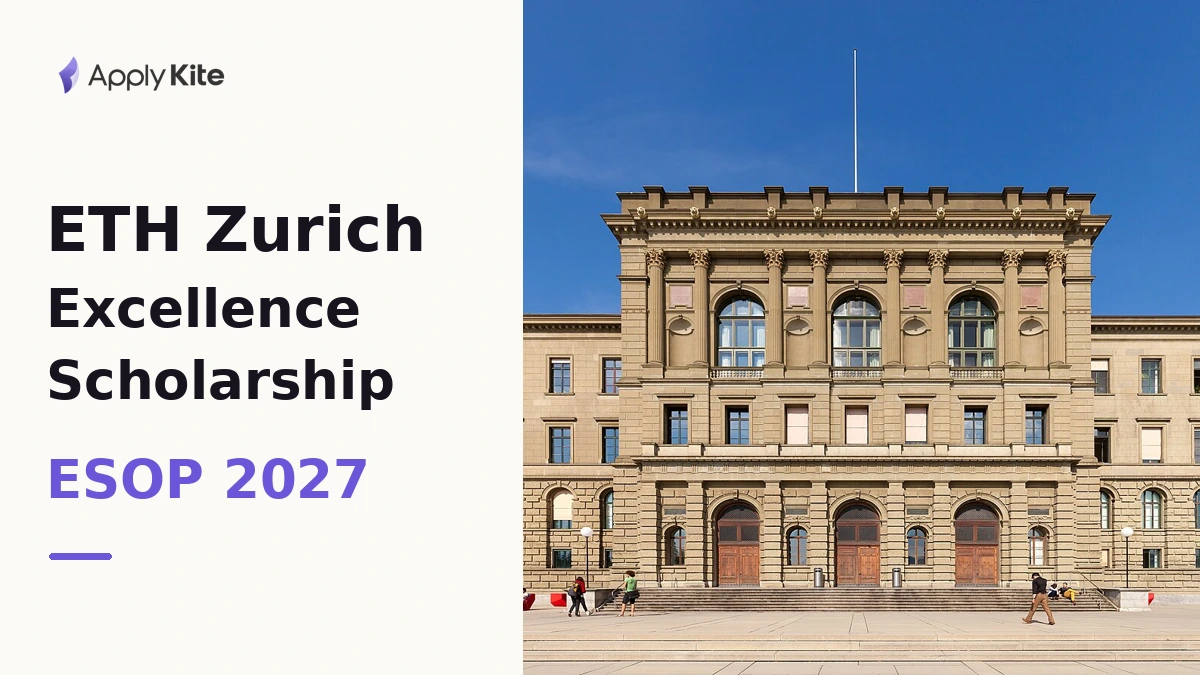
Getting into a Master's program at ETH Zurich is a major achievement. Now, imagine pursuing that degree with your tuition covered and financial support for living expenses. That's what makes the ETH Zurich Excellence Scholarship such a sought-after opportunity.
The competition is tough, though. Around 60 students receive the scholarship each year, and earning a place at ETH is only the first step. The ESOP scholarship 2027 offers a full tuition fee waiver and up to CHF 13,500 per semester toward living costs for the standard duration of your Master's degree.
In this guide to the ETH Zurich Excellence Scholarship and Opportunity Programme, you'll discover who can apply for the 2027 round, what the scholarship covers, which eligibility requirements matter, and how to prepare an application that showcases your academic strengths. If ETH Zurich is your next big goal, here's where to start.

What Is the ETH Zurich Excellence Scholarship (ESOP)?
The ETH Zurich Excellence Scholarship is a merit-based scholarship offered to outstanding students applying for a Master's degree at ETH Zurich. It is funded through donations managed by the ETH Zurich Foundation, making it a university-backed opportunity supported by private contributions.
For the 2027/28 academic year, around 60 scholarships are planned, depending on available funding. To put that into perspective, 57 Excellence Scholars began their Master's studies in 2026. The program is supported by ETH Rector Professor Günther Dissertori, who serves as its patron. According to the ETH Foundation, around three-quarters of international Excellence Scholars choose to remain in Switzerland after graduation.
Before you start preparing your application, there's one important distinction to understand: ESOP is not the same as the Swiss Government Excellence Scholarships (ESKAS). Although these two programs are sometimes confused on scholarship websites, they serve different purposes and have different eligibility requirements. We'll explain the key differences in the comparison section below.
| Feature | ESOP | ESKAS |
|---|---|---|
| Provider | ETH Zurich Foundation | Swiss Government |
| Purpose | Master's degree funding | Research, PhD and postdoctoral funding |
| Master's funding | Yes, at ETH Zurich | Generally not for regular Master's degrees |
| Selection criteria | Academic excellence | Varies by scholarship category and country |
| Application | Alongside ETH Master's application | Depends on country and scholarship type |
Who Can Apply for ESOP 2027
ESOP is open to both international and Swiss applicants, as long as you meet the regular admission requirements for your chosen ETH Master’s program. There’s no nationality restriction, but the academic bar is real, and it's challenging to get in. You need to be among the top 10% of your bachelor’s program. ETH’s own application guidance is explicit that meeting a program’s subject requirements for missing coursework in the required academic background, for instance, math, a specific science, or technical preparation.
Let's check some of the most important eligibility details.
- You can apply before finishing your Bachelor's: ETH's own admissions page states that you don't need to present your Bachelor's degree at the time of application. You just need to provide proof of it by the start of the semester if admitted. If you’re still finishing your final year right now, this doesn’t rule you out.
- Where you earned your degree is important, not your nationality: A Swiss citizen who studied abroad applies through the same international window as everyone else; it isn't about your passport.
- An English-taught Bachelor's can exempt you from a language certificate: This is true and truly a privilege, but only with official confirmation from your university's central administration. This document needs to carry a stamp and signature or a certified electronic signature. A letter from a professor is explicitly not accepted, and inadequate confirmation leads to rejection on formal grounds, since you can't submit a certificate after the deadline to fix it.
You're excluded from ESOP if:
- You have already completed a Master's degree.
- You are currently enrolled in a Master's program at ETH Zurich.
- You plan to pursue a Master of Advanced Studies (MAS), a part-time professional qualification designed for continuing education rather than a regular Master's degree. ESOP funding is intended for eligible ETH Master's programs.
Easily Convert Your GPA to ETH's Grading Scale with Kite AI
The top 10% bar is where most applicants get stuck before they even reach the scholarship form. ETH's self-assessment format assumes you can state you’re standing with confidence. To avoid this confusion, you can use Kite AI to convert your CGPA, GPA, or percentage score to the grading convention ETH and your target country use, so you know where you stand before you commit weeks to an application. Check which grades are good for Master’s and PhD application here.
Looking for fully funded?
Discover PhD, Master's, and Postdoc positions tailored to your goals with ApplyKite's smart AI tools.
What ESOP Covers: Funding, Duration and Mentorship
The ESOP scholarship provides CHF 12,000 per semester, increasing to CHF 13,500 per semester from the autumn semester of 2027 (HS27), along with a full tuition fee waiver. The funding covers the standard duration of your Master's program, which is usually three or four semesters, depending on the degree. Recipients also benefit from mentorship and access to the ETH Foundation's professional network.
The tuition waiver adds significant value to the scholarship. ETH Zurich currently charges international students who do not qualify for an exemption CHF 2,190 per semester, compared with CHF 730 for students eligible for the standard tuition rate. For a four-semester Master's program, this amounts to CHF 8,760 in waived tuition fees alone, in addition to the financial support provided by the scholarship.
| Component | Amount / Detail |
|---|---|
| Living and study stipend | CHF 12,000/semester (rising to CHF 13,500/semester from HS27) |
| Tuition fee waiver | Full waiver (standard international fee is CHF 2,190/semester) |
| Duration | Regular Master's length, 3 or 4 semesters |
| Scholarships planned (2027/28) | ~60, subject to available funding |
| Extras | Mentorship + ETH Foundation network access |
| Payment method | Paid at the start of each semester, after enrolment, to a Swiss bank or post office account |
Key Dates and Deadlines for the 2027/28 Round
For the autumn 2027 intake, ESOP applications must be submitted during ETH Zurich's international Bachelor's application window, which runs from 1 to 30 November 2026. This is the application period that qualifies you for ESOP. The separate April application window available to certain Swiss Bachelor's degree holders does not include ESOP eligibility.
| Stage | Date |
|---|---|
| Application window opens | 1 November 2026 |
| Application deadline | 30 November 2026, 11:59 AM CET |
| Possible interview | February 2027 |
| Decision announced | End of March 2027 |
| Studies begin | September/October 2027 |
Pay close attention to the deadline time. Applications close at 11:59 AM CET on 30 November, not at midnight. That leaves no room for last-minute assumptions or technical issues. Aim to submit your application well before the deadline so you have time to address any problems.
Documents You'll Need
Along with the standard documents required for your chosen Master's program, you'll need to prepare the materials specific to ESOP. This includes academic transcripts from every university you've attended, even if you transferred, took part in an exchange, or did not complete a previous program. Make sure your documents meet ETH's translation requirements where applicable.
| Document | Notes |
|---|---|
| Academic transcripts | All institutions attended, translated where necessary |
| Thesis pre-proposal | Self-written, maximum 500 words excluding references (per ETH's official pre-proposal guideline) |
| Two professor reference letters | Only required if your chosen program doesn't already request references |
| Language certificate | Required unless you qualify for the English-taught Bachelor's exemption (see Eligibility above) |
| Program-specific materials | CV, motivation letter, portfolio, or test scores. Requirements vary by program, so check your specific admission profile. |
How to Write a Strong ESOP Thesis Pre-Proposal
Your ESOP pre-proposal has a strict limit of 500 words, excluding references. ETH Zurich expects you to develop it independently, so the focus should be on presenting a clear, feasible research idea rather than trying to make it sound ambitious or overly complicated.
You don't need to have your entire Master's thesis figured out already. What matters is showing that you understand the problem you want to explore, why it deserves attention, and how you might investigate it.
What should your pre-proposal include?
ETH recommends a structure that takes you from the main idea to a practical research plan:
- Title: Give your proposed research a clear, specific name.
- Introduction: Explain the topic and why it matters.
- Objectives and goals: State what you want to find out or achieve.
- Methods: Describe how you plan to approach the research.
- Background and previous work: Briefly outline relevant research or existing knowledge.
- Timetable and milestones: Break the work into manageable stages.
- References: List the sources you've used. These don't count toward the 500-word limit.
Pay particular attention to the timetable. Your plan should fit the Master's thesis period specified by ETH, which is typically four to six months, depending on the program. A realistic schedule shows that you've considered the time, methods, and resources your proposed research would require.
Make your research question specific and workable
A broad topic can be a useful starting point, but it needs to become something you can actually investigate. For example, wanting to address climate change is a general ambition. Studying how a particular insulation material performs under defined temperature conditions gives you a more focused question, a possible method, and a clear direction for your research.
You don't need to promise groundbreaking results. Instead, explain what you want to examine and how you would go about it. Keep the scope manageable, and make sure your proposed methods match your objectives.
ETH requires the proposal to be developed independently. Its official guidelines state that all forms of plagiarism will disqualify your ESOP scholarship application. Take care with your sources, acknowledge others' work, and make sure the proposal reflects your own thinking.
Finally, prepare to discuss your idea. ETH states that the proposal will be discussed during an interview with a professor or scientist as part of the application review. Be ready to explain why you chose your approach, what challenges you anticipate, and how you might adapt if your original method proves impractical. Understanding the reasoning behind your proposal will help you discuss it clearly and confidently.
How to Apply for ESOP, Step by Step Plan
You apply for ESOP through the same ETH Zurich Master's application process. There is no separate scholarship portal, and you should request funding when submitting your Master's application rather than waiting for an admission decision.
- Start with your chosen Master's program: Review its admission requirements and make sure your previous studies meet the specific academic and subject prerequisites.
- Prepare the required documents: Gather your admission materials and write your ESOP pre-proposal according to ETH Zurich's official guidelines. Keep it within the 500-word limit.
- Contact your referees in advance: If your program requires two references, ask your referees early and give them enough time to prepare. ETH's system contacts them by email after you enter their details, so let them know to expect the request.
- Complete your application before the November deadline: Submit everything through ETH's eApply portal and select ESOP as part of your application. An application fee applies and is non-refundable. Check the amount displayed at checkout, along with the accepted payment methods, before submitting.
- Check your contact details and watch for updates: Keep the phone number on your CV current in case you're invited to an interview in February. Scholarship decisions are generally communicated by the end of March, with the final decision made by ETH's Rector.
Which Subjects Can Apply for ESOP?
ESOP is open to applicants across ETH Zurich's Master's programs, with no specific subject or department restrictions stated in the official scholarship requirements. To qualify, you generally need to rank among the top 10% of your Bachelor's cohort and meet the scholarship's eligibility rules.
Keep in mind that scholarship eligibility and academic admission are separate requirements. Since you apply for ESOP through your regular Master's application, you must still meet the admission criteria for your chosen program. Your field of study does not automatically exclude you from ESOP, but your academic background must satisfy the program's specific requirements.
| Subject Area | Example Programs |
|---|---|
| Architecture & Civil Engineering | Architecture, Civil Engineering, Geomatics, Landscape Architecture |
| Engineering Sciences | Computer Science, Electrical Engineering and Information Technology, Mechanical Engineering, Robotics, Systems and Control |
| Natural Sciences & Mathematics | Biology, Chemistry, Mathematics/Applied Mathematics, Physics |
| System-Oriented Natural Sciences | Earth Sciences, Environmental Sciences, Health Sciences and Technology |
| Management & Social Sciences | Management, Technology and Economics, Science, Technology and Policy |
Common Mistakes That Rule Applicants Out
- Missing the November deadline: The ESOP application window is limited, and missing it means losing your chance to apply for that cycle. The April application round available to certain Swiss Bachelor's degree holders does not include ESOP eligibility.
- Trying again after a first-round rejection: ETH Zurich does not allow you to submit another application for the same Master's program in a later round if your first-round application was rejected.
- Already studying for a Master's at ETH: ESOP is intended for incoming Master's students, so you cannot apply if you're already enrolled in an ETH Master's program.
- Leaving your application incomplete or submitting it late: ETH does not process late or incomplete applications. Make sure every required document is ready and submitted before the deadline, as you should not expect an extension or a request to fill in missing materials.
Frequently Asked Questions
Is the ETH Zurich Excellence Scholarship renewed every year?
No separate annual renewal application is required. The scholarship is awarded for the standard duration of your Master's degree, typically three or four semesters, provided you maintain satisfactory academic progress. Any additional semesters beyond the standard program duration are not automatically funded.
Can I apply for ESOP if I already have a Master's degree?
No. Applicants who already hold a Master's degree are not eligible for ESOP. The same restriction applies to students currently enrolled in an ETH Master's program and applicants pursuing a Master of Advanced Studies (MAS).
What GPA or percentage is considered within the top 10% for Indian and international applicants?
ETH Zurich does not provide a universal conversion table for different grading systems. Applicants must assess their academic performance in relation to the grading distribution of their own degree program. Indian students should carefully evaluate how their CGPA or percentage compares with the performance of other students in their program before applying.
Is ESOP limited to engineering and science programs?
No. ESOP is available to academically qualified applicants applying to any eligible Master's program at ETH Zurich. It is not restricted to engineering, science, or other specific academic disciplines.
What should I expect during an ESOP interview?
Only some applicants are invited for an interview. If selected, you may be interviewed by phone or video call in February. Make sure the contact number listed on your CV is accurate and up to date so the university can reach you if needed.
Do I need to submit a language certificate for ESOP?
Yes, a valid language certificate is generally required unless you qualify for the exemption applicable to certain English-taught Bachelor's degrees. This exemption requires official confirmation from your university's central administration. A letter issued by an individual professor is not sufficient. Applications missing a valid certificate or the necessary exemption documentation may not be evaluated.
How does ESOP differ from ESKAS?
ESOP is a Master's scholarship offered by ETH Zurich and supported by the ETH Foundation. ESKAS, on the other hand, is a Swiss government scholarship program intended for research at the doctoral and postdoctoral levels. It does not provide funding for Master's studies, so it is not an alternative to ESOP for Master's applicants.
Can I work part-time while receiving an ESOP scholarship?
ETH Zurich's published scholarship information does not clearly specify a dedicated part-time work policy for ESOP recipients. Before accepting employment, contact the ETH Financial Aid Office to confirm the applicable rules and any potential restrictions.
Is the ESOP scholarship stipend taxable in Switzerland?
Tax treatment depends on your personal circumstances, including your tax residency and applicable regulations. ETH's scholarship information does not provide a definitive answer for every recipient. It is best to consult a qualified tax advisor to understand whether your stipend is taxable in your particular situation.
What is the acceptance rate for ESOP?
ETH Zurich does not publish an official ESOP acceptance rate. Approximately 60 scholarships are awarded, making it a highly competitive opportunity relative to the university's overall Master's applicant pool. Strong grades alone do not guarantee selection.
Can I apply for ESOP again after being rejected?
Yes, you may submit a new application in a future application cycle, subject to ETH Zurich's eligibility rules. However, if your application for a particular Master's program is rejected in the first round, you cannot reapply to that same program in the immediately following round.
Can I apply for ESOP before completing my Bachelor's degree?
Yes. You do not need to have completed your Bachelor's degree when submitting your application. However, if you receive an admission offer, you must provide proof of your completed degree by the beginning of the semester, in accordance with ETH Zurich's requirements.
Are EU and EEA students eligible for ESOP, or is it only for non-EU applicants?
ESOP is not restricted by nationality. Swiss, EU, EEA, and other international applicants may apply, provided they satisfy the admission criteria for their chosen Master's program and meet the scholarship's eligibility requirements.
Will an ESOP rejection affect my admission to a Master's program at ETH Zurich?
No. The scholarship evaluation and the regular Master's admission process are separate decisions. Not receiving ESOP does not automatically mean your Master's application will be rejected. Your academic admission is assessed independently of the scholarship outcome.