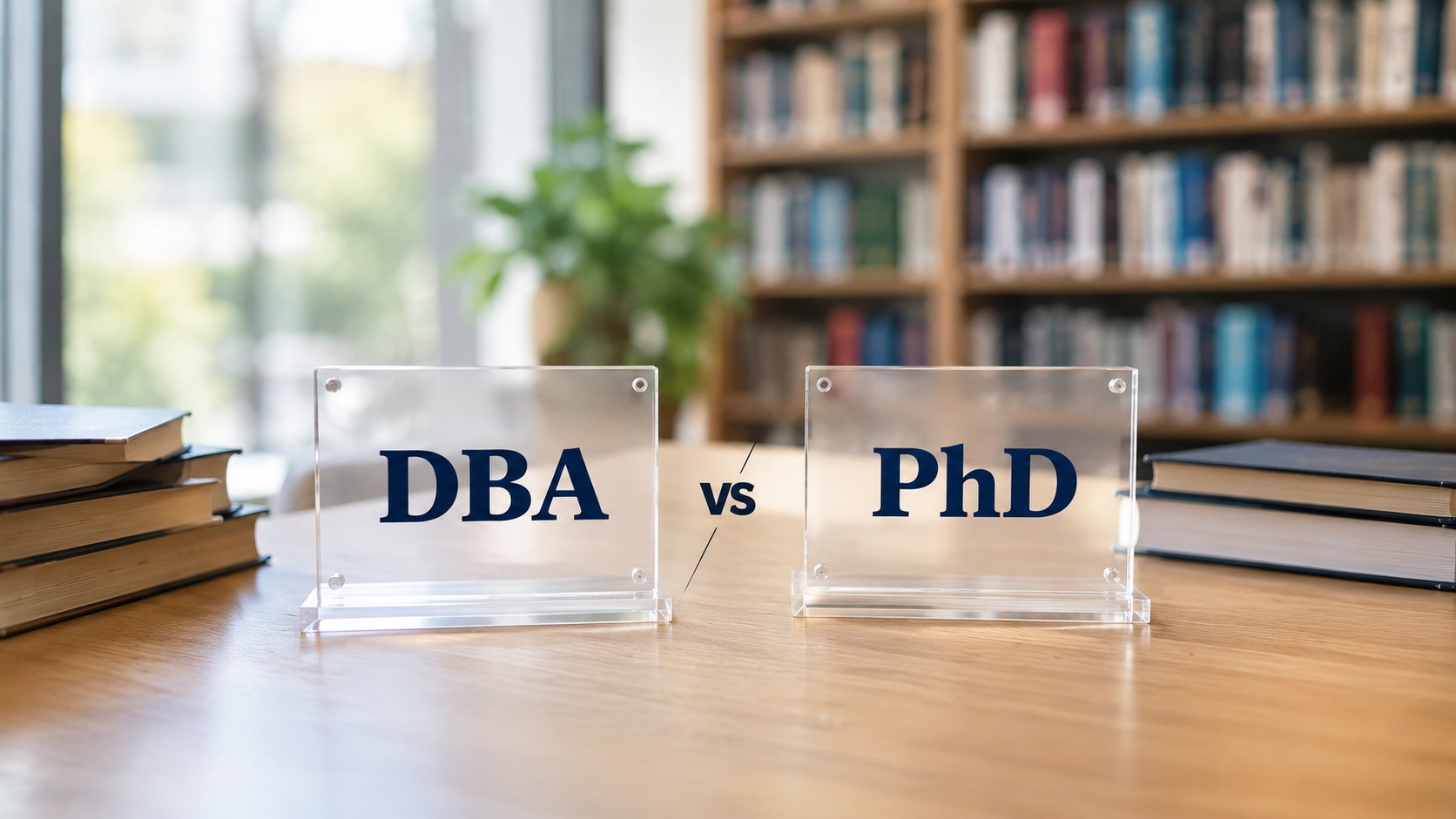
If you’ve spent years building a real career and you’re now seriously considering a doctorate as the next step, you’ve almost certainly come across two acronyms everywhere in your research: DBA and PhD. At first, they seem interchangeable. They aren’t, and this is exactly what we’re going to cover in this guide.
A DBA tends to attract people who are already deep into their careers, people who want to take a real problem they've wrestled with at work and study it properly, with actual research behind them instead of just instinct.
A PhD pulls a different crowd. Students, scholars, and researchers aiming to build something new in a field, contribute to the theory itself, and often end up teaching or researching for a living afterward.

What's the Actual Difference Between a DBA and a PhD?
They’re both considered doctoral-level degrees. Both culminate in a dissertation and are the top academic credential business schools award. Where they actually split is their process.
With a PhD, you're usually chasing a gap in existing theory, something nobody's fully explained yet, and building toward findings that matter beyond just your own company or industry. Say a researcher notices a hole in the literature. They build a question around it, dig in, and the resulting work is meant to hold up broadly, not just solve one specific headache at one specific firm.
A DBA runs closer to the ground. You're not chasing an abstract gap in theory; you're usually working through something you've actually run into, a real snag at your job, in your industry, somewhere in your professional life, and using proper research methods to pick it apart and land on conclusions you can actually use.
Neither one is less real research than the other, and it's worth saying that plainly because people assume otherwise constantly. Both demand serious, original work. What separates them comes down to purpose, not rigor; a PhD leans toward building academic knowledge, a DBA leans toward solving something specific and practical.
Table 1: DBA vs. PhD at a Glance
DBA | PhD | |
Research focus | Applied, solving real business problems | Theoretical, contributing to academic theory |
Typical candidate | Experienced professional, often 40+ | Earlier career, often 5-10 years' experience |
Format | Usually part-time, online, or hybrid | Usually full-time, in-person |
Typical duration | 3-4 years | 4-6 years |
Primary career outcome | Executive leadership, consulting | Academia, tenure-track research |
Funding | Rarely funded, mostly self-financed | Often funded via fellowships/assistantships |
Federal classification (NCES) | Research/scScholarship doctorate (same category as PhD) | Research/scholarship doctorate |
Recognized as equivalent by US Dept. of Education and NSF | Yes | Yes |
DBA vs. PhD in Management, Specifically
A PhD in Management is probably the closest academic alternative to a DBA. The two can cover many of the same subjects, including organizational behavior, strategy, leadership, decision-making, and other questions about how organizations operate. The difference is usually less about the subject itself and more about the purpose and design of the research.
PhD in Finance or Economics: These programs typically place a much greater emphasis on quantitative methods, econometrics, mathematical modeling, and statistical analysis. They are a better fit for candidates who want to pursue research in financial markets, economics, or other highly quantitative areas.
PhD in Marketing: Marketing PhDs often draw on psychology, consumer behavior, experimental methods, and statistics. Research may focus on topics such as consumer decision-making, advertising, branding, or market behavior.
For someone deciding between a DBA and a doctorate focused on management, the PhD in Management is therefore the most relevant comparison. A Finance, Economics, or Marketing PhD represents a more specialized research path.
The name of the degree does not always tell you exactly what you will study. Some universities award a PhD in Management, while others offer a PhD in Business Administration with Management as a concentration or specialization.
That distinction matters when comparing programs. Look beyond the title of the doctorate and check the specific concentration, faculty research areas, required courses, and dissertation expectations. Two programs with similar degree names can prepare students for quite different types of research.
Looking for fully funded?
Discover PhD, Master's, and Postdoc positions tailored to your goals with ApplyKite's smart AI tools.
Who Is Each Degree Actually For?
Age and professional experience can be useful indicators when comparing DBA and PhD programs, although there is considerable variation between universities.
The University of Florida's Warrington College of Business, for example, reports an average DBA student age of 44 and an average of 14.5 years of management experience. That profile reflects the broader purpose of many DBA programs: they are designed for experienced professionals who want to pursue doctoral research without necessarily leaving their careers.
Admissions requirements vary considerably. Some DBA programs ask for seven to ten years of professional or management experience, while others accept candidates with less experience or prefer applicants with substantially more. The important point is that professional experience is usually a central part of the DBA admissions process.
PhD programs tend to draw a wider range of candidates. Babson, for example, reports applicants with an average of five to ten years of professional experience, although business PhD programs can also admit candidates with relatively little time in the workforce, particularly those coming directly from a master's degree.
The difference is therefore less about age than about career direction. DBA candidates are typically established professionals who want to use research to address problems in their field. PhD candidates are more often preparing for careers centered on academic research and teaching.
For a mid-career professional with a decade or more of management experience, a DBA may therefore be the more natural fit. But experience alone should not determine the choice; the intended career after the doctorate matters just as much.
Format and Duration: Can You Actually Do This While Working?
Short answer for the DBA: yes, and that's more or less the whole design philosophy behind it. Most programs are built specifically so a working professional can get through one, with part-time schedules, online delivery, and hybrid formats with the occasional in-person residency instead of a full campus commitment. Three to four years is typical, though pacing and dissertation timelines can push that out to six.
The PhD asks for something structurally different. You're generally expected to be there full-time, working closely and continuously with faculty, which is genuinely hard to layer on top of a job that also expects you full-time.
A handful of flexible or part-time PhD tracks exist somewhere out there, but they're rare enough to be the exception, and honestly, that gap is a big part of why the DBA came into existence as its own separate path. Four to six years is the usual window, sometimes longer.
If staying employed and keeping your income intact throughout isn't negotiable for you, that alone tilts things pretty firmly toward the DBA.
Admission Requirements
DBA programs typically expect:
A completed master's degree (an MBA is common, though not always mandatory)
Substantial professional experience, often 7-10 years minimum in management or leadership roles
Requirements vary by institution; some accept candidates from 5 years of experience, others expect 15 or more
PhD programs typically expect:
A master's degree
Strong academic references
A research proposal or statement of research interests, demonstrating you can already think and work like a future academic, since that's essentially what the program trains you to become
DBA admissions lean heavily on years of real management experience, while PhD admissions weigh research readiness more than time spent in the workforce.
Cost Differences
Cost is one of the biggest practical differences between a DBA and a PhD, especially once funding is taken into account.
DBA Tuition Varies Widely
DBA tuition varies widely. Current programs range from relatively affordable online options to executive programs costing well into six figures. For example, William Howard Taft University lists total tuition of about $56,560, Hood College about $66,000, and Florida International University about $75,000. The University of North Texas is around $114,000, while Drexel University's Executive DBA is about $131,800.
Lower-cost online DBA programs can bring the total down considerably. Some programs are available for roughly $35,000 to $50,000, although the exact cost depends on the number of credits, fees, and whether additional residency or dissertation charges apply.
DBA students are generally expected to finance the degree themselves, although employer tuition assistance, scholarships, and other forms of support may be available depending on the program.
PhD Funding Changes the Equation
PhD programs work differently. Although published tuition can be just as high as many business PhD programs provide financial support through fellowships, research assistantships, teaching assistantships, tuition waivers, and stipends. In a fully funded program, the university may cover tuition and provide a living stipend while the student completes the degree.
This makes the headline tuition figure somewhat misleading when comparing the two degrees. A DBA may cost tens of thousands of dollars out of pocket, while a funded PhD can involve little or no tuition expense for the student.
The trade-off is time. PhD funding usually comes with a much greater commitment, and students are generally expected to treat the doctorate as their primary professional focus. A DBA can require a substantial tuition investment, but its part-time structure can allow students to remain employed throughout the program.
Table 2: Best Countries and Universities for a DBA
University | Country | |
1 | United Kingdom | |
2 | United States | |
3 | Italy | |
4 | United States | |
5 | United States | |
6 | United Kingdom | |
7 | United Kingdom | |
8 | United States | |
9 | United Kingdom | |
10 | United States |
Note: This table’s information is relative and the information can change every year. So, if you’re serious about applying for a DBA degree, it’s always better to check each university’s offical website.
Is a DBA Less Than a PhD?
No, and this misconception comes up constantly. Both are genuine doctoral-level degrees. In the US, the DBA actually falls under the federal classification of research doctorates, the same category as the PhD, though that doesn't mean the two are interchangeable for every purpose.
Neither is less than the other. They're just built for different destinations. Where they actually diverge:
A PhD leans toward academic research and theory-building, the credential the scholarly world is built to expect.
A DBA is more focused on applied business research, aimed squarely at experienced professionals solving real organizational problems.
How to Decide Which One Is Right for You
Forget the degree title for a moment. What actually matters more is what you want to be doing five or ten years from now, and a handful of honest checkpoints will get you there faster than any chart.
Career direction matters most. Chasing a professorship, an academic research career, or eventually running a research team yourself? PhD, clearly. Trying to sharpen your standing as an executive, consultant, or someone your industry actually listens to? DBA, almost every time.
Time away from work is the biggest practical divide. Most PhD programs demand full-time commitment, genuinely hard to reconcile with a demanding job. DBA programs, by design, fit around one, part-time schedules, online delivery, hybrid formats built for people who need to keep working. If staying employed throughout is non-negotiable, that alone tilts things toward the DBA.
The actual research question you'd want to spend years on tells you a lot too. A live problem inside your own company or industry points toward a DBA. A genuine gap in theory, something you want to chase for its own sake, points toward a PhD.
And then there's what you're actually willing to invest, not just money, but time, lost income, residency requirements, the whole opportunity cost of several years spent this way.
A funded PhD can look financially appealing, but it usually asks you to treat the degree as your primary focus. A DBA lets you keep working, but you're typically covering a much larger share of the tuition yourself.
Choose a DBA if staying close to business practice while using research to improve it sounds right. Choose a PhD if research itself becoming the center of your career, especially in academia, sounds right. There will always be exceptions on both sides, but where you want to end up should carry more weight than which letters end up after your name.
Frequently Asked Questions
Can a DBA graduate still go into academia and teach?
Yes, though it's often a secondary path rather than the primary one. Many DBA graduates move into executive or consulting roles, but a meaningful share transition into academia as guest lecturers, adjunct faculty, or even tenure-track positions, where their practitioner background is often specifically valued.
How is funding typically different between a DBA and a PhD?
PhD students generally have more access to institutional funding, fellowships, assistantships, and stipends that can cover most or all of the cost. DBA students more commonly self-finance, use employer tuition support, or rely on loans, since DBA programs are built around people already earning a full salary.
Can a working professional pursue a PhD instead of a DBA?
Technically yes, but it's uncommon and difficult. Most PhD programs expect full-time, in-person engagement and close faculty collaboration, which rarely fits around a full-time job. A small number of flexible or part-time PhD tracks exist, but they're the exception, which is a large part of why the DBA exists as a separate path.
Is a DBA academically equivalent to a PhD in terms of rigor?
Yes. Both are terminal, doctoral-level degrees requiring rigorous original research culminating in a dissertation. The rigor is comparable, what differs is the type of research, applied versus theoretical, not the seriousness or difficulty of the work.
Does choosing a DBA over a PhD limit future academic career options?
Not entirely, but it shapes them differently. DBA graduates can and do teach, often at schools that specifically value real-world executive experience, but a traditional tenure-track research career at a top research university is more directly built for by a PhD.
Is a DBA officially recognized as equivalent to a PhD?
Yes. Both the US Department of Education and the National Science Foundation formally recognize the DBA as equivalent to the PhD, real institutional backing, not just business school marketing.
What's the typical age and experience level of a DBA student?
Genuinely concrete data here: University of Florida's DBA program reports an average student age of 44 with 14.5 years of management experience, and a minimum of 10 years of management experience required just to apply. More broadly, DBA candidates typically bring 5 to 20 years of work experience depending on the institution.
Can DBA research actually be published in academic journals, the same way PhD research can?
Yes. DBA dissertations are expected to be original academic research with genuine potential for peer-reviewed publication, not a lesser or purely internal project.
What does it actually mean when a degree is called a "doctorate"?
A doctorate is simply the highest level of academic degree a university awards, sitting above a bachelor's and a master's. Both a DBA and a PhD fall under this umbrella, they're two different types of doctorate, not a doctorate and something lesser.
Why would someone choose a DBA instead of just gaining more years of industry experience? Experience teaches you what worked in your own situation. A DBA adds structured research training and a way to test whether your instincts hold up beyond your own company, turning intuition into something defensible and applicable more broadly.
Can someone pursue a PhD purely out of intellectual curiosity, without a specific career goal in mind?
Yes, and it's a common motivation, especially for people already settled professionally. It still helps to stay open to where the research leads career-wise, even if that wasn't the original reason for starting.
Is the job market currently stronger for DBA holders or PhD holders?
Depends on the market. DBA demand is strong in industry right now, especially consulting, tech, and finance. PhD demand in academia is more measured; the US Bureau of Labor Statistics projects 7% growth for postsecondary business teacher roles, but tenure-track openings stay limited by faculty turnover timing.