You have probably spent weeks, maybe months, memorising vocabulary and practicing essay structures. So a bit anxious about the final result?
Absolutely normal. But here’s the thing. It’s about knowing the real math that goes into your score.
Once you understand how the system adds things up, you no longer have to guess. You can finally prep with a real target in mind.
Let’s clear up the confusion.
Short Answer: How is a band score calculated?
Component | Calculation Logic |
Individual Sections | Listening, Reading, Writing, and Speaking are each scored on a 0–9 band scale. |
Overall Score | The average of these four component scores. |
Rounding Rule | If the average ends in .25 it rounds up to the next half band. If it ends in .75 it rounds up to the next whole band. |

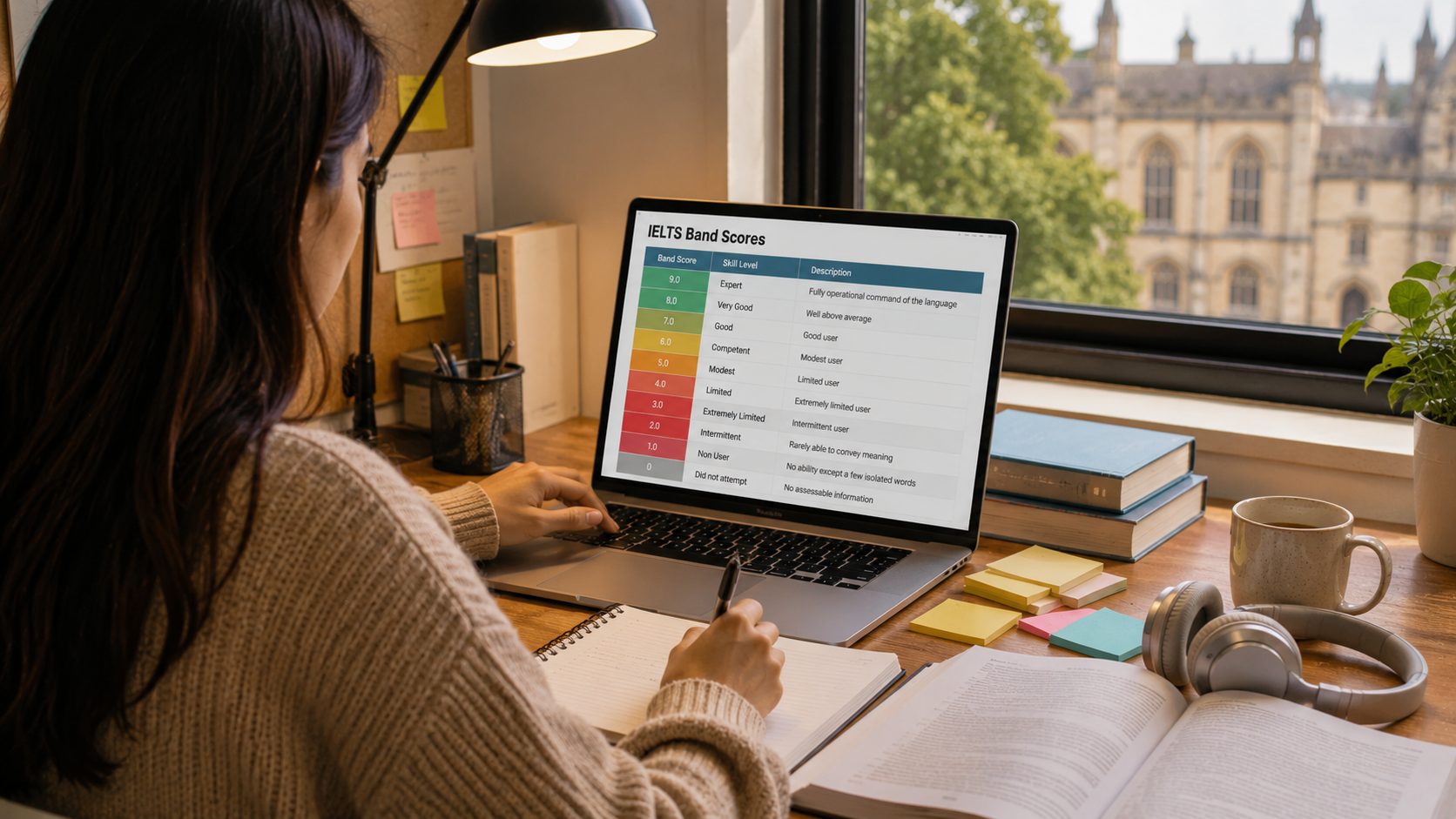
Understanding the IELTS 9-Band Scale and CEFR Levels
The IELTS tests your English in 9 bands. Every band is a level of proficiency that helps universities and immigration offices to evaluate your language ability.
Band Score | Skill Level | Description |
9 | Expert | Fully operational command. Appropriate, accurate, fluent, complete understanding. |
8 | Very Good | Fully operational command with only occasional unsystematic inaccuracies. |
7 | Good | Operational command, occasional inaccuracies/misunderstandings. Handles complex language well. |
6 | Competent | Effective command despite some inaccuracies. Uses reasonably complex language in familiar situations. |
5 | Modest | Partial command, copes with overall meaning, and makes many mistakes. Handles basic communication in their field. |
4 | Limited | Basic competence limited to familiar situations. Frequent problems in understanding/expression. |
3 | Extremely Limited | Conveys/understands only general meaning in very familiar situations. |
2 | Intermittent | Great difficulty understanding spoken and written English. |
1 | Non-user | No ability to use the language except a few isolated words. |
0 | Did not attempt | No answers provided. |
IELTS vs. CEFR: What is Band 7.5?
A score of 7.5 is often treated as being the same as level C1 of the Common European Framework of Reference (CEFR). Level C2 is typically achieved at 8.0 and above.
How Are Your Overall IELTS Band Scores Calculated? (The Rounding Rules)
Your overall score is the average of your scores in Listening, Reading, Writing and Speaking. And then we add those four numbers and divide by four.
The system of IELTS has some rules of rounding. If your average is .25 it is rounded up to the next half band. If it ends in .75 it rounds to the next full band
Test Taker | Listening | Reading | Writing | Speaking | Average | Final Band Score |
A | 6.5 | 6.5 | 5.0 | 7.0 | 6.25 | 6.5 |
B | 4.0 | 3.5 | 4.0 | 4.0 | 3.875 | 4.0 |
C | 6.5 | 6.5 | 5.5 | 6.0 | 6.125 | 6.0 |
Important Rules to Remember:
The .25 rule: An average that ends in .25 is rounded up to the next half band 6.25 = 6.5
The .75 rule: Same Logic End with a .75 and your score jumps to the next full band (6.75 jumps straight to 7.0).
The .125 rule: If it is below .125 , then it is rounded to the nearest whole or half number . “6.0” is a “6.125”
Looking for fully funded?
Discover PhD, Master's, and Postdoc positions tailored to your goals with ApplyKite's smart AI tools.
IELTS Listening Band Scores: Raw Score to Band Conversion
There are 40 questions in the Listening test. 1. There is one mark for each correct answer . There is no penalty for wrong answers . Always guess if you are unsure . Raw scores are converted to the 9 band scale.
Band Score | Listening Raw Score (out of 40) |
8 | 35 |
7 | 30 |
6 | 23 |
5 | 16 |
Note: The precise number of marks needed to achieve these band scores can vary slightly between different test versions.
IELTS Reading Band Scores Explained: Academic vs. General Training
You'll face 40 questions here, with each correct answer earning one point. Both the Academic and General Training tests use the exact same grading scale. But here's the catch. The reading materials differ in difficulty. Because General Training texts are slightly easier to read, you usually need a few more correct answers to reach the same band score.
Band Score | Academic Reading (out of 40) | General Training Reading (out of 40) |
8 | 35 | 37–38 |
7 | 30 | 34 |
6 | 23 | 30 |
5 | 15 | 23 |
If you are taking the General Training test, aim for a higher raw score to reach the same proficiency level as an Academic candidate.
IELTS Writing Band Score Explained: Task Weighting & Criteria
The Writing section is not marked by a single human. It is graded by examiners who follow a strict assessment rubric. They grade Task 1 and Task 2 independently based on four criteria. Each criterion represents 25% of the grade for that task.
Assessment Criterion | What the Examiner Measures |
Task Achievement / Response | How fully and accurately you answer the specific prompt. |
Coherence and Cohesion | How well your ideas connect and your use of paragraphing. |
Lexical Resource | The range, accuracy, and appropriate use of your vocabulary. |
Grammatical Range & Accuracy | Your use of sentence structures and your control of grammar/punctuation. |
The “Two-Thirds, One-Third” Rule for IELTS Writing Tasks 1 and 2
A common misconception is that Task 1 and Task 2 are of equal value. They are not. If you do not manage your time correctly you run the risk of losing a lot of your marks.
Task 1 This is one third (33%) of your final writing grade.
Task 2 is 66 per cent (or 2/3) of your writing score.
Why it is important for your time management
Task 2 is worth twice as much as Task 1, so devote twice as much time to Task 2 as you do to Task 1; 40 minutes on Task 2 and 20 minutes on Task 1.
Scenario | Task 1 Band | Task 2 Band | Final Writing Score |
Balanced | 7.0 | 7.0 | 7.0 |
Strong T1, Weak T2 | 9.0 | 5.0 | 6.33 (Rounds to 6.5) |
Weak T1, Strong T2 | 5.0 | 7.0 | 6.33 (Rounds to 6.5) |
As shown in the table, a high score in Task 1 cannot fully compensate for a low score in Task 2. Prioritize your Task 2 essay.
IELTS Speaking Band Scores Explained
The Speaking test is an interview with an examiner and is conducted face to face (or via video). There are four specific criteria, as there are for Writing. Each of the four areas is weighted equally i.e. they each count for 25% of your speaking band.
Speaking Criterion | What It Measures |
Fluency and Coherence | How easily you speak and how well your ideas flow. |
Lexical Resource | Your ability to use varied vocabulary to express precise ideas. |
Grammatical Range & Accuracy | Your sentence structure and your knowledge of grammar/punctuation. |
Pronunciation | How clearly you communicate, including intonation and stress. |
Examiners do not judge your personality or your opinions. They only assess your ability to use the language across these four areas. If you make a mistake, don't worry, one error rarely changes your band score. Focus on keeping the conversation going naturally.
How Long Is My IELTS Score Valid?
Your IELTS test results are generally considered valid for two years from the test date. This timeframe is based on research into second-language acquisition and retention. However, validity can be subjective depending on the organization you are applying to.
Organization Type | Policy on Validity |
Universities | Most require results less than 2 years old, but check specific course requirements. |
Immigration Authorities | Strict 2-year requirement is standard. |
Professional Bodies | Check with your particular board (nursing, law etc). Some will let you use older results if you've been living in an English speaking country since. |
Always double check with the university/ institution directly. They decide whether they will take your score or not.
Reached Your Target IELTS Score? How to Secure Your Academic Future
Getting your target band score takes a huge weight off your shoulders. But remember that the score is just part of the puzzle. The next challenge is to turn that score into a successful admission, especially if you are applying for MSc, PhD or Postdoc positions.
If you are applying to schools, tools to help you map out your academic journey can save you a lot of time.
Challenge | How Tools Help |
Finding Positions | Use Academic Positions services to filter opportunities by field, degree, and country without manual, endless scrolling. |
Finding Supervisors | Use Professor Databases to identify supervisors actively seeking candidates with recent grants in your field. |
Personalizing Docs | Use ApplyKite AI to tailor your CV, SOP, and correspondence to the specific requirements of the professor or position. |
Real-World Experiences: Expectations vs. Reality
The path to your target band score is rarely a straight line. Many students first fail and then succeed. It’s good to know you are not alone in the challenges you may be facing. Here’s what real students had to say about their journeys:
Choosing the Right Speaking Format
A nurse seeking migration to the USA found the video-call speaking format frustrating. After failing to hit their target twice, they switched to a face-to-face test with the British Council. That was the difference and they reached their target score.
Taking the Risk with Enquiry on Results (EOR)
One student needed a 7.0 for university admission but was stuck at 6.5. They took the risk to submit an EOR. It cost money, and it was a gamble, but the result updated the next day to exactly 7.0, securing their place.
Succeeding Through Self-Study
Multiple students have achieved Band 7.5–8.0 without expensive formal coaching. They relied heavily on official Cambridge books and consistent, timed mock testing.
The Importance of Strategy Shifts
Many students share that they were stuck until they started studying differently. They concentrated on Band 9 writing samples and skimming for Reading, and they have boosted their scores by a full half-band or more.
The word from successful applicants? Persistence is rewarded. It’s not just about raw intelligence, but understanding the system and making adjustments when the first attempt doesn’t go to plan.
Conclusion
Once you understand how they actually calculate these scores, everything feels a lot less overwhelming. The test becomes a clear target instead of a giant hurdle. No more guessing. Just real, focused improvement.
It really doesn't matter if you're chasing a 6.5 for college or aiming for that 8.0 for a visa. The next steps are the same. See where you are right now.
Work on the parts that feel difficult. And just keep practicing. You finally have the roadmap.
All this hard work you're putting in today? It's the very foundation for your new life abroad.
Frequently Asked Questions (FAQ)
Is 6.25 means 6.5 in IELTS?
Yes. Due to the rounding rules described above, an average of 6.25 is rounded up to 6.5. This is to your advantage if you are just below a higher half band.
Is a 7.5 IELTS score easy?
No. Task 2 is twice as important (2/3) so if you do poorly on Task 2 then your overall score will be dragged down even if you do well on Task 1.
Can a strong Writing Task 1 balance out a weaker Task 2?
No. Task 2 is twice as important (2/3), so if you do badly in Task 2 then your overall score will be dragged down even if you do well in Task 1.
Do examiners give half-bands for individual criteria?
No. The examiner gives whole band scores for each of the four criteria (e.g. 6, 7, 8). The half-bands are only displayed in the final section average.
What is a good IELTS band score for universities?
It depends. Many programs in Canada or the UK require a 6.5 overall. The requirement is often 7.0 or above for competitive research degrees. Always check your particular department.