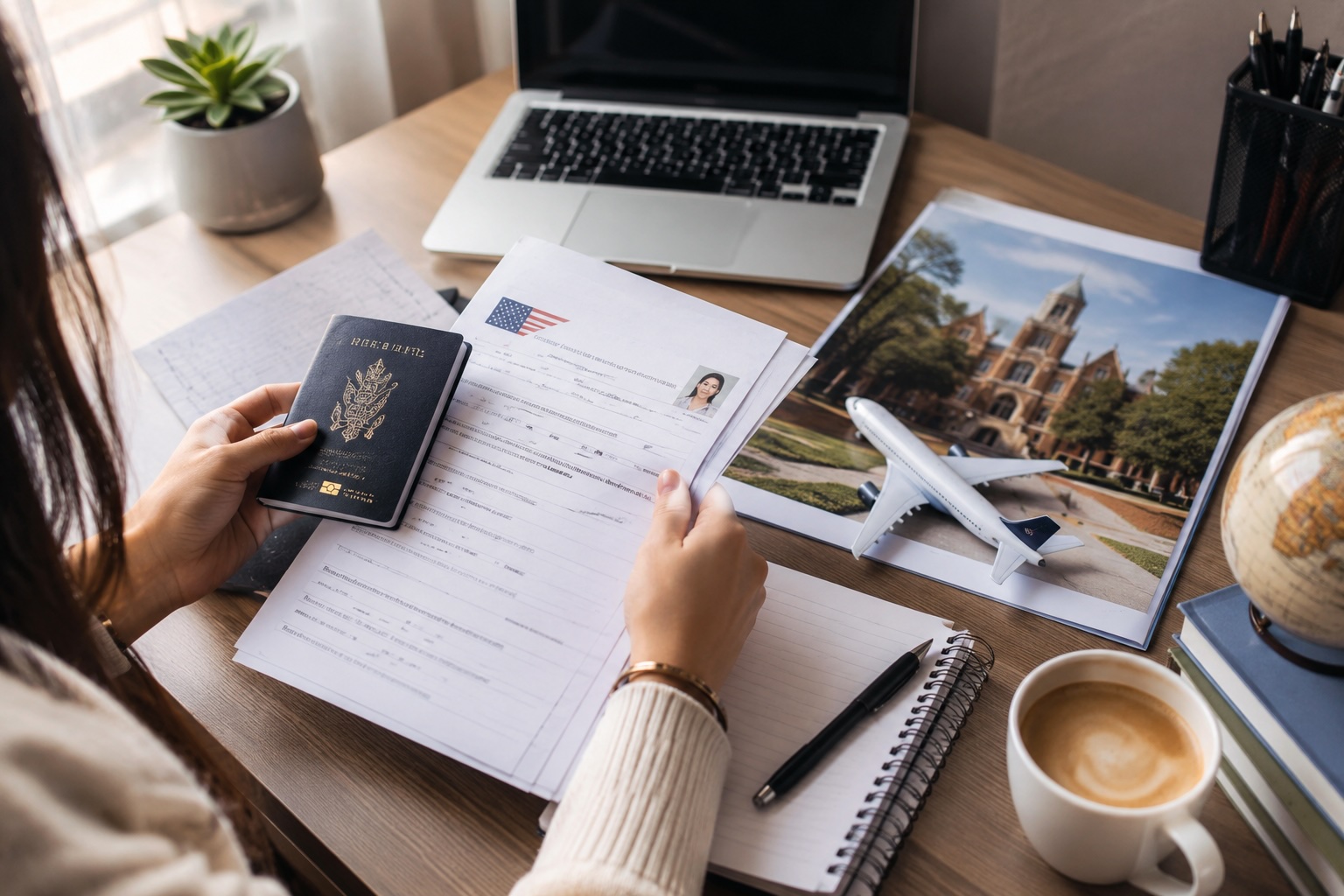
You got the admission. This is great. Now comes the part most students underestimate: the visa process. The problem is not always the documents or the interview; it’s the waiting. If you have your I-20 in hand and you’re not sure what to do next, or you’ve already started watching slots disappear, read this guide before you do anything else.
Nothing makes the F1 visa process less stressful than actually knowing what to expect. The F1 visa process is where timelines get real, and where most Indian students lose valuable weeks they can't afford to lose.

Quick Read
Topic | Key Information |
Visa processing time | The wait is for an interview slot, not the visa itself. Total F-1 processing typically takes 2 to 4 months, while the actual visa decision is usually made in one afternoon. |
2025 refusal rate | 61% of Indian F-1 applications were refused in 2025, up sharply from 36% in 2023. Every part of your application now carries more weight. |
Best time to apply | Apply within one week of receiving your I-20. For Fall 2026, the ideal application window is April to May. Students who wait until June may struggle to secure interview slots. |
Choosing a consulate | You are not limited to your nearest U.S. consulate. Chennai and New Delhi currently have the shortest F-1 visa wait times in India. If Mumbai has long delays, consider applying elsewhere. |
Visa appointment wait time vs. visa issuance time
Here’s something nobody explains clearly enough to students: F1 visa processing time is not one number. It's two very different things that most students confuse, and mixing them up is how people miss their intake.
The first is your visa appointment wait time. This is how long it takes from completing your DS-160 and paying your fees to actually sitting across from a visa officer. This is where all the delay happens, especially during peak season (May to August). Most Indian students have to wait anywhere from 6 to 16 weeks to get an interview slot, which makes the process baffling and overwhelming. That's before anyone has even looked at your application.
The second is visa issuance time. This is the time between your interview and getting your passport back with the stamp. Fortunately, this part is fast, and you can get the officer's decision on the same day, though passport return takes 7 to 14 days.
So, when someone says "F1 takes 2 to 4 months", nearly all of that time is just waiting for a slot. The actual decision takes one afternoon.
Looking for fully funded?
Discover PhD, Master's, and Postdoc positions tailored to your goals with ApplyKite's smart AI tools.
F1 Visa Application Timelines for Indian Students
To give you a realistic picture of the process, check this table.
Here is the content from the image converted into a text table:
Stage | What Happens | Fall 2026 Timeline | Spring 2027 Timeline | Time Taken | Common Mistake |
University Admission and I-20 | Receive admission letter and I-20 from university | Jan to Mar 2026 | Jul 1 to Oct 2026 | 2 to 6 weeks | Delaying I-20 request after accepting. Every week lost is a slot gone. |
SEVIS Fee and DS-160 | Pay SEVIS fee (USD 350) and complete visa application form | Feb to Apr 2026 | Sep to Nov 2026 | 1 to 7 days | DS-160 details that do not exactly match your I-20 or bank statements. |
Visa Slot Booking | Book interview at US embassy or consulate | Apr to Jun 2026 | Oct to Dec 2026 | 1 to 4+ months (longest stage) | Waiting for perfect documents before booking. Book first, finalize after. |
Visa Interview | Attend interview with visa officer | May to Jul 2026 | Nov to Dec 2026 | 1 day | Limiting yourself to one consulate. Delhi and Chennai are currently fastest. |
Visa Approval and Stamping | Passport submitted for visa stamping | May to Aug 2026 | Dec 2026 to Jan 2027 | 7 to 14 days | Booking flights before your passport is back in hand. |
Administrative Processing (if triggered) | Additional background or security checks | Varies | Varies | Weeks to 4 to 6+ months | Slow response to 221(g) requests. Your delay extends the wait directly. |
F1 Visa Processing Time Trends in India. What Has Changed?
The F1 visa process has gone through a lot since 2020, including embassy shutdowns, a post-COVID demand surge, longer wait times, and stricter background checks. Each year added a new layer of complexity.
2026 is more stable than the years before it, but stable doesn't mean easy. Fall slot competition is still intense, refusal rates for Indian applicants hit a decade high in 2025, and administrative processing cases have increased across STEM fields. The window to secure a slot for August intake is narrow. If you have your I-20 and you haven't started yet, you're already behind where you need to be.
F1 Visa Processing Timeline After Your Interview
What does "Approved" status mean?
The officer wraps up your interview, pauses, and says the word that you’re approved. You’ve been waiting for that moment for a long time. That single moment is what months of preparation, document gathering, and slot-hunting have been building toward.
You’re excited, but don’t forget that getting approval is not the end. You're not done with the process yet. Status on the CEAC portal shifts from "Application Received" to "Approved”, meaning you need to wait a bit more, this time for stamping. Your passport stays at the consulate. The visa hasn’t been printed yet. You’re in a different kind of limbo now, a much shorter one, fortunately, and less stressful.
Passport stamping and delivery timeline (7 to 14 days)
When the portal updates to "Issued," that's the signal. The visa is printed, your passport is handed to a courier, and it's on its way back to you.
For most students in metro cities, this takes 7 to 10 business days from the interview date. If you're in a smaller city, expect 10 to 14 days. Don't book flights the moment you see "Issued”. Wait for the passport to actually arrive.
And when it does arrive, don't just flip to the visa page and exhale. We know you’re happy and you should be. But reading every detail carefully is critical.
Make sure your name spelling, the visa start date, the expiry date, and the number of entries permitted are correct and match your personal information. Although errors at this stage are rare, correcting them after the fact is a process you don't want to deal with in the middle of packing.
Administrative processing. What causes delays?
A 221g slip is the thing most students fear, and it's reasonable. But what does it mean? It means the officer couldn't decide on the day. Either more information is needed, or further review is required. No timeline is given, making it much harder. However, don’t consider it a rejection. It's not a green light, and it leaves you uncertain, as it's not clear how much time it will take, whether weeks or months.
The most common triggers for these delays are varied, including:
Field of study. Sometimes your subject is on the Technology Alert List. Robotics, aerospace, quantum computing, advanced materials, and several adjacent STEM areas are flagged more often than others. These are sensitive areas. If your research area has any overlap with dual-use technology, the probability of 221g goes up, though this doesn’t mean you don’t have a chance of approval.
Inconsistencies between your DS-160, your financial documents, and what you said at the interview. Even small mismatches get noticed. Be careful about the data you’re presenting to the officer.
Background checks requiring supplemental information. This is largely outside your control.
Specific institutional affiliations or home addresses that trigger additional screening.
If you get a 221g, submit any requested documents immediately, the same day if you can. Don’t delay; it's disappointing, but you need to stay focused. After 60 days with no update, follow up with the consulate directly, politely, and specifically. Most cases close within 4 to 6 weeks. Some take 4 to 6 months. There's genuinely no way to predict which it will be.
When is the Right Time to Apply for an F1 Visa?
Ideal application window (90 to 120 days before intake)
Here's the honest answer most students don't hear early enough: consider the moment your I-20 arrives as the moment you just entered a long race.
The practical window to apply is 90 to 120 days before your program start date. For Fall 2026 with an August start. That puts you in April to May. It sounds like plenty of time. It isn't, not once you factor in how quickly slots fill and how unpredictably they're released. Students who start in June are regularly scrambling. Students who start in July are sometimes making peace with deferral.
Earliest you can apply (365 days before)
US consulates can issue an F1 visa up to 365 days before your program start date. Most students won't need to move that early, and you can't enter the US more than 30 days before your I-20 start date anyway. But if your field of study is likely to attract 221g, robotics, advanced computing, aerospace, biotech, building in extra buffer isn't paranoia. It's planning. Do it if it fits your situation.
Visa approval vs. travel date (30-day rule)
Getting your visa stamped in May doesn't mean you can fly to the US in May. This is a common mistake among many students.
F1 holders can only enter the United States up to 30 days before the program start date on their I-20. That date is fixed, and it doesn't matter how long ago you got the visa. If your program begins August 20, the earliest you can enter is July 21. Not a day before.
Plan your flights after your passport is back in your hands, your entry date is clear, and you've double-checked the I-20 start date one more time. There's no recovering gracefully from arriving at the airport a month too early.
F1 Visa Appointment Slot Booking: Step-by-Step Process
Here's the image converted into a text table:
Step | Action | Details |
1 | Verify your I-20 | Check your name, SEVIS ID number, program dates, and university details. Any error must be corrected with your university before you proceed. |
2 | Pay the SEVIS I-901 Fee | Pay at fmjfee.com the same day you receive your I-20. Save the receipt. You need it at your interview and at the US port of entry. |
3 | Complete the DS-160 Form | Fill out the form at ceac.state.gov. Every detail must match your I-20 and financial documents exactly. Inconsistencies are one of the most common reasons for 221(g). |
4 | Pay the MRV Fee | Non-refundable. Pay online at ustraveldocs.com/in or via NEFT or demand draft at HDFC Bank branches. Save this receipt too. |
5 | Book Your Consular Slot | Go to ustraveldocs.com/in and select F1 Student Visa. Check all five consulates simultaneously. Do not limit yourself to the nearest city. Delhi and Chennai currently have the fastest availability. |
Total Upfront Cost
Item | Amount |
Total Upfront Cost | USD 535 (Approximately INR 51,000 at current rates, July 2026) |
VAC appointment booking
The VAC (Visa Application Centre) is where your biometrics, fingerprints, and photograph are collected. Book your VAC appointment at the same time as or just before your consular interview booking. VAC slots are considerably easier to get than consular interview slots.
Consular interview scheduling on ustraveldocs.com
Visit ustraveldocs.com/in to schedule your consular interview. You'll need your DS-160 confirmation number, MRV fee receipt reference, and passport details. Select "F1 Student Visa" as your category.
One important thing: don't wait until your documents are perfect to book a slot. Get the slot first. You have time to finalize everything between booking and your actual interview date.
Factors Affecting F1 Visa Processing Time for Indian Students
Visa slot availability (biggest bottleneck)
This is the factor that determines everything else. During April to August, demand for slots is at its highest and new slots fill within hours of being released. Students who booked in January or February faced minimal competition. Students booking in June are often scrambling across multiple consulates.
Time of application (peak vs. off-season)
April to August is peak season for Fall intake. If you're applying after May, you're competing with tens of thousands of other Indian students. The January to February window is substantially less congested. Every week you delay after receiving your I-20 is a week of booking advantage lost.
Consulate location (regional variations)
You are not required to apply at the consulate closest to you. Wait times vary significantly:
Here's the image converted into a text table:
Consulate | Normal Wait Time | Peak Season Wait (Jun to Aug) |
Chennai | ~1 month (fastest) | 2 to 3 months |
New Delhi | 3 to 5 weeks | 2 to 3 months |
Hyderabad | 6 to 8 weeks | 2 to 3 months |
Kolkata | 6 to 8 weeks | 2 to 3 months |
Mumbai | 8 to 12 weeks (slowest) | 3 to 4 months |
If you're based in Mumbai, seriously consider applying in Delhi or Chennai. The consulate you choose doesn't have to be the nearest one.
What to Do If No F1 Visa Slots Are Available?
Try alternate consulates
You are not limited to your nearest consulate. India has five, and you can walk into any of them. During peak season, Mumbai can stay dry for months, while Delhi or Chennai open up within weeks. Students have flown to Delhi for a single-day interview. The inconvenience is nothing compared to deferring a semester.
Check during off-hours (10 PM to 8 AM IST for slot drops)
Cancellations appear at odd hours without announcement and disappear in minutes. Indian students consistently report better results checking between 10 PM and 8 AM IST. Set reminders. Check multiple times through the night if your intake is close.
Apply for emergency appointment (if start date is within 30 days)
If your program starts in fewer than 30 days and you still have no slot, go to ustraveldocs.com/in and request an emergency appointment. Bring your I-20, admission letter, and anything documenting your start date. Be specific and honest. Approval is case-by-case and not guaranteed, but not requesting one is a guaranteed dead end.
Request deferral from university (mid-August deadline)
If the visa isn't coming in time, contact your university's international admissions office now. Most US universities allow deferral to Spring or the following Fall, but you need to ask before mid-August for Fall intake. Wait until orientation week and you may simply lose your seat.
How to Speed Up Your F1 Visa Processing?
Apply as soon as you get your I-20
Pay the SEVIS fee, complete the DS-160, and book your slot in the same week your I-20 arrives, ideally the same few days. Every hour you wait is someone else booking the slot you could have had.
Track slots regularly for cancellations
A slot that appears at 2 AM can be gone by 2:05 AM. Check the portal several times a day, especially late at night. Some students use third-party notification tools; these are not official US government services, so never share your login credentials with any of them.
Pay the SEVIS fee and complete DS-160 immediately
You cannot book a slot without both. Pay the SEVIS fee the day you get your I-20. Complete the DS-160 the next day. By day three, you should be looking at slot availability. Every day you delay is a day lost.
Check multiple consulates simultaneously
Open tabs for all five: Delhi, Chennai, Hyderabad, Kolkata, Mumbai. Check them all at the same time, every time. The best slot in India right now is probably not in your city.
Keep all documentation consistent and complete
Your DS-160, I-20, bank statements, and financial sponsorship letters must match exactly. Every name, every date, every figure. Inconsistencies give the visa officer a reason to take a closer look, and that's the last thing you want.
Frequently Asked Questions
How long does it take to get an F1 visa in India?
The total F1 visa processing time for Indian students typically runs 2 to 4 months from I-20 receipt to passport return. Nearly all of that time is waiting for an interview slot, not the visa decision itself. Once you've had your interview, the decision usually comes the same day, with passport delivery in 7 to 14 days.
Will F1 students have to pay $100,000 for H-1B?
The short answer: not out of your own pocket, and probably not at all. The $100,000 fee is real; it came into effect September 21, 2025, but it applies when an H-1B beneficiary is outside the US when their employer files the petition.
If you're already in the US on OPT when your employer files, you're typically exempt. Check uscis.gov for official fee information.
How long can an F1 student stay in the US?
You can stay for the entire duration of your program, as long as you stay enrolled. After graduation, you get a 60-day grace period before you need to leave or change status.
Can Indians apply for an F1 visa?
Yes. Indian citizens are fully eligible to apply for an F1 visa with a valid admission from a SEVP-approved US institution. You need your I-20, proof of financial funds, a valid passport, completed DS-160, SEVIS fee receipt, and MRV fee receipt.
How long is it taking to get an F1 visa appointment from Delhi, India?
Right now, New Delhi and Chennai are your fastest options in India, typically 3 to 5 weeks outside peak season, stretching to 2 to 3 months during June to August. If you're based in Mumbai or Hyderabad and slots are backed up, it's genuinely worth booking a flight to Delhi or Chennai. The travel cost is small compared to missing your intake.
How to replace an F1 visa for international Indian students?
If your F1 visa stamp has expired but your I-20 and student status are still valid, you only need a new visa stamp when you travel internationally. Go through the same process: DS-160, MRV fee payment, and a consular interview. If your program has been extended or you've transferred universities, get an updated I-20 from your designated school official before applying.