
Sources: Verified against the official Education in Russia portal instruction manual, the Open Doors Russian Scholarship Project rules, and university quota rules from NUST MISIS and St. Petersburg State University (SPbU).
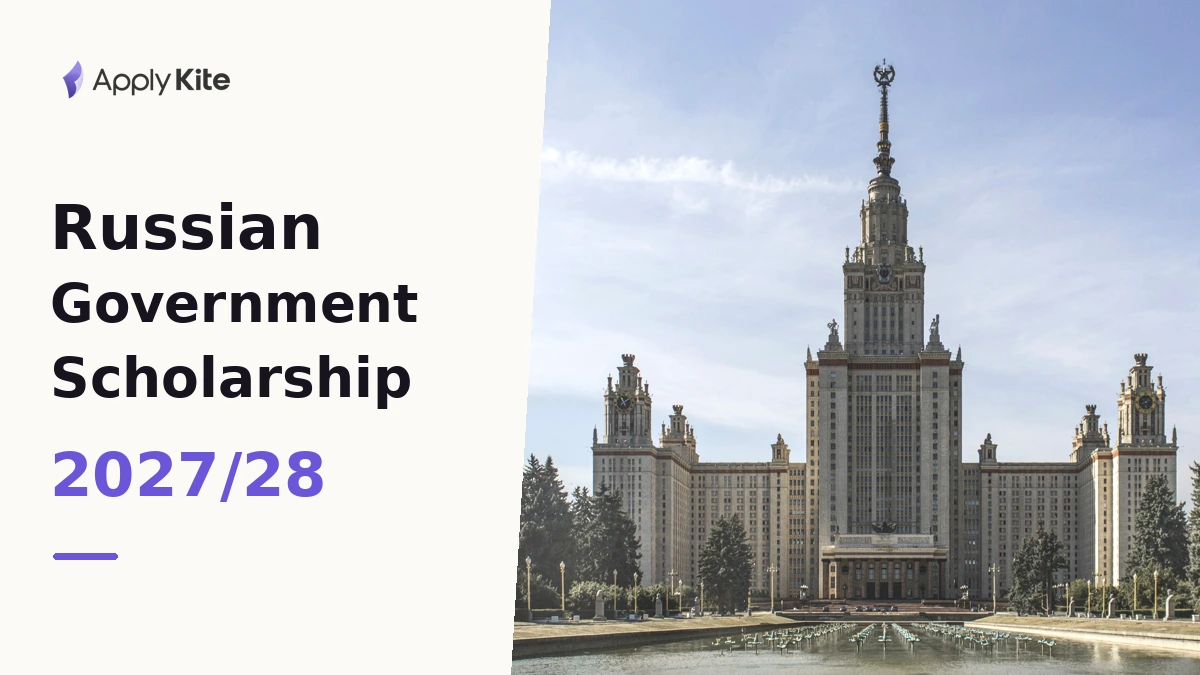
Most big scholarships turn down almost everyone, so a funded seat abroad can feel like a long shot. This one’s different. The Russian Government Scholarship funds around 30,000 international students every year across 150+ countries, and you don’t need IELTS or Russian language skills to apply. The timing works, too: the 2026 application window for the 2027/28 academic year is open right now, through two separate online tracks. Below, we’ll walk through how both tracks work, which living costs still come out of your own pocket, and how to submit your portal form step by step without getting disqualified.
Quick answer
The Russian Government Scholarship (officially the Government Quota) funds roughly 30,000 international students each year. It covers Bachelor’s, Specialist’s (MBBS), Master’s, PhD, residency, and vocational degrees.
The Russian federal budget pays 100% of your tuition for your entire degree. You also get a free 1-year Russian language prep course (Rabfak) if you need it, a monthly stipend, and cheap university dorm housing (about 2,500 to 3,769 RUB per month). What do you pay for? Flights, health insurance, visa fees, and daily food ($250 to $600 USD per month).
This year, you have two ways to apply. The Open Doors Olympiad opened August 20 and closes November 1, 2026. The Embassy Quota on education-in-russia.com runs from September 2026 until December 15, 2026 for CIS countries and January 15, 2027 for all other countries. Deadlines vary by country, so check with your local Russian Embassy.
Want to look at specific degrees? Browse our 2027/28 Russian Government Scholarship Listing (or our 2026 Russia Scholarship archive). And if you’re still comparing countries, our Top Fully Funded Scholarships for 2027 and Best Countries to Study Abroad guides will help.
Looking for fully funded?
Discover PhD, Master's, and Postdoc positions tailored to your goals with ApplyKite's smart AI tools.
1. Two ways in: Embassy Quota vs. Open Doors Olympiad
Here’s something most applicants never hear: there are two separate doors into the same pool of Russian state-funded seats. The Embassy Quota and the Open Doors Olympiad run on different websites with different selection rules. So you can apply to both at once and double your shot at free tuition.
| Feature | Route 1: Embassy Quota | Route 2: Open Doors Olympiad | Bonus Route: University Olympiads | Direct Contract Route (Paid Backup) |
|---|---|---|---|---|
| Official website | education-in-russia.com | od.globaluni.ru/rules | University sites (such as RUDN and SPbU) | University admissions pages |
| Who runs it | Ministry of Science and Higher Education, Rossotrudnichestvo (Russian Houses), and Russian Embassies | Global Universities Association and Ministry of Science and Higher Education | Individual Russian universities | University international offices |
| Degree levels | Bachelor’s, Specialist’s (MBBS), Master’s, PhD (аспирантура), Residency, Vocational | Bachelor’s, Master’s, Doctoral (PhD), Postdoctoral | Mostly Bachelor’s and Master’s | All degree levels and short language courses |
| Age limits | No single federal age cap (must match prior diploma) | 16 to 23 (Bachelor’s), 20 to 33 (Master’s), 22 to 35 (PhD), 24 to 39 (Postdoc) | Varies by university | None |
| How you’re judged | Country quota: GPA, achievements portfolio, local screening tests, and interviews | Online competition: portfolio, proctored online exams, and PhD interviews | Subject exams or portfolio contests | Basic online entrance tests (such as a 30/100 pass mark at RUDN) |
| 2026/27 deadlines | Opens Sep 2026; closes 15 Dec 2026 (CIS) and 15 Jan 2027 (Non-CIS; varies by embassy) | Opened 20 Aug 2026; registration closes 1 Nov 2026 | Typically Nov 2026 to Mar 2027 | March to August 2027 (some up to 10 to 20 Aug) |
| What you get | 100% tuition, free prep year (Rabfak), monthly stipend, cheap dorm | 100% state-quota tuition waiver, free prep year, and university stipend | 100% quota seats or 50% to 80% tuition discounts | Paid tuition (~210,000 RUB/year in regions to $4,190+ USD at MSU) |
Route 1: The Rossotrudnichestvo Embassy Quota (education-in-russia.com)
Say “Russian Government Scholarship” and most people mean this track. It runs under Government Resolution No. 2150 and Ministry Order No. 1378, and it hands out state-funded seats country by country.
You submit your file on the central portal. Stage 1 then happens in your home country, run by the local Russian House (Rossotrudnichestvo) or the Russian Embassy. In places like Pakistan, Bangladesh, India, Malaysia, Indonesia, Nigeria, Ethiopia, Kenya, Sri Lanka, Zambia, or across Arab states, local bodies such as Pakistan’s HEC or Malaysia’s MoHE often help manage nominations. The main deadline is December 15, 2026 for CIS citizens and January 15, 2027 for everyone else. Dates shift by country, though, so check with your local embassy early.
Route 2: The Open Doors Russian Scholarship Project (closes November 1, 2026)
Does your home country get only a small embassy allocation? Then Open Doors is for you. This Olympiad lets you skip local embassy limits completely. It’s a free, 100% online academic competition, and winners get the same state-quota funding: free tuition, plus a free Russian prep year if needed.
- Registration window: August 20 to November 1, 2026
- Portfolio submission deadline: November 13, 2026
- Proctored online tasks: open through December 21, 2026
- Doctoral and Postdoctoral interviews: December 22, 2026 to February 26, 2027, where PhD winners match with a research supervisor
Bonus route: University-specific Olympiads (HSE GSC, SPbU, and RUDN)
Some Russian universities run their own international contests outside the central portal. The HSE Global Scholarship Competition (GSC), the SPbU International Competition, and the RUDN Open Olympiad all fall in this group. Winners get either 100% tuition-free quota spots or 50% to 80% tuition discounts.
Maybe you’d like to compare these Russian tracks with funded Master’s, PhD, or Postdoc openings in other countries, without opening dozens of university websites? The Positions tool (Explore Academic Positions Worldwide) on ApplyKite lets you filter daily updated opportunities by degree level, field, and location. And if you can’t decide between countries or application tracks, you can book a single Consulting session under Mentoring and Application Support.
2. What it covers (and what you pay yourself)
Plenty of websites call the Russian Government Quota “100% free.” That makes students think it also pays for plane tickets and groceries. It doesn’t. Legally, it’s a co-funded award: the Russian government pays 100% of your academic costs, while you cover your own travel, health insurance, and daily living expenses.
| Expense category | Covered by Quota? | What you get vs. what you pay (official numbers) |
|---|---|---|
| Full degree tuition | Yes (100%) | Paid by the federal budget for your entire Bachelor’s, Specialist’s, Master’s, PhD, or Residency degree. |
| 1-year Russian prep course (Rabfak) | Yes (100%) | Free 1-year language and subject course via preparatory faculties if you do not speak Russian. This saves you ~150,000 RUB at regional schools or $7,183 USD on the paid route at MSU. |
| Monthly academic stipend | Yes | Paid every month during your degree and prep year regardless of initial entry grades (for example, 2,000 to 5,000 RUB/month at KSU, though rates vary by university). |
| University dormitory place | Guaranteed and subsidized | You get a dorm bed at the subsidized Russian student rate. Expect 2,500 to 3,769 RUB/month at NUST MISIS (~20,000 RUB/year at TSU, or $15 to $70 USD/month). |
| Flights and vacation travel | No | You pay for your flight to Russia and summer trips home, unless your home government gives you a separate bilateral travel grant. |
| Medical insurance (VHI) | No | Mandatory for all foreign students in Russia; paid by the student every year. |
| Visa, translation, and apostille | No | You pay for your consulate visa fee, notarized Russian translations, and document apostille or legalization. |
| Monthly living and food costs | Self-funded top-up | Your stipend mainly covers dorm rent. Budget $250 to $400 USD/month in regional cities, or $450 to $600 USD/month in Moscow and St. Petersburg. |
How the money works in practice
A quota seat saves you 210,000 to 300,000 RUB per year at regional and technical universities (such as STANKIN or KrasSMU). At Moscow State University, the savings are $4,190+ USD per year.
Truescho’s scholarship page points out that the Russian government doesn’t publish one flat ruble stipend for every school. A typical base stipend (say, 2,000 to 5,000 RUB per month at KSU) covers your dorm rent (~2,500 to 3,769 RUB per month at NUST MISIS). Many universities pay more if you keep top grades.
One more thing worth knowing. Under Russian federal law, full-time international students at accredited universities can work legally, with no separate work permit. Campus job offices, such as the KubSTU Career Center, can help you find internships and part-time work.
3. Eligibility, age limits, and the two-stage document checklist
Russia awards roughly 30,000 seats a year. That means your odds are much better than with smaller programs like Chevening or South Korea’s GKS.
Who can apply?
- Citizenship: Any foreign citizen or stateless person can apply, including Russian compatriots living permanently abroad.
- Dual Russian citizens: You’re eligible only if you live permanently outside Russia and hold no Russian-issued school or university diploma.
- Supported levels: Bachelor’s (4 years), Specialist’s (5 to 6 years), Master’s (2 years), Postgraduate/PhD (аспирантура, 3 to 4 years), Medical Residency, Secondary Vocational, and Additional Vocational Training.
- Medical degrees (MBBS): Over 50 Russian medical universities are recognized by the WHO. They offer 6-year General Medicine (31.05.01), Dentistry (31.05.03), Pediatrics (31.05.02), and Pharmacy (33.05.01) in English or Russian.
- Required diplomas: For a Bachelor’s or Specialist’s degree, you need a high school certificate. A Master’s needs a Bachelor’s degree, and a PhD or Residency needs a Master’s or Specialist’s degree. Three-year Bachelor’s degrees from countries like India, the UK, or Australia get case-by-case recognition for Master’s entry.
- Age limits: The Embassy Quota has no single federal age cap. Open Doors, on the other hand, enforces strict age bands (16 to 23 for Bachelor’s, 20 to 33 for Master’s, 22 to 35 for PhD, and 24 to 39 for Postdoc).
Stage 1 vs. Stage 2 documents checklist
Relax: you don’t need HIV blood tests or notarized translations just to register online in December. The portal splits documents into Stage 1 (needed now, to apply) and Stage 2 (needed after you pass Stage 1).
Every file you upload must be a .pdf, .jpeg, .jpg, or .png, with a limit of 10 MB per file and 60 MB total.
| Stage | Document name | Who needs it and rules |
|---|---|---|
| Stage 1 (Apply now) | 1. Personal Data Consent | Mandatory for all. Click “Print consent” in the portal, sign it, scan it, and upload it. |
| Stage 1 (Apply now) | 2. Passport scan | Mandatory for all. Must be valid for at least 18 months after your planned study visa entry date. |
| Stage 1 (Apply now) | 3. Diploma and transcripts | Mandatory for all. Graduating in 2027? Upload an official enrollment letter and current grade sheet from your school or university. |
| Stage 1 (Apply now) | 4. Achievements portfolio | Optional, but it raises your score. Upload Olympiad wins, student competition awards, sports medals, or research papers. |
| Stage 1 (Apply now) | 5. Motivation letter, research summary, and CV | Mandatory for PhD (аспирантура) and Residency, and recommended for Master’s. PhD applicants need a 2 to 5 page research summary or published article. A recommendation letter from a Russian professor helps a lot. |
| Stage 2 (After nomination) | 6. Notarized Russian translations | Every foreign-language document (passport, diplomas, transcripts, medical certificates) must be translated into Russian and notarized. |
| Stage 2 (After nomination) | 7. General medical certificate | Official certificate from your local health authority proving you have no medical conditions that prevent studying in Russia. |
| Stage 2 (After nomination) | 8. Negative HIV/AIDS certificate | Official lab test proving negative HIV/AIDS status, issued within 3 months of your visa application. |
| Stage 2 (After nomination) | 9. Hep B/C, TB, and antibody tests | Negative lab tests for Hepatitis B, Hepatitis C, and Tuberculosis (issued after Sept 1 of the application year), plus rubella, mumps, diphtheria, and measles antibody records where required. |
| Stage 2 (After nomination) | 10. Apostille or legalization | Apostille or consular legalization on your diploma plus a foreign education recognition certificate. Start this 2 to 3 months early. |
How to write your motivation letter, research summary, and CV
There’s no single federal points formula across all countries. Committees look at your GPA, and they also look at how clearly your documents show you fit the subject.
On the portal’s Preferences and Achievements tab, you’ll also fill in short text boxes for post-graduation plans (for example, “After graduating from university, I want to immediately get a job in my specialty”) and extra achievements (for example, “Graduated from school with a gold medal”). When you write your motivation letter PDF, keep it concrete:
- Name your exact specialty code (such as 01.03.01 Mathematics or 31.05.01 General Medicine) and tie it to your past classes.
- Explain why your chosen universities fit by naming specific labs, professors, or clinical facilities at the Russian schools on your list.
- Put numbers on your achievements: class rank, GPA, Olympiad prizes, or published papers.
- Lay out a specific career plan showing how you’ll use the degree back home. At the bottom, include your full passport name, citizenship, and Application ID.
Keep your CV to one page unless you’re applying for a research Master’s or PhD. Applying for a Master’s, PhD, or Postdoc and short on time? You can upload your resume to Kite AI on ApplyKite to adapt your CV summary and generate a motivation letter draft for your project. Want a human to look it over before you submit? ApplyKite’s Mentoring and Application Support offers one-on-one Consulting sessions for CV and SOP feedback, plus ongoing Mentoring with advisors who’ve been through academic applications themselves.
4. How to apply online at education-in-russia.com (step by step)
The portal looks simple. But a few hidden steps disqualify thousands of applicants every year. Follow these four steps from the official portal instruction manual, and you’ll avoid them.
Step 1: Register and log in
- Go to education-in-russia.com and click Register.
- Enter your Surname and First name in Latin letters (matching your passport), pick your country of application, add your email and password, type the picture code, and tick the consent boxes.
- Log in and open My Applications from the left menu, which also holds My Profile, Screening Tests, Appeals, Notifications, Favorites, Selected, Calendar, Inquiries, and Services.
- Click “+ Create a new application” in the top right corner.
You can only create one free quota application at a time. Your file gets an Application ID (such as VGB-10043/21) and starts in Draft status. And please don’t click “Withdraw application” unless you really want to drop out of the competition.
Step 2: Fill out “Form” and “Preferences and Achievements”
- Click your Application ID, open the Form tab, and press Edit.
- Fill in every required personal field marked with a red asterisk (*): passport data, address, prior school details, and representative contacts. Missing fields will block your submission later. Click Save or Next.
- On the Preferences and Achievements tab, select Full-time format, your Education level, and your Field of study (speciality, profession).
- For PhD, Residency, or Internship applicants, the Research Subject field is mandatory.
- Under language skills, tick the box if you don’t speak Russian and need the 1-year preparatory course.
- Click +Add to log any student competition, Olympiad, or athletic achievements and attach proof files (these also show up under Other Documents). Then tick whether you’d accept a paid contract spot as a backup, and click Next.
Step 3: Rank up to 6 universities (Moscow and St. Petersburg caps)
You can pick 1 to 6 universities in order of preference. #1 is your first choice, #6 your last. Before you lock anything in, browse our Russian Universities & Scholarship Listings and compare schools.
The portal enforces strict geographic limits on your 6 picks:
- Maximum 2 universities in Moscow
- Maximum 2 universities in St. Petersburg
- Maximum 3 universities in any single federal district
Don’t fill all 6 slots with famous Moscow or St. Petersburg schools. Put one or two top-choice metropolitan universities at #1 and #2. Then use slots #3 to #6 for strong regional federal or research universities, such as NUST MISIS, RUDN, Tomsk State University, Kostroma State University, or KrasSMU. Keep in mind that once you submit, you can only edit the full form if the embassy sends it back for revision.
Step 4: Upload documents, print, sign, scan, and escape “Draft” status
- On the Documents tab, click “Print consent”, sign the printed page, scan it, and upload it.
- Click + Upload a file under Required documents for Selection Stage I and attach your passport scan, diploma or transcripts, and achievement files.
- Click Next to open the Sending a request for verification (Submit for Review) tab.
- Click “Print Application” to download your generated PDF form. (This button unlocks only when all required fields and files are complete and your country’s window is open.)
- Print the PDF, sign it by hand, scan it, and upload it with the “Scanned Copy of the Original Document” button.
- Click “Submit Application” and confirm.
Here’s the trap: uploading your files does not submit your application. If your status badge still says Draft after the deadline, your file gets ignored without review. So check that your status has changed to Submitted, Send for verification, or Under review.
5. Selection process, screening tests, and 2027/28 results timeline
Once your status says Under review, your file goes through a two-stage review.
Stage 1: Country screening tests and interviews (Jan to Mar 2027)
Your local Russian House (Rossotrudnichestvo) and Russian Embassy run Stage 1. Committees score your grades and achievement portfolio, then invite you to take online or in-person Screening Tests, or to attend an interview. Check your portal’s Screening Tests, Notifications, Calendar, and Appeals tabs every week. Stage 1 results usually arrive between April and May. If you’re nominated, you then upload your Stage 2 medical certificates and notarized Russian translations.
Stage 2: University placement, PhD supervisors, and “My Education” (April to July 2027)
In Stage 2, the Ministry sends your file to your 6 chosen universities. You’ll get email notifications as each school reviews your materials.
For PhD (аспирантура) and research Master’s applicants, faculty committees check two things: whether your research topic fits their labs, and whether a professor agrees to supervise your dissertation. So get ahead of it. Contact Russian professors with your CV and research summary before Stage 2, or get a letter of support from a Russian university (for example, through [email protected] at KSU). It gives you a major advantage.
Reaching out to professors abroad and matching your proposal to a lab’s active grants is often the hardest part of a Master’s or PhD application. Portal manuals don’t explain how faculty committees judge research fit, either. On ApplyKite, the Supervisors tool (Explore Professors and Research Supervisors) lets you search verified professors by field, university, and research keywords. You can check your CV match percentage against their recent papers, and use Kite AI to draft personalized outreach and follow-up emails. Prefer human guidance? ApplyKite is an academic mentoring marketplace where you can review mentors’ academic backgrounds, compare packages and pricing, and choose Consulting (single sessions for CV/SOP or email evaluation), ongoing Mentoring (a step-by-step roadmap and regular feedback), or Full Service (where the team handles document drafting, professor outreach, and applications for you).
Once a university accepts you, three things happen:
- My Education tab: Your portal status changes to Assigned for Study, and the My Education section appears in your left menu. There you’ll find your unique Student ID, Data Form, Student’s Documents (editable if marked Returned for Improvement), University’s Documents, Arrival and Stay, and Health tabs.
- Visa invitation (Приглашение): Issued via GUVM in June to August, and it takes 30 to 45 days at minimum. Take it to your local Russian Consulate to get your student visa.
- Arrival and legal registration: Classes start September 1 (preparatory courses start Sept 1 to Oct 1). After you land, you must complete Migration Registration within 7 business days (or the next working day at your university International Office if you live in a dorm, under Federal Law 109-FZ). You must also finish mandatory biometrics (fingerprinting) and medical checks within 90 days (Federal Law 274-FZ). And you can apply for an optional RVPO student residence permit (valid for your degree plus 180 days after graduation).
Full 2026–2027 timeline table
| Dates (2026–2027 cycle) | Action |
|---|---|
| Aug 20 to Nov 1, 2026 | Open Doors Olympiad registration open (portfolio due Nov 13; online tasks until Dec 21). |
| Sep to Nov 2026 | Embassy Quota portal opens. Register, pick up to 6 universities, and start diploma apostille or legalization (takes 2 to 3 months). |
| December 15, 2026 | Quota deadline for CIS countries. Status must be Submitted or Send for verification, not Draft. |
| January 15, 2027 | Quota deadline for Non-CIS countries (deadlines vary by country; check your embassy). |
| Dec 22, 2026 to Feb 26, 2027 | Open Doors PhD and Postdoc interviews with potential supervisors. |
| Jan to Mar 2027 | Stage 1 Embassy screening: subject tests, portfolio review, and interviews. |
| Apr to May 2027 | Stage 1 results: nominated students upload Stage 2 medical forms (HIV, Hep B/C, TB) and notarized Russian translations. |
| May to Jul 2027 | Stage 2 university placement: status changes to Assigned for Study and unlocks the My Education tab. |
| Jun to Aug 2027 | Visa invitation and consulate visa: GUVM invitation takes 30 to 45 days; apply for your entry visa. |
| Sep 1 to Oct 1, 2027 | Arrival in Russia: degree or preparatory year begins; complete migration registration within 7 business days. |
6. Language rules: Free Russian prep year (Rabfak) vs. English programs
You don’t need to speak Russian or hold an IELTS or TOEFL certificate to win this scholarship.
How the free 1-year preparatory faculty (Rabfak) works
Applying for a Russian-taught degree without speaking Russian (or at a level below B1 to B2)? Tick the preparatory course box on the Preferences and Achievements tab in the portal. You’ll get 100% free tuition for one academic year (Sept to June or Oct 1 to July; online prep options also exist at RUDN and TSU), plus your monthly stipend. During that year, you study intensive Russian alongside the foundation subjects for your major: Math and Physics for Engineering, Biology and Chemistry for Medicine (MBBS), or Economics and Social Science for Humanities.
Studying in English without IELTS or TOEFL
Dozens of Russian universities offer English-taught degrees. That’s especially true for 6-year General Medicine (MBBS), Dentistry, Pharmacy, Computer Science, Engineering, and Master’s or PhD programs. Neither the Embassy Quota nor Open Doors asks for IELTS or TOEFL. Universities check your English through your past transcripts or your Stage 1 interview. Even if your classes are in English, though, pick up basic Russian in your first semester. You’ll want it for grocery shopping and hospital clinical rotations.
7. Frequently asked questions (FAQ)
Is the Russian Government Scholarship fully funded?
Yes, for all academic costs. It covers 100% of your tuition, a free 1-year Russian prep course (Rabfak), a monthly stipend (for example, 2,000 to 5,000 RUB/month at some schools, though rates vary), and subsidized dorm housing (about 2,500 to 3,769 RUB/month at NUST MISIS, or $15 to $70 USD/month). You pay for your own flights, health insurance, visa fees, translations, and monthly food and living costs ($250 to $600 USD/month).
How do I apply online for the Russian Government Scholarship?
Go to education-in-russia.com and follow 5 steps: (1) Register in Latin letters and click “Create a new application”; (2) Fill out your Form and Preferences and Achievements, ranking up to 6 universities; (3) Upload your signed Personal Data Consent and Stage 1 PDFs (under 10 MB each); (4) Click “Print Application”, sign the printed PDF by hand, scan it, and upload it under “Scanned Copy of the Original Document”; and (5) Click “Submit Application” so your status changes from Draft to Submitted or Under review. You can also apply for the Open Doors Olympiad at od.globaluni.ru.
What’s the 2027 deadline for the Russian Government Scholarship?
In the 2026 application window for the 2027/28 academic year, the Open Doors Olympiad closes November 1, 2026. The Embassy Quota closes December 15, 2026 (for CIS countries) and January 15, 2027 (for all other countries). Deadlines vary by country, so always check with your local Russian Embassy or Russian House.
Is IELTS required for the Russian Government Scholarship?
No. Neither IELTS nor TOEFL is required for the Russian Government Quota or the Open Doors Olympiad.
Do I need to speak Russian to apply?
No. You can study in an English-taught program, or tick the preparatory course box on your application to get a free 1-year Russian language course (Rabfak) before your degree starts.
Does the Russian Government Scholarship cover flights?
No. The federal quota doesn’t pay for flights to Russia or vacation trips home, unless your home country’s government gives you a separate bilateral travel grant.
Can dual Russian citizens apply, and can international students work in Russia?
Dual citizens with a Russian passport can apply only if they live permanently outside Russia and hold no Russian-issued diploma. Once you’re studying full-time at an accredited Russian university, you can work legally without a separate work permit.
Don’t let your application sit in Draft status, and don’t wait until the last day to print, sign, and scan your form. Check our 2027/28 Russian Government Scholarship Listing for direct program links, compare backup options in our Top Fully Funded Scholarships for 2027 and Best Countries to Study Abroad guides, or use ApplyKite to find supervisors, adapt your CV and motivation letter with Kite AI, and track your applications in one place.