
If you're applying to study abroad, you’ll soon come across the word transcript. You may already have a marksheet at home and wonder if that’s the same thing. It’s not. Along with a transcript, you may be asked for a Consolidated Marksheet, Bonafide Certificate, Provisional Certificate, or Degree Certificate. Each document has a different purpose, and knowing the difference can save you a lot of back-and-forth later.
This guide breaks down what each document means, what it is used for, and when you may need it. We’ll also compare them in one place and explain which documents are commonly required for university admission, student visa applications, and education loans.
What Is an Academic Transcript, and Why Do Universities Ask for It?
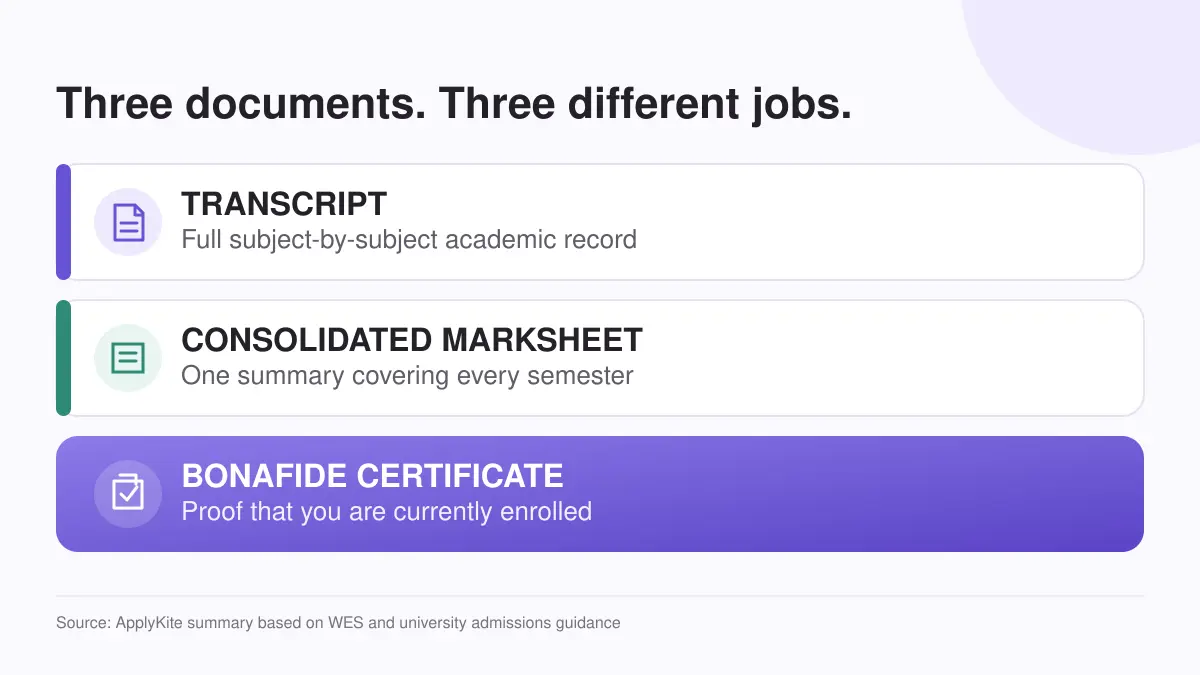
An academic transcript is a complete record of your studies. It lists the subjects or courses you took, the grades you received, the credits for each course, and usually the semester or year in which you completed them. Your institution’s registrar’s office or another authorized academic office issues the transcript.
When you apply to a university, you may be asked to submit an official transcript. This usually means the document needs to come directly from your institution, either in a sealed and stamped envelope or through an approved electronic system. The purpose is to make sure the receiving university can verify that the academic record is genuine and has not been changed after it was issued.
For students in India, the word transcript can be a little confusing because the system is not always structured in the same way. Indian colleges and universities have traditionally provided marksheets for individual semesters or examinations rather than one consolidated document covering your entire academic history. Your collection of semester-wise marksheets essentially contains the information that a transcript is meant to provide.
So, when an international university asks you for a transcript, it generally isn't asking you to provide a completely new academic record. It is asking for your academic information in a format that its admissions office can review and verify.
It is also worth arranging your transcripts well in advance. Depending on the universities you're applying to, you may need multiple official or attested copies. If you are applying to around ten universities, for example, having 15 or 16 properly prepared copies can save you from having to request additional ones later. The exact number you need will depend on each university's application requirements, so check those before ordering your copies.

What Is a Consolidated Marksheet?
A consolidated marksheet is basically a summary of your academic results. It brings together the results from all the semesters or years of your degree into one document. Once you have completed your course and cleared all your exams, your university issues it with details such as your SGPA for individual semesters, your final CGPA, and your overall results.
We can consider it as a comprehensive academic record covering all semesters or years of a programme. That is a useful way to understand what the document does. Instead of keeping track of several separate semester marksheets, you have one official document that puts your results together.
Is a Consolidated Marksheet the Same as a Transcript?
There is an important distinction to keep in mind when you are applying abroad. A consolidated marksheet is not the same thing as a detailed academic transcript. The consolidated marksheet gives the overall picture, while a transcript normally contains the details of individual subjects, including the courses you studied, grades, credits, and other academic information.
This difference matters because universities and credential evaluation agencies may ask for the transcript specifically. WES, for example, has its own document requirements for academic records. Depending on the university or evaluation agency, you may be asked to submit both your transcript and consolidated marksheet. They serve different purposes, so it is safer not to assume that one can replace the other.
You may also come across conflicting advice online. Some students say that a consolidated marksheet and a transcript are the same document, while others use the terms interchangeably because their university issues something that combines both. That can make things confusing, especially when different institutions use different names for their documents. What matters for your application is the information the receiving university has asked you to provide, not just the name printed at the top of your document.
In most Indian universities, you can request a consolidated marksheet through the examination branch, student services office, or an online student portal. The process is different from one university to another. Delhi University, Mumbai University, JNTU Hyderabad, VTU, and Anna University, for example, have their own systems for issuing academic documents. Autonomous colleges may handle these requests through their examination or administrative office instead.
Give yourself some time for this. A request may take anywhere from two to six weeks, and during busy periods it can take longer. Some universities also have an urgent service for students who need their documents sooner. Where available, this can sometimes reduce the waiting period to a few days.
Before you apply for the document, check your university's current procedure and the requirements of the university you are applying to. It can save you from ordering the wrong document and having to start the process again.
Transcript vs Consolidated Marksheet vs Marksheet vs Provisional Degree vs Degree Certificate vs Bonafide Certificate
At the center of most of this confusion sits the transcript vs consolidated marksheet question; get that one right, and the rest of this table falls into place quickly. Let's compare each side by side, since seeing them together makes the differences click faster than reading about them one at a time.
| Document | What It Is | Issued When | Accepted Abroad? |
|---|---|---|---|
| Marksheet | Result for a single semester or exam cycle only | After each semester | Not alone, supporting document only |
| Consolidated Marksheet | Summary of all semester marksheets, with SGPA per term and final CGPA | After course completion | Not alone, usually needed alongside a transcript |
| Transcript | Detailed, subject-wise, semester-by-semester record with grades and credits, sealed by the Registrar | On request, after completion | Yes, the standard document foreign universities and evaluators expect |
| Provisional (Degree) Certificate | Temporary placeholder confirming degree completion, issued before the final degree is ready | Soon after final results, before convocation | No, original degree required for foreign attestation instead |
| Degree Certificate | The permanent, official document confirming degree completion | At convocation, or on request afterward | Yes, this is the original degree attestation processes actually require |
| Bonafide Certificate | Proof of current, active enrollment, not a historical academic record | On request, while still enrolled | Yes, but for visas, loans, and scholarships, not academic evaluation |
Note: Five of the six documents listed above record what you studied and achieved. A Bonafide Certificate is different because it confirms your current enrollment status rather than your completed academic record.
The Provisional Certificate is valid as proof of degree completion in India until the final degree is issued. However, it does not carry the same weight for international attestation. For foreign use, the MEA, HRD, and foreign embassies generally require the original degree certificate. Universities may have their own alternatives as well. For example, Oxford uses a Degree Confirmation Letter in situations where degree verification is required.
What Is a Bonafide Certificate, and Why Is It Different?
A Bonafide Certificate is used to confirm that you are currently enrolled at an educational institution. It tells the person reviewing your documents that you are an active student there at the time the certificate is issued. That makes it quite different from a transcript, marksheet, or degree certificate, all of which describe your academic record or qualifications.
The validity of a Bonafide Certificate can depend on why you need it. Some institutions issue a temporary certificate that remains valid for a specific period, often anywhere from three months to a year. A certificate requested for a visa may need to be more recent than one being used for a bank account or another administrative purpose. Other institutions issue a certificate that remains valid for as long as you continue to be enrolled.
Even if there is no expiry date printed on the certificate, it is generally better not to rely on an old copy for an international application. Universities, embassies, and other organisations may expect the certificate to have been issued within the last few months. If you have had the document for a long time, check the current requirement before submitting it.
One document that students sometimes confuse with a Bonafide Certificate is the Transfer Certificate. They are actually used at opposite points in your academic journey. A Transfer Certificate is issued when you leave an institution, whereas a Bonafide Certificate confirms that you are still enrolled there. If an application asks for one and you submit the other, it can lead to unnecessary delays.

How to Obtain Each Document from Your Indian University
Transcript and attestation
Start by requesting your transcript directly from your Registrar's Office. If your destination country requires Apostille, and it will for any country that's part of the Hague Convention, India has been a member since 2005. The document will generally go through a series of steps: verification by the issuing authority, notarization, State HRD or Sub-Divisional Magistrate attestation, and finally the MEA Apostille stamp.
There are cases where applicants can go directly to MEA and skip the state-level attestation, so check whether that applies to you before assuming you have to follow the full chain. For countries outside the Hague Convention, embassy attestation is required after the MEA step.
The timeline can be quite different from one application to another. It depends on which part of the process you are looking at and whether your documents are being handled digitally or on paper. For documents processed through e-SANAD, the Ministry of External Affairs' digital attestation platform, MEA states that the final attestation or Apostille takes 7 working days after verification. Overall digital processing for eligible documents has also come down to roughly 15 to 20 working days as of 2026, compared with the 30 to 45 days that was more typical of the older, fully manual process.
There is one important limitation with e-SANAD. It only works when your institution's records are available through a linked digital depository, such as the National Academic Depository. If your institution has not been integrated yet, you will still have to use the traditional physical process, which can take longer.
Consolidated Marksheet
You usually request this through your university's exam branch or student portal, generally after your final results have been published. Universities typically require you to have cleared all your subjects and backlogs and settled any pending dues before issuing it. If any of these are still outstanding, the document may not be issued.
There is also a digital option in some cases. Consolidated marksheets can be available through DigiLocker's National Academic Depository, which, under Ministry of Education and UGC instruction, is intended to carry consolidated marksheets along with other academic certificates, free of charge. The coverage is not universal yet. If you cannot find your record there, it may simply mean your institution has not uploaded it yet.
You may also see the term Consolidated Marks Memo or CMM when dealing with universities in certain parts of India. It refers to the same type of consolidated academic document, although the name varies by region and institution. Some institutions issue both a college-level and university-level version. For study abroad applications, credential evaluation, and government use, the university-issued CMM is typically the one accepted.
Bonafide Certificate
This is usually requested from your Registrar or administrative office. There is no single processing time or fee that applies to every institution. In many cases, it takes a few days to around two weeks and is either free or costs under INR 500. Since the process varies from one institution to another, it is best to check directly with your university rather than plan around a fixed timeline.
Do You Need All of These? Breaking It Down by Stage
Not every document shows up at every stage, and knowing which one belongs where saves a lot of back-and-forth with your university's exam office.
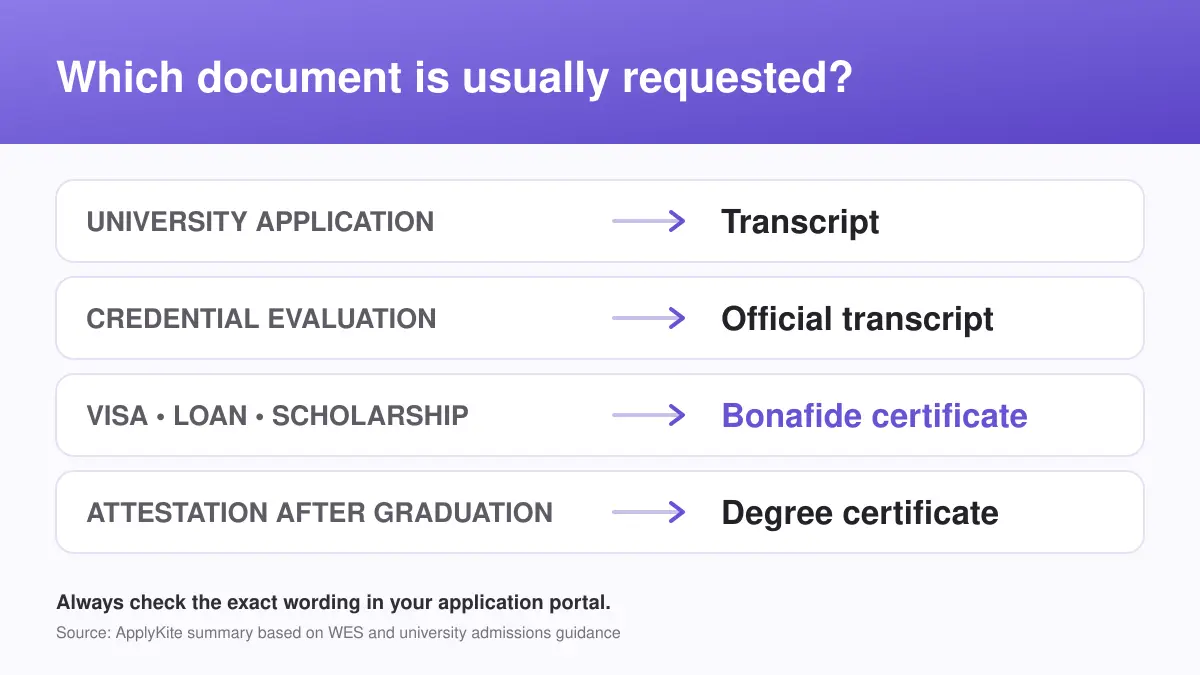
- University application: Transcript required. Consolidated Marksheet often requested alongside it, never as a replacement.
- Credential evaluation (WES and similar agencies): Transcript specifically required. A Consolidated Marksheet alone is routinely rejected here.
- Visa application: Bonafide Certificate typically required as proof you're currently enrolled or admitted; the Transcript may also be requested depending on the country.
- Loans and scholarships: Bonafide Certificate commonly required; some lenders also want the Consolidated Marksheet as academic proof of standing.
- Job applications or further study within India: Consolidated Marksheet and Degree Certificate generally sufficient; a Provisional Certificate can bridge the gap if the final degree hasn't been issued yet.
Common Mistakes That Delay or Reject Applications
Most document problems are not complicated. They usually come down to small details that are easy to overlook when you are managing several application requirements at once. These are some of the issues worth checking before you submit anything.
- A consolidated marksheet is not a substitute for a transcript: This is one of the most common misunderstandings, and it can be an expensive one if you discover it after submitting your application. A consolidated marksheet gives a summary of your academic results, while universities and credential evaluators may specifically require the detailed transcript.
- Check the names on every document: Something as simple as having "Riya Sharma" on one document and "Riya A. Sharma" on another can raise questions. The same applies to affidavits and other supporting documents where the name may be written slightly differently. Consulates and admissions offices can flag these inconsistencies, so make sure your documents use the same name wherever possible.
- Do not submit a transcript that you scanned yourself if an official copy is required: Many universities will not accept an unsealed or self-scanned transcript. They may instead require a sealed copy sent directly by the issuing institution or a digital transcript verified through an approved system such as WES.
- A Bonafide Certificate has a limited practical shelf life: If you request one several months before you actually need it, you may end up having to get a new copy. It is usually better to time the request around your application, visa, loan, or scholarship requirements.
- Attestation and Apostille should not be left until the end: Even when the document itself is correct, missing the required attestation or Apostille can result in rejection. Check what your destination country and institution require early in the process and allow enough time for the additional steps.
If you want help reviewing your application documents, explore ApplyKite’s mentoring service.
Frequently Asked Questions
How many transcript copies should I keep?
Most universities ask for around two copies. If you're applying to 10 universities, it’s a good idea to keep 15–16 properly attested copies ready.
Why do Indian students often confuse transcripts with marksheets?
In India, colleges and universities traditionally issued marksheets for each semester or exam instead of using the term transcript. Your complete set of marksheets essentially served the same purpose as a transcript.
Can I laminate my marksheet or certificate?
You generally can for regular domestic use. However, it’s better not to laminate documents that may need attestation or apostille, as lamination can sometimes cause problems during verification.
Can I use my consolidated marksheet instead of a transcript for WES?
Usually, no. WES and other credential evaluation agencies generally ask for a detailed transcript. A consolidated marksheet by itself may not meet their requirements.
Should I send my transcript or marksheet to WES Canada?
You should generally provide your transcript. If your university does not issue a formal transcript, check whether you can obtain a consolidated marksheet along with your semester-wise marksheets, as WES needs detailed academic information.
Do I need both a transcript and a consolidated marksheet?
In many cases, yes. They serve different purposes, so they are usually submitted as separate documents rather than replacing one another.
Where can I apply for a consolidated marksheet?
You can usually get it from your university’s examination department or student portal after all your results are declared. Some universities provide it online, while autonomous colleges may issue it through their examination cell.
How long does it take to receive a consolidated marksheet?
The timeline depends on the university. It often takes around 2–6 weeks after the final results, although it can take longer during busy periods. Some institutions also offer urgent processing.
What should I do if I lose my consolidated marksheet?
You can apply for a duplicate through your university. It may take a few weeks, although urgent processing may be available. Some universities may also ask for an affidavit or police report.
How can I correct a mistake on my consolidated marksheet?
Contact your university and submit a correction request along with your ID and supporting marksheets. A correction fee may apply. If the error is also shown on DigiLocker, the university must first update its records.
Can I download my consolidated marksheet from DigiLocker?
Yes, if your university has uploaded the document to DigiLocker. Availability varies between institutions, so a missing document may simply mean your university has not uploaded it yet.
How is CGPA converted into a percentage on a consolidated marksheet?
The conversion method depends on your university. Some institutions use a formula such as CGPA × 9.5, but you should always follow the conversion formula officially provided by your university.
Can I apply for higher studies with only a consolidated marksheet?
For many Indian institutions, you may be able to. For studying abroad, however, universities and credential evaluators often ask for a detailed transcript as well.
Is a consolidated marksheet enough for a student visa?
Not necessarily. Visa requirements depend on the country and type of visa. Always check the official document checklist for your specific visa application.
Is a consolidated marksheet the same as a degree certificate?
No. A consolidated marksheet records your academic results, while the degree certificate confirms that you have officially completed your course. They are separate documents.
Is a consolidated marksheet the same as a provisional certificate?
No. The consolidated marksheet contains your academic results, while the provisional certificate confirms that you have completed your program and can receive your final degree certificate.
What information does a Consolidated Marks Memo (CMM) contain?
A CMM, or Consolidated Marks Memo, is another term commonly used for a consolidated marksheet. It brings together your academic results from different semesters or exams into one document.
How long is a Bonafide Certificate valid?
It depends on the institution. A temporary Bonafide Certificate may be valid for 3–6 months or sometimes up to a year. For overseas verification, you may still be asked for a recently issued certificate.
Is a Bonafide Certificate the same as a Transfer Certificate?
No. A Bonafide Certificate confirms that you are currently enrolled at an institution. A Transfer Certificate is issued when you leave or transfer from that institution.
How much does a Bonafide Certificate cost? It varies by institution. Many issue it for free; where there's a fee, it's commonly under INR 500.
How long does it take to get a Bonafide Certificate? It depends on the institution, typically a few days to around two weeks. Check your specific college or university for its current timeline.