
Master's Application Timeline 2027: The Complete Intake Guide
Missing a master's deadline by one day costs you an entire year. And for the 2027 cycle, the dates you see on university homepages are probably lying to you. If you need full funding or a student visa, your real cutoff is months earlier than the official admission close date. We built this master's application timeline 2027 to clear up the confusion. Let's map out exactly when to contact professors, take your language tests, and hit submit before the money runs out.
Short Answer: When Should You Actually Apply?
Aim for December 2026. Most top master’s deadlines fall between December 1, 2026, and January 15, 2027. But if you’re hoping for a major award, like Chevening or a 2027 DAAD grant, you’ll need to submit earlier. Think October or November 2026.
Fixed, Rolling, and Round-Based Deadlines
Before marking dates on your calendar, let’s look at how admissions teams actually read applications. Every university handles files a bit differently, and knowing the setup helps you plan without extra stress.
Fixed Deadlines: You apply by a set date, and the committee reviews all candidates together. Miss the date? You’ll have to wait a year. For example, Stanford’s Civil and Environmental Engineering master’s programs enforce a strict December 1 cutoff.
Rolling Admissions: Here, files are evaluated as they arrive until all seats fill up. Timing really matters. A file sent in October stands a much stronger chance for admission and funding than the exact same file submitted in January.
Round-Based Admissions: Very common with business schools. Deadlines run in stages: Round 1 in October, Round 2 in January, and Round 3 in March. Round 1 almost always gives you the best odds for financial aid. The NUS MBA, for instance, typically closes its first round in late October.
Looking for fully funded?
Discover PhD, Master's, and Postdoc positions tailored to your goals with ApplyKite's smart AI tools.
The Real Deadline: Why Funding and Visas Change Everything
Most applicants look at a university's main deadline and think they have plenty of time. They see a May cutoff for a fall program and relax. But if you need financial support or a student visa, that May date is a complete illusion.
Funding deadlines almost always close months before the general admission window. If you want a fully funded spot, you operate on a completely different timeline. Let us look at the actual numbers to see how this plays out in the real world.
We recently analyzed 2,817 funded master's openings and 195 active master's scholarships in the ApplyKite database. The data tells a very clear story. Deadlines heavily pile up in the winter. January is the single biggest month with 308 funded openings, followed closely by February, December, and March. That four-month winter stretch holds 57% of all funded deadlines for the year. The scholarship data mirrors this perfectly, with deadlines strongly clustering around October and January.
Funding Deadline Distribution (ApplyKite Data)
| Season | Percentage of Funded Deadlines | Key Months | Strategy |
|---|---|---|---|
| Winter Rush | 57% | Dec, Jan, Feb, Mar | Submit all primary applications |
| Second Wave | 13% | Aug, Sep, Oct | Target alternative intakes or late openings |
| Quiet Period | 30% | Apr, May, Jun, Jul | Focus on visas and housing |
What about the quality of these funding options? Out of the 195 active master's scholarships we tracked, 46% are fully funded. Even better, only 12 restrict eligibility based on nationality. The opportunities exist. And with over 9,400 people on ApplyKite currently targeting a master's degree, the competition for those early winter spots is fierce. Plan your entire schedule around the earliest funding deadline, not the final university cutoff.
If you need help tracking down these specific, fully funded openings before they expire, you can use the Explore Academic Positions Worldwide feature on ApplyKite. It filters global academic positions by deadline and funding status so you never miss an early window.
2027 Master's Application Deadlines by Region
Every country follows a different academic rhythm. Let us look at what to expect across the globe.
United States Deadlines
For the Fall 2027 intake, selective US programs cluster their deadlines between early December 2026 and mid-January 2027. Research-heavy degrees usually close earlier than coursework programs. Public universities often have separate dates based on residency. Cal State LA generally sets mid-February deadlines for international students to allow for visa processing, while domestic students have until May.
Canadian Master's Intakes
Canada master application deadline windows follow a similar pattern. Universities like UBC and McGill set deadlines by specific faculty. For international students aiming for Fall 2027, the window typically closes between December 1, 2026, and January 15, 2027. Winter intakes starting in January usually have deadlines falling between June and August of the previous year.
Europe and United Kingdom
Europe university application deadline 2026 dates vary wildly. A Germany Master's application deadline for international students usually falls around July 15 for the winter semester via uni-assist. But be careful. If you need a visa or must open a blocked bank account, applying in July is too late.
In the UK, rolling admissions dominate. Meanwhile, highly competitive Swiss programs have strict, early cutoffs. The ETH Zurich master's application deadline typically closes in November or December 2026 for Autumn 2027 entry.
Asia and Australia Intakes
Australia master application deadline windows are unique because their academic year starts in February or March. For a mid-2027 start, applications usually close around April or May 2027. In Asia, schools like HKU and CUHK use phased rounds starting as early as September or October 2026 for the 2027 intake.
Global Deadline Overview (Fall 2027 Intake)
| Region | Standard Intake | Primary Deadline Window | Admission Style |
|---|---|---|---|
| United States | August/September | Dec 2026 - Jan 2027 | Fixed |
| Canada | September | Dec 2026 - Jan 2027 | Fixed (by faculty) |
| UK | September/October | Nov 2026 - Jan 2027 | Rolling |
| Germany | October (Winter) | May 2027 - July 2027 | Fixed |
| Switzerland | September | Nov 2026 - Dec 2026 | Fixed |
| Australia | Feb/March | Oct 2026 - Dec 2026 | Rolling/Rounds |
The 2027 Timeline: When to Do What
Breaking the process into a chronological timeline keeps the stress low. Here is exactly how to pace your work.
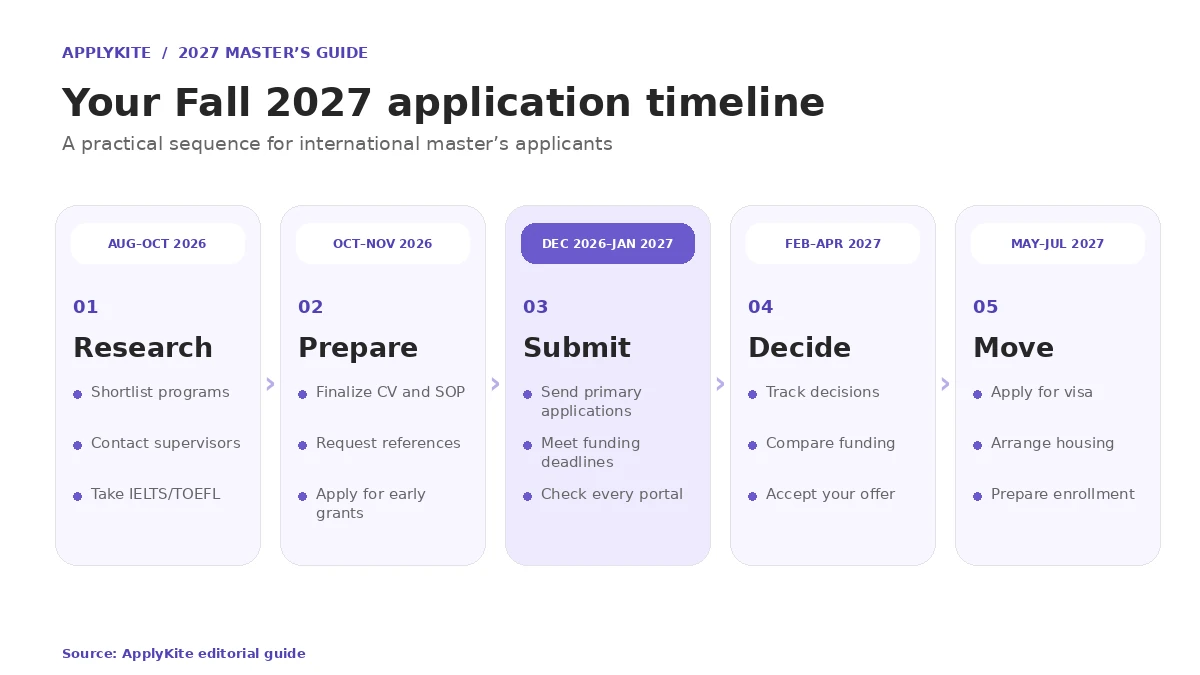
- August–October 2026: Shortlist universities. Contact potential supervisors if required by your program. Take language tests like IELTS or TOEFL.
- October–November 2026: Finalize your CV and Statement of Purpose (SOP). Apply for major early grants like the DAAD scholarship deadline for 2027.
- December 2026–January 2027: Submit the bulk of your applications.
- February–April 2027: Await admission decisions. Accept offers.
- May–July 2027: Apply for student visas and arrange housing.
Winter Semester 2027/2028 Timeline
Programs starting in January or February 2028 run on a shifted calendar.
- March–May 2027: Research programs and take necessary exams.
- June–August 2027: Main application submission window for international students.
- September–November 2027: Visa processing.
Summer Semester 2027 Timeline
Summer semester in Germany application deadline windows usually fall between December 2026 and January 15, 2027. Note that summer intakes are far less common for master's programs globally compared to Fall.
Documents To Prepare Before You Apply
You know you need to aim for the winter deadlines. The next logical step is gathering your materials. This is where most applicants make a critical miscalculation.
You might assume that once a funded master's position is advertised, you have a few months to put your application together. Our data shows the exact opposite. We measured the gap between when a funded master's ad appears and when the application officially closes. The median window is just 37 days.
Let that sink in. Roughly 42% of these programs give you 30 days or less to apply. Two-thirds give you under two months. You simply cannot write a compelling statement of purpose, contact your references, and gather official university documents in 30 days without panicking. Your materials must be 90% finished before the opportunity even hits the internet.
This is exactly why we built KiteAI. Instead of staring at a blank page when a 30-day deadline drops, you can upload your base resume to KiteAI. It acts as your personal academic assistant to instantly draft highly specific SOPs and professional outreach emails suited to the exact position description.
Practical Checklist for Your Application
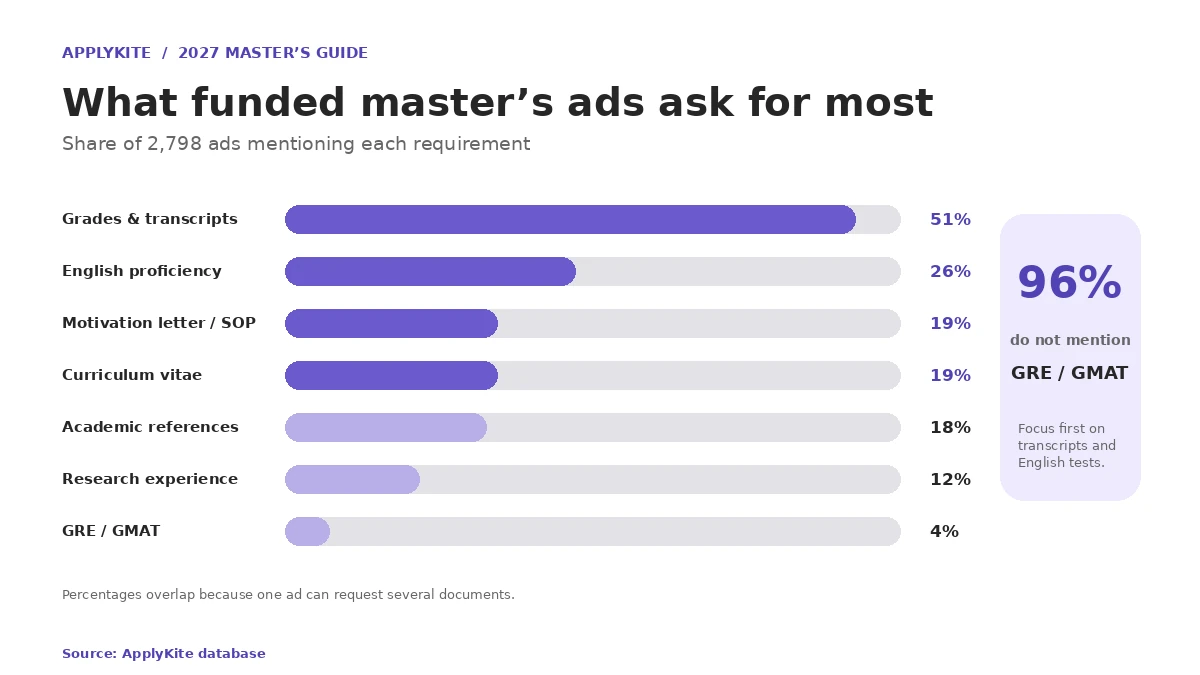
What should you actually prepare? We mined the stated requirements from 2,798 master's ads to see what admission committees prioritize.
Most Requested Application Documents
| Document Type | Frequency in Funded Ads | Priority Level |
|---|---|---|
| Grades and Transcripts | 51% | High |
| English Proficiency Tests | 26% | High |
| Motivation Letter (SOP) | 19% | High |
| Curriculum Vitae (CV) | 19% | High |
| Academic References | 18% | Medium |
| Research Experience | 12% | Medium |
| GRE/GMAT Scores | 4% | Low |
Requirements Based on Fields
Research-based degrees like an MPhil or thesis-track MS often require you to secure a supervisor before applying. Coursework-based programs strictly evaluate your grades, test scores, and professional experience.
Requirements Based on Country
Notice anything missing from the data above? The GRE or GMAT appears in only 4% of the requirements. Unless a specific US business or engineering school explicitly demands it, do not waste months studying for standardized tests that 96% of programs ignore completely. Focus your energy on securing your transcripts and passing your English test.
If figuring out country-specific rules feels overwhelming, Mentoring and Application Support can help. Booking a Consulting session or Full Service mentoring with someone who has actually been through the process saves time and prevents technical rejections based on misunderstood requirements.
How to Find the Real Date
University websites are notorious for burying information. A general admissions page might say the international deadline is April 1. But the specific Computer Science department page might say the deadline for financial aid consideration is December 15.
Always trust the specific department or faculty page over the university’s main homepage. Check the financial aid page separately.
Build Your Own Deadline Calendar
With hundreds of programs opening and closing in tiny 37-day windows, relying on your memory guarantees you will miss out. You need a system.
So start with a simple spreadsheet. Make columns for the university name, the program, the link to the application portal and the login credentials. Then, create two separate columns for the dates: one for the funding deadline, and one for the master application deadline in general. Finally, add a status column to track whether the application has been drafted, submitted, or is in review.
A good calendar also tracks professor outreach. ApplyKite’s Explore Professors and Research Supervisors feature helps you find aligned academics. Manage your emails and follow-ups directly within the platform’s Activity dashboard and avoid the chaos of spreadsheets.
Common Mistakes That Delay Admissions
- Waiting for final test scores: Many universities allow you to apply and send your official IELTS or TOEFL score later. Don't hold up your whole application without talking to admissions.
- Sending rushed cold emails: Sending generic "Dear Sir/Madam" emails to professors usually results in silence. Customize your message to their specific, recent publications.
- Missing the intake season entirely: Assuming a university offers a Spring intake when they only offer a Fall intake. Always verify term start dates.
Frequently Asked Questions (FAQ)
When should I start Fall 2027 MS applications?
Target August 2026 for faculty outreach and program evaluation. Plan to submit completed packages during October or November 2026.
Do all Fall 2027 MS applications open at the same time?
No. Applications usually open between September and November of 2026 depending on the region and the university.
Should I wait for my final GRE score before shortlisting?
No need. Shortlist early using academic compatibility and lab focus instead. Only about 4% of master’s programs globally maintain a strict GRE requirement.
Can I apply close to the final deadline?
You can, but it carries real drawbacks. Last-day submissions routinely miss early scholarship allocations, dormitory priority, and timely visa clearance windows.
When should I apply for grad school for fall 2027?
Submit between December 2026 and January 2027 to ensure consideration for institutional financial aid.
What is the intake for the DAAD scholarship 2027?
The DAAD scholarship deadline for 2027 varies by the specific program. Most deadlines for master's scholarships fall between September and November 2026 for a Winter 2027 start.
What is the deadline for Masters applications?
It depends entirely on the country and program. US and Canadian research programs close in December or January. UK programs often run on rolling admissions into the spring.
How far in advance should I apply for a Masters?
You should apply 9 to 12 months before the program officially begins.
Is June too late to apply for Masters?
For a Fall 2027 start, June is generally too late for international students due to visa processing times. However, our data shows a second wave of late openings between August and October for alternative intakes.