
There’s a strange moment in every master’s application where the numbers run out. Your transcript has said everything it's going to say. Your test scores are what they are. Then the application asks for something else entirely, an essay explaining, in your own words, why any of this matters to you.
That's the Statement of Purpose for Master's applications, more commonly shortened to SOP for Masters once you spend any time in study-abroad forums, and it's usually the part applicants put off the longest, partly because it's the one piece nobody can hand you a formula for.
This guide tries to close that gap. We'll walk through what an SOP is actually supposed to do, how it's typically structured, what genuinely strong writing looks like next to weak writing, and where AI fits into the process and where it very much doesn't.
What’s Statement of Purpose, and Why Does it Matter?
At its simplest, a Statement of Purpose is an essay that covers your academic background, why you want to study this subject further, why this specific program, and what you’re planning to do with the degree once you have it. SOP exists to help a committee understand your academic objectives and determine if you’re a good match, and just as importantly, it shows them how you think and write, which a transcript simply can’t.
A lot of applicants to any given program look remarkably alike on paper. Similar grades, coursework, test scores clustered in a tight band. Somebody on the other side of the pile has to make distinctions between candidates. It isn’t a formality tacked onto the end of an application.
Statement of Purpose vs. Personal Statement vs. Letter of Motivation
People use these three terms as if they're interchangeable. They're not, and getting this wrong can genuinely cost you.
| Document | Focus | Common Usage |
|---|---|---|
| Statement of Purpose (SOP) | Future goals, program fit | US, Canada, most master's and PhD programs globally |
| Personal Statement | Past journey, personal motivation | UK (via UCAS), some UK postgraduate programs |
| Letter of Motivation | Direct enthusiasm and suitability | Germany and much of Europe |
What makes this more than a vocabulary lesson is that some universities ask for both an SOP and a Personal Statement in the same application, as two separate documents, and they're explicit that one shouldn't just echo the other. The Personal History Statement should not duplicate the Statement of Purpose. Personal statements should cover genuinely different ground than the academic SOP submitted alongside it.
So, if you're staring at an application asking for both, don't try to write one essay and split it in half. The SOP is where your evidence lives, what you've built, studied, or worked on, and why this exact program fits what comes next. The personal statement is where your reasons live, what actually shaped you into someone applying for this in the first place. Committees read a lot of these. They notice when two documents are quietly saying the same thing twice.
Which Masters Are You Applying To? Research, Coursework, or Professional
Before you write anything, it's worth pausing on a question most applicants never ask themselves: what kind of master's program is this, actually?
- A research or thesis-track master's usually comes with a named adviser and an expectation that you'll spend the degree producing something original. This is the version where the advice that circulates about PhD statements genuinely applies. Name a research direction, show you've already done something resembling research, explain why this particular department and not the twelve others offering something similar.
- A coursework or taught master's is different. There's no thesis, often a capstone in its place, and the person reading your file may well be sitting in an admissions office rather than a faculty lounge. This is exactly where name-dropping a professor you have no real intention of working with starts to backfire, it reads as borrowed seriousness, and readers who've seen a thousand of these can tell.
- A professional master's or the MBA-adjacent degrees, public health, engineering management is judged on something else entirely: does the story you're telling about your career actually connect to what this program produces. Work experience here isn't a gap to smooth over. That's the whole point.
The quickest way to figure out which one you're dealing with: check whether a thesis is required or optional, and whether the application even gives you a field to name faculty or research interests. If it doesn't, you're probably not writing for a future adviser, and the statement should be built accordingly.
SOP Format for Master's: The Five-Part Structure
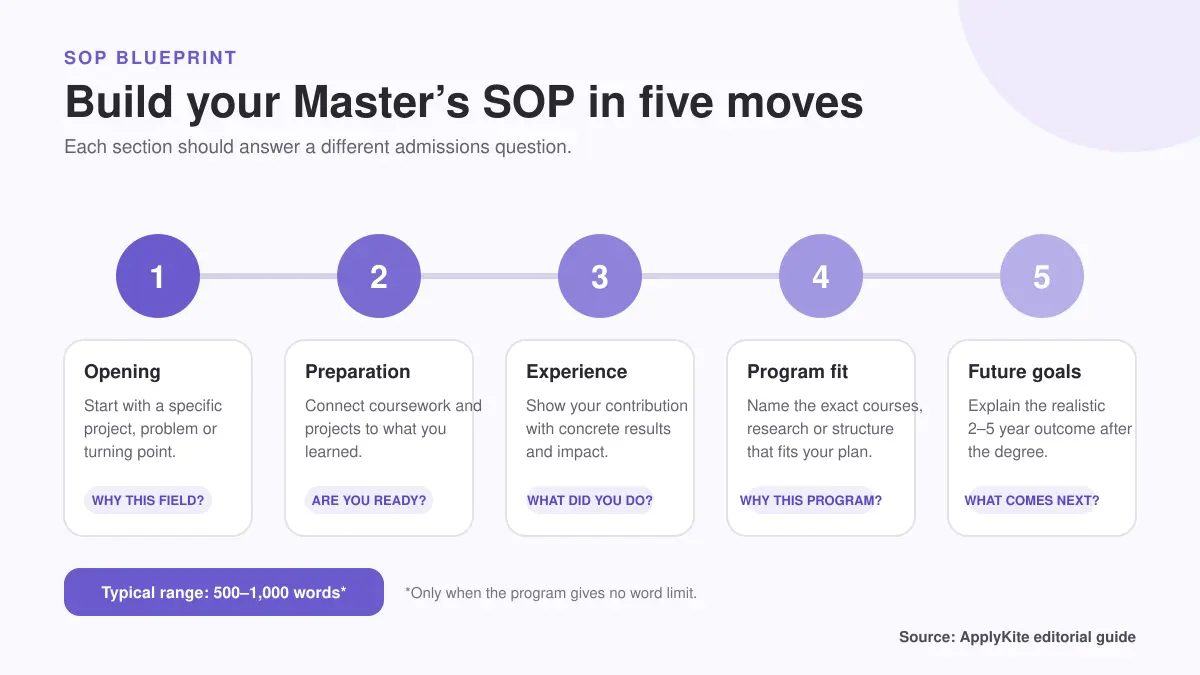
Whatever type of master's program you're applying to, a strong SOP usually follows the same basic flow: where you come from, what has prepared you, why this program fits, and where you want to go next. The exact emphasis can vary by program, but these are the core points admissions committees commonly look for.
1. Introduction: Start by naming your field and giving the reader a clear sense of what led you to it. Skip openings like ever since I was young. A specific project, problem, or experience is usually more effective because it gives the reader something concrete about you.
2. Academic Background: Briefly discuss your degree, relevant coursework, and two or three projects that support your application. Don't just list what you studied. Explain what you learned and how those experiences prepared you for graduate study.
3. Professional Experience: If you have work experience, use it to show what you can actually do. Specific results are much stronger than general claims. For example, saying you reduced processing time by 20 percent tells the reader much more than saying you improved efficiency. It's also recommended to use concrete and quantitative examples when describing your experience.
4. Program Fit: This is often the most important section to personalize. Avoid generic praise about a university's reputation or academic environment. Instead, explain what specifically connects you to the program, such as relevant courses, research areas, projects, or faculty whose work genuinely interests you. Your goal is to show that you understand the program and that it makes sense for your academic plans.
5. Future Goals: End by explaining what you hope to do after graduation. A realistic two to five-year plan is enough. Connect those goals to the skills and opportunities you hope to gain from the master's. Stanford's graduate admissions guidance similarly asks applicants to address their preparation, reasons for applying, research interests, and future career plans.
How Long Should It Actually Be?
There is no universal SOP word count. Every university or program can set its own limit, so its instructions should always come first. When no specific length is given, around 500 to 1,000 words is a reasonable range. UC Berkeley recommends approximately 500 to 1,000 words when a program does not specify otherwise, while Stanford recommends a maximum of 1,000 words for its general graduate application.
A shorter, focused SOP is usually better than a long one filled with repetition. Every paragraph should help answer one of the main questions: What have you done? What did you learn? Why this program? What do you want to do next?
One final point: your reader may not be an expert in your exact area. Keep technical language to what is necessary and explain your work clearly enough that an intelligent reader outside your specialty can follow it. Avoiding excessive jargon and focusing on the skills, contributions, and impact behind your work are some of the best methods you can apply.
SOP Examples for Master's: Weak vs. Strong Writing
A strong SOP is not about using impressive words. It is about giving the reader something real to remember about the applicant.
There is little value in copying a sample paragraph and changing a few words before adding it to an application. That approach can make an SOP sound borrowed rather than genuine. The bigger problem is that the writing may no longer sound like the person behind the application.
A more useful way to understand good SOP writing is to look at weak and strong examples side by side. The difference is often surprisingly simple: weak writing tells the reader what to think about the applicant, while strong writing gives the reader enough detail to reach that conclusion naturally.
Weak vs. Strong: The Opening
- Weak opening:
"Ever since I built my first circuit as a child, I have been fascinated by how electricity shapes modern life."
- Strong opening:
"Two years of field commissioning taught me where my training stops: I can debug a controller in situ, but I cannot model why the same fault recurs across an installed fleet."
The first sentence sounds positive, but it could belong to hundreds of applicants. The second immediately gives the reader a specific experience, a practical skill, and a clear area where further study is needed. It also creates a natural question: what does this applicant want to learn next?
Weak vs. Strong: Preparation
- Weak preparation paragraph:
"I gained exposure to data analysis and machine learning during my internship at a large logistics firm."
- Strong preparation paragraph:
"I rebuilt the routing team's weekly exception report, cut it from nine pages to one, and found that two-thirds of the flagged shipments came from a single depot's scanning gap."
The difference is not the complicated language. The weak version simply says the applicant gained experience. The strong version shows what was actually done and what came out of that work.
This is a useful habit to develop while editing an SOP. Whenever words such as hardworking, passionate, experienced, analytical, or highly motivated appear, ask whether there is a specific example underneath them. One concrete example can say much more than a sentence full of adjectives. The goal is to give the reader enough evidence to understand the applicant without having to be told what conclusion to reach.
AI SOP Checklist: What's Safe to Use, What Isn't
Let's address the elephant in the room: using AI while writing an SOP is incredibly common now. That doesn't automatically make it wrong. What matters is how you're using it, and universities are starting to make those boundaries clearer.
- What's generally permitted: Using AI to brainstorm ideas, checking grammar and spelling on your own writing, translating individual words or short phrases, and formatting citations for work you've written yourself.
- What's not: Having AI generate your outline, draft, or substantial parts of your SOP; copying AI-generated text and lightly editing it; using AI to translate a substantial piece of your writing; or using AI in a way that misrepresents your experiences or qualifications.
Cornell also asks applicants to disclose permitted AI use. So don't assume that "I only used AI for grammar" automatically means there's nothing to mention. Always check the specific university's policy before submitting.
One more thing: don't write your SOP around trying to beat an AI detector. Cornell itself says it does not rely on automated AI detection as its main evidence of a violation, noting concerns about false positives, particularly for non-native English speakers.
The consequences of crossing the line can still be serious, including disqualification, withdrawal of an admission offer, or disciplinary action after enrollment.
So the rule to remember is simple: Use AI to support your writing, not to become the writer. Brainstorm with it. Check your grammar. Organize your thoughts. But the experiences, reasoning, voice, and story in your SOP should come from you.
Common Mistakes That Get an SOP Rejected
Most SOP mistakes are avoidable. Before you submit, take a few minutes to check for these.
- A generic "Why this university?" paragraph: This is one of the easiest ways to make your SOP feel copied and impersonal. Try replacing the university's name with another one. If the paragraph still works, it's too generic. Tell the reader why this specific program makes sense for you.
- Copying from sample SOPs: Use sample SOPs to understand structure and expectations, not to borrow sentences. Even heavy paraphrasing can make your writing sound borrowed. Learn from the example, then write your own story in your own words.
- Ignoring the word limit: If the program asks for 1,000 words, don't submit 1,400. Following instructions is part of the application. Also, if you're reusing an SOP, check the university name before submitting. Leaving another university's name in your essay is an avoidable mistake that can seriously hurt your application.
- Making excuses: If you have a low grade, gap year, or another weakness, explain it if necessary, but don't spend half your SOP defending it. State what happened, keep the explanation factual, and move quickly to what you learned or what changed.
- Letting AI take over your voice: An SOP can be grammatically perfect and still feel empty. If every sentence sounds overly polished, generic, or unlike the way you normally communicate, something is wrong. Your SOP should sound like a thoughtful version of you, not like a machine trying to sound impressive.
Handling a Weak Profile, Gap Year, or Career Switch in Your SOP
Not having a perfect profile doesn't mean you need to hide it. It means you need to explain it carefully. If your application has a separate section for explaining academic performance, use it. Don't use valuable SOP space to explain something the application already gives you a place to address. If there isn't a separate section, keep the explanation short.
For example:
During my second year, I became my mother's primary caregiver during a family health crisis while continuing my full-time studies. My grades in two courses suffered during that period. Since then, I have completed advanced coursework in machine learning and statistics with a 3.8 GPA while also leading our department's undergraduate research symposium.
The important part isn't the explanation itself. It's what comes after it. Acknowledge the problem, then show the evidence that things changed.
The same applies to an employment gap. Don't treat it like something you need to apologize for. If you were learning new skills, freelancing, caring for family, working on projects, or figuring out your next direction, say what you actually did. Then connect that experience to why you're applying now.
If you're changing fields, don't spend three paragraphs trying to convince the reader that the switch is reasonable. Show the connection instead.
How ApplyKite Can Help You Write and Refine Your SOP
Knowing the structure is one thing. Actually getting personalized feedback on your specific background is a different problem, and it's the one most applicants struggle with alone.
Get Feedback with Kite AI
You can upload your resume directly to Kite AI and get personalized responses based on your actual background, not generic advice built for an average applicant. It can look at what you've done, your coursework, your projects, your work experience, and help you think through which parts are strong enough to lead within your SOP and which need more specific framing.
Used this way, it's a genuinely useful assistant for the drafting process: a second set of eyes on your material before you sit down to write, not a replacement for the writing itself.
Find a Mentor Who's Been in Your Position
ApplyKite also offers a mentor marketplace, where you can browse mentors by their background, including where they studied, their degree level, and their field, and choose someone whose profile actually matches where you're headed. Mentors offer a range of bookable services, including working with you directly on your SOP, someone who's been through the exact application process you're facing, not a generic template.
If your resume feedback from Kite AI raises questions about how to frame a weak GPA or an unusual career switch, a mentor who's navigated that same situation is often the more useful next step.
Frequently Asked Questions
Is a Statement of Purpose the same as answering what is your motive for this career?
Close, but not quite. A prompt asking specifically about your motive wants something narrower and more personal than a full SOP, which also has to cover preparation, fit, and future goals. If a form asks for both, give each one its own answer instead of repeating yourself in different words.
Can I use the same SOP for multiple universities?
Not as-is. Tailor at least 20–30% of it per university, concentrated in the program-fit section. Committees read a lot of these in a short window, and a generic one is easy to spot.
How do I address a low GPA without it reading as an excuse?
State it once, briefly, then move straight into evidence that things changed, an upward grade trend, a strong recent project, a certification. Resist the urge to over-explain the cause.
Can a high GRE or test score make up for a low GPA?
It helps. A strong test score is one of several things, alongside research experience, work history, and a well-written SOP, that committees weigh together against a weaker GPA.
How is a master's SOP different from a PhD SOP?
A doctoral statement is arguing you can generate original research. A master's statement is arguing you're ready for the coursework and know what you'll do with the degree. The evidence overlaps quite a bit; the direction and the ending diverge.
Should I name a specific professor in my master's SOP?
For a research-track program, yes, if you've actually read their work and can say something specific about it. For a coursework program, usually skip it, your reader may not be faculty at all, and a name with no real substance behind it reads as performance.
Do master's programs also require a separate research statement?
Rarely. That's usually a PhD-specific requirement. Check your own program's checklist rather than assuming.
What if I have no research experience at all?
Then you build your preparation section from coursework, projects, and work experience, and you don't apologize for it. Coursework programs take people from exactly this position all the time. The actual mistake isn't the missing research, it's padding the space where it would've gone with vague, unspecific claims instead.
Is it okay to use an SOP writing service or a counselor's help?
Help with structure, editing, and feedback is normal and fine. The core story and the actual examples need to be yours, a service writing a fabricated narrative for you risks both a rejection now and an awkward authenticity question later.
What's the best font and formatting for an SOP?
A safe default is Times New Roman 12pt or Arial 11pt, 1.5 line spacing, 1-inch margins, unless your program specifies something else, in which case follow that instead.
What happens if my SOP gets rejected along with my application?
It's rarely the SOP alone that decides things, but a weak or generic one can tip a borderline case the wrong way. If you're reapplying, get real feedback on your program-fit paragraph specifically, it's the section most often cited as the deciding factor in close calls.
How is a visa SOP different from a university admission SOP?
An admission SOP is arguing you're a strong fit academically. A visa SOP is arguing you're a genuine student who intends to return home afterward. Different readers, different concerns, don't treat them as the same essay with a new heading.
How early should I start writing my SOP?
Give yourself two to three months before the deadline just for brainstorming. Most strong drafts go through three or four revisions over a couple of weeks, and the mistakes that get essays rejected tend to cluster in the ones written in a single rush sitting the week it's due.
Does my SOP need section headings?
Not necessarily, check your program's formatting instructions first. They show up more often in technical fields than in the humanities, but headings alone won't rescue a statement that doesn't have a real argument underneath them.
What if I genuinely don't have anything unusual about me?
You're probably not missing an extraordinary story. What actually gets essays marked down isn't an ordinary background, it's an unspecific one. The fix isn't finding a more dramatic angle, it's finding one bounded, concrete example of something you actually did and describing it well.
Should I explain why I chose to study in this particular country?
Only if the prompt actually asks. If it does, answer in terms of the program, not the country, world-class universities tell a reader nothing they didn't already assume. A specific structural reason, like a course sequence or a practicum model your home country doesn't offer, actually carries information.