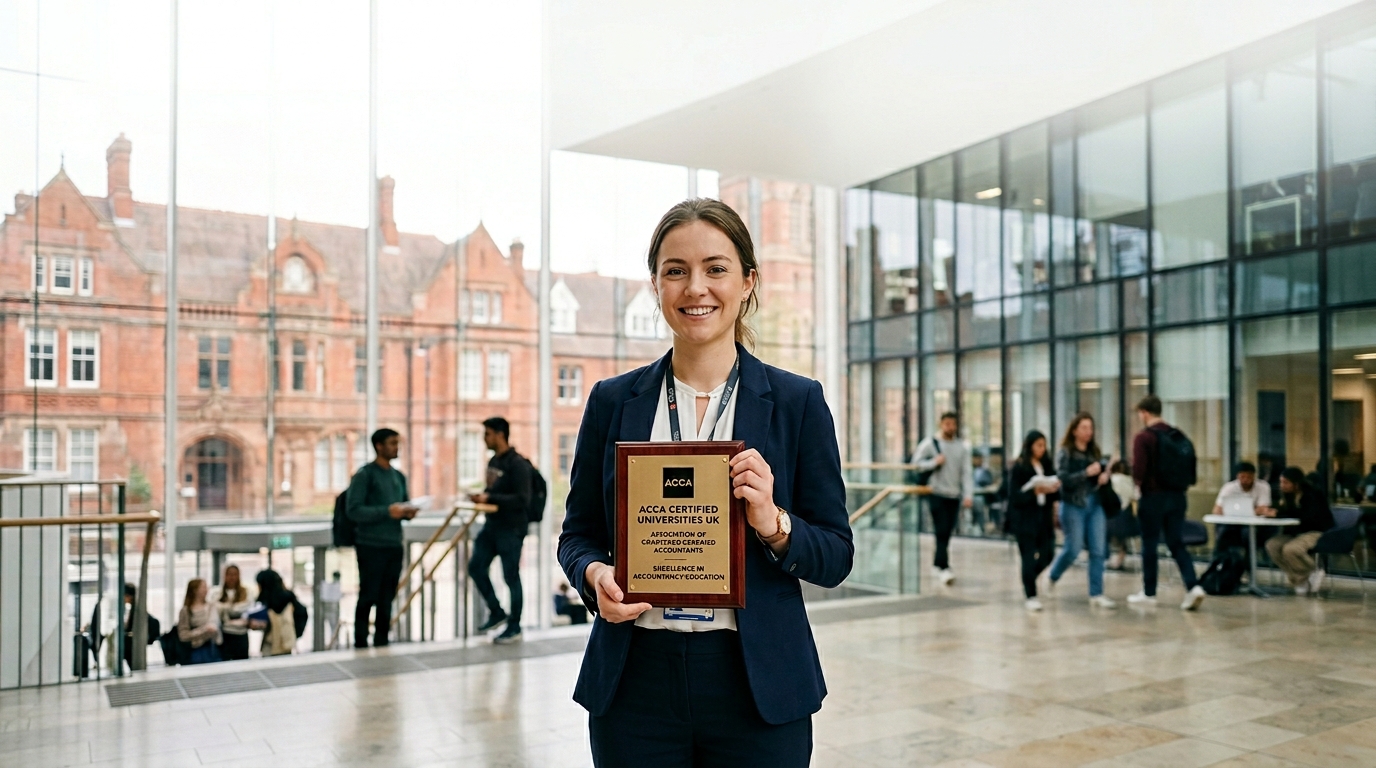
Facing extra exams after graduation is exhausting. We get it. But choosing the right ACCA-Certified Universities in the UK actually lets you skip up to nine professional papers automatically. You earn a respected degree, and you save years of study time.
Let's break down the Top ACCA-Certified Universities in the UK and the costs to fast-track your career.

Quick Answer: Top ACCA-Certified Universities in the UK at a Glance
University Name | City | Programme Example | ACCA Exemptions | Tuition Range (Annual) | Ranking | Best For |
University of Edinburgh | Edinburgh, Scotland | ACCA-Oriented Accounting & Finance Curriculum | Up to 9 exemptions | £28,000 – £35,000 | #34 QS World Ranking 2026 | Global employability outcomes |
The University of Manchester | Manchester, England | BSc Accounting and Finance | 6 to 9 papers | £24,000 | Top 35 QS World Ranking 2026 | Real-world placements (KPMG/PwC) |
University of Warwick | Coventry, England | Warwick Business School Finance Programs | Up to 9 exemptions | £27,000 | Top 70 QS World Ranking 2026 | Practical corporate scenarios |
University of Glasgow | Glasgow, Scotland | MSc Accounting and Finance | 6 to 9 papers | £22,000 | Top 80 QS World Ranking 2026 | Hands-on training with UK systems |
University of Leeds | Leeds, England | Accounting and Finance BSc | 6 to 9 papers | £23,500 | Top 85 QS World Ranking 2026 | Financial reporting and analytics |
University of Southampton | Southampton, England | BSc Accounting and Finance | Up to 9 exemptions | £25,200 | #87 QS World Ranking 2026 | Research & industry partnerships |
Durham University | Durham, England | Accounting and Finance BSc | Up to 9 exemptions | £25,000 – £35,000 | #94 QS World Ranking 2026 | Intensive accounting curriculum |
Newcastle University | Newcastle, England | Accounting and Finance BSc | Exemptions available | £14,000 – £24,000 | #137 QS World Ranking 2026 | Industry-standard financial training |
Lancaster University | Lancaster, England | Accounting and Finance BSc | Up to 9 exemptions | £25,000 – £35,000 | #157 QS World Ranking 2026 | Employability training at LUMS |
University of Strathclyde | Glasgow, Scotland | Accounting and Finance Programme | Exemptions available | £14,000 – £24,000 | #251 QS World Ranking 2026 | Professional corporate placements |
Oxford Brookes University | Oxford, England | BSc / Applied Accounting | Up to 9 exemptions | £17,000 | Top 450 QS World Ranking 2026 | Direct unique ACCA connection |
London Metropolitan University | London, England | BA / MSc International Accounting | Up to 9 exemptions | £16,500 | #1001+ QS World Ranking 2026 | Budget-friendly London experience |
University of Brighton | Brighton, England | Accounting-Oriented Programs | Exemptions available | £14,000 – £24,000 | #801-850 QS World Ranking 2026 | Regional accounting exposure |
Note: Exemption quantities depend directly on the specific optional modules you pick during your studies. Make sure to consult the official ACCA exemption calculator to verify the status of your chosen course.
What Exactly Are ACCA-Certified Universities in the UK?
An ACCA-accredited pathway means the professional body reviewed the university's syllabus line by line. They ensure the classes meet the exact technical standards required for global status، saving international students an immense amount of time.
To qualify normally، you have to pass thirteen exams across three levels: Applied Knowledge، Applied Skills، and Strategic Professional. But if you graduate from a certified UK university، you skip those first two levels entirely. That is nine fewer exams to worry about، letting you jump straight into the final strategic papers. It gives your career a beautiful head start.
Looking for fully funded?
Discover PhD, Master's, and Postdoc positions tailored to your goals with ApplyKite's smart AI tools.
Is ACCA a University? (University vs ACCA Explained)
ACCA isn't a physical school with student dorms. It's a global professional credential. Instead of a traditional degree, you earn a professional license that proves to employers you understand corporate reporting and taxation.
A standard university degree gives you a Bachelor or Master of Science over three or four years. But unless that program has an active partnership with the professional association, you must sit for all thirteen professional exams after graduation. Combining them completely eliminates that extra step.
Who Should Choose ACCA Over a University Accounting Degree?
Choosing a standard accounting degree with no external alignment leaves you facing years of part-time evening study while working an entry-level job. On the flip side, studying for the qualification without a degree means you miss out on campus life and university recruitment fairs.
The magic happens when you bring them together. By choosing an accredited degree option, you get the best of both choices. You enjoy the university experience while skipping up to nine professional exams automatically. This blended track is ideal for international students who want to build a stable financial background in the UK while earning a qualification that works globally.
Is ACCA Recognised in the UK?
This qualification is highly respected across the British job market as a top standard for financial expertise. Major global corporations and the Big Four accounting firms, including Deloitte, PwC, EY, and KPMG, actively search for candidates with these credentials on their resumes.
Your license also functions as a global passport. The association connects over 252,500 qualified members and 526,000 students across 180 countries.
Understanding ACCA UK NARIC and the UK Chartered Certified Accountant Status
The official UK national recognition agency, previously known as UK NARIC, evaluates the full professional qualification as equivalent to a taught master's degree.
When you complete your exams and log your practical training, you earn the legal title of a uk chartered certified accountant. This status places you on equal footing with other elite domestic accounting qualifications, including the standard ACA or CIMA tracks.
Will your ACCA hold up outside the UK?
Yes. Multinational companies, big audit firms, and global banks generally respect the qualification.
But you might need to pass an extra tax exam, log specific training hours, or deal with local registration.
Region | Recognition Level | What You Need to Know |
UK | Maximum employer and professional backing | Full membership secures your Chartered Certified Accountant status. |
EU | Recognized qualification، but local audit rights differ | Local registration is often required. The Strategic tier officially benchmarks at a Master’s level. |
Middle East | Exceptionally high demand across finance and audit | Highly valuable if you're targeting hubs like the UAE، Qatar، Saudi Arabia، or Bahrain. |
Asia | Highly respected by international employers | Corporate recognition is excellent، but local public-practice and signing rights vary by country. |
Canada, Australia, NZ | Great for corporate finance; rarely a direct swap | It opens corporate doors but doesn't automatically replace local CPA or CA pathways. |
Can I Study ACCA in the UK as an International Student?
The short answer is an absolute yes.
The local immigration system provides a specific Student Route visa for full-time degree programs.
The good news? The UK's Graduate Route visa gives international graduates two full years to easily stay and work in the country.
We know hunting for degrees across hundreds of websites is exhausting. The Positions search engineon ApplyKite lets you sort open options by field and location quickly and easily.
Beyond the Campus: Best UK Cities and Regions for Your ACCA Journey
The city you pick is about more than just classes. It actually becomes your starting line for internships and those big initial corporate interviews. Let's look at the UK's main regions, because each one offers a very different mix of career opportunities and living costs.
London and the Southeast: The absolute center of international finance. Want to be right down the street from the biggest headquarters and top starting salaries? London is the place. You do have to budget carefully, though, because it is expensive.
Scotland: Up north, cities like Glasgow and Edinburgh offer historic schools with deep roots in financial education. Programs at Glasgow or Strathclyde plug you straight into a huge professional network. And the best part? It usually costs quite a bit less to live here compared to London.
The Midlands and the North: Manchester, Leeds, and Birmingham offer a wonderfully welcoming student community. You get top-tier Russell Group academics alongside much friendlier rent prices.
Oxford: Through Oxford Brookes University, students here enjoy a direct, unique connection with the ACCA.
University of Manchester Campus. Source: Eric Latham / Getty Images
Which University is Best for ACCA in the UK? (Our Top Picks)
Leading ACCA Accredited Universities in the UK
The University of Manchester: Recruiters globally trust this school because it prioritizes real-world placements. You’ll frequently see graduates step directly into roles at KPMG and PwC.
Warwick Business School: This program focuses on realistic corporate scenarios. It builds the exact practical skills needed to step into senior financial manager roles down the line.
The University of Edinburgh: This institution stands out globally for its academic status and exceptional graduate employment numbers.
The University of Glasgow: Its accounting tracks provide hands-on training with domestic financial systems. This makes it a highly popular option for overseas applicants.
Top Options for an ACCA University London Experience
City, University of London: Ranked in the global top 350, this school sits right next to London’s financial hub. Your professors are usually active consultants or former auditors who bring real case studies straight to class. Plus, the location makes it incredibly easy to attend evening networking events and land internships.
London Metropolitan University: This institution offers a BA in Accounting and an MSc in International Accounting with up to nine paper exemptions. Tuition is £16,500 per year, and weekly housing runs between £180 and £250. It pays off, too—graduates frequently step straight into roles at KPMG, PwC, Deloitte, and EY with average starting salaries around £38,000.
Queen Mary University of London: Located directly in the financial heartbeat of the region, this campus is ideal for international students seeking high graduate salary potential.
London School of Business and Finance: Positioned directly in the city's financial heart, this campus is perfect for international students looking for excellent graduate salary potential.
Finding the Right ACCA University Degree: BSc vs. ACCA Accredited Masters in UK
BSc Accounting and Finance: This is the standard undergraduate track lasting three years, or four years if you add an industrial placement. It is designed from the ground up to secure up to nine professional paper exemptions. It serves as an excellent starting block if you are entering directly from high school.
ACCA Accredited Masters in UK: Already have a relevant bachelor's degree? Pursuing an ACCA accredited master's in the UK is usually the smartest next step. These fast-paced, one-year programs are built to prepare you for those challenging final strategic papers. You'll dive deep into complex areas like risk management and advanced corporate reporting.
Combined MBA Programs: Alternatively, some business schools offer a global MBA. This blends essential management skills directly with your accountancy modules. You might receive fewer foundational exemptions this way, but you gain a strong leadership background. This is perfect if you are aiming for an executive role later on.
ACCA Exam Structure and Levels Explained (Applied, Strategic, Professional)
The ACCA framework relies on three distinct pillars: Applied Knowledge، Applied Skills، and Strategic Professional.
The major perk of picking an ACCA-certified accounting or finance degree? You can completely bypass those first two levels.
Just keep in mind that exemptions aren't automatic across the board—they depend entirely on your specific modules and the ACCA’s official calculator at the time.
Which Exams Can You Skip?
ACCA Level | Papers | Exemptions Available? | What to Know |
Applied Knowledge | Business & Tech, Management Accounting, Financial Accounting | Yes، in most cases | This is the standard exemption area for finance majors. |
Applied Skills | Law, Performance Management, Tax, Audit, Financial Reporting | Yes، depending on the course | Top-tier accredited degrees can wipe out all six papers. |
Strategic Professional | SBL, SBR, plus elective modules | No | No university bypasses this. Everyone takes these exams. |
Put simply، a maximum exemption path clears up to nine exams off your plate. But to become fully qualified، you’ll still need to sit for the final Strategic Professional papers yourself.
Maximizing Your Exemptions at Universities That Teach ACCA
How do you actually get your exemptions? It's easier than you might think. When universities that teach ACCA set up these pathways, they map their classes directly to the ACCA exams. All you do after graduation is send your official transcripts to the association. They handle the rest.
ACCA Exemptions Breakdown by UK Universities (How Many Papers You Can Skip)
Accredited UK BSc Degree: Bypasses up to 9 foundational papers automatically. You skip the entire Knowledge and Skills levels.
Indian B.Com Graduate: Eligible to receive up to 4 exam exemptions.
Indian M.Com / MBA Holder: Eligible to receive up to 6 exam exemptions.
Chartered Accountant (ICAI India): Bypasses up to 9 papers directly.
What does this mean for your day-to-day planning? If you choose a maximum-exemption bachelor's degree, you will save thousands of pounds in study materials and exam fees. More importantly, you won't have to spend your weekends locked away studying for intermediate modules like performance management or taxation.
Admission Requirements: What Do You Need to Get Accepted?
The exact numbers depend entirely on where you apply. But generally speaking? Here is what international students actually need to get in.
High School Scores: Top universities usually want to see a 75% to 85% average on your 12th-grade finals.
Mathematics Prerequisite: Expect to need at least an 80% in your high school math or accounting classes.
Postgraduate Entry: For an advanced master's, a related bachelor's degree with a score of at least 60% to 65% is the standard baseline.
Professional Background: For a master's program, you must have a related bachelor's degree. A final score of 60% to 65% is typically the starting point.
Age Requirements: There is no upper age limit. However, if you are under 18 years old when applying, you must provide a parental consent certificate.
English Language Requirements for ACCA Programs
Most UK business schools look for an overall IELTS Academic score of 6.5، with no single section below 6.0.
Top-tier institutions like LSE or Warwick usually push that baseline up to a 7.0 overall. If you'd rather take a different test، most universities accept Duolingo (usually between 105 and 120) or a TOEFL iBT score around 90 to 100.
Application Deadlines and Intake Seasons for International Students
Timing your application perfectly protects your future plans. Most top-tier classes start in September or October, while a few programs offer smaller January options.
Let's look at the exact dates we need to track:
Undergraduate Track (UCAS): While the standard window closes in late January, you can apply until June 30th as an international student. But popular programs fill up fast.
Postgraduate Track: Portals open in October. Elite finance faculties at schools like Manchester or Glasgow often close international spots by March or April.
Professional Body Registration: Registration stays open all year. However, we recommend submitting your files by October 15th for December exams, or by April 15th for June sessions.
Tuition Fees and Living Expenses: Budgeting for Your ACCA Degree
Your total expenses will combine your university tuition fees, monthly living costs, and direct fees paid to the professional association itself.
Here are the standard annual tuition costs you can expect for the 2026–2027 academic intake:
Undergraduate Accounting Degrees (BSc): Generally range from £14,000 to £24,000 per year. Higher-ranked institutions like Manchester or Warwick sit closer to the top end of this scale.
Postgraduate Accounting Degrees (MSc): Typically sit between £17,000 and £29,000 for the full one-year course. Some highly specialized management tracks can go up to £32,000.
Standalone Professional Tuition Blocks: If you choose a direct preparation course without a degree component, tuition drops down to a range of £3,000 to £5,000.
Your living costs depend completely on where your campus is located. If you select a university in London, you should budget approximately £1,334 per month, which totals £16,008 per year. Moving outside the capital area brings your baseline living costs down to around £1,023 per month, totaling £12,276 annually. This covers your accommodation, utility bills, food, and regional transport options.
Available Financial Support and Professional Fees
We know that funding your international education is a major commitment, so it helps to see that many UK institutions offer automatic merit awards. You can find scholarships ranging from £5,000 at the University of Leeds up to £10,000 through the GREAT Scholarship program for specific postgraduate applicants.
On top of your standard university tuition, you will also need to budget for the official professional association fees.
Here is a quick breakdown of those costs:
Operational Fee Type | Estimated Cost (GBP) | Fee Frequency |
Initial Student Registration | £89 | One-time fee upon signup |
Annual Student Subscription | £140 | Paid every year of active study |
Applied Knowledge Exemption Fee | £86 per exemption | Paid to claim your skipped exam |
Applied Skills Exemption Fee | £114 per exemption | Paid to claim your skipped exam |
Standard Exam Entry Fees | £80 – £135 per paper | Paid when sitting for active testing |
Strategic Business Leader Exam | £286 | Mandatory final executive paper |
Ethics & Professional Skills Module | £83 | Compulsory online practical module |
ACCA Study Duration in the UK: How Long It Really Takes
Generally, you're looking at about two to four years in the UK.
Year 1 to Year 3 (The Academic Stage): This is when you complete your full-time bachelor's degree at an accredited university.
Post-Graduation (The Strategic Stage): You transition to your Graduate Route visa and begin full-time employment in an accounting firm.
The Practical Experience Requirement (PER)
Choosing the right accounting path depends entirely on where you want to work after graduation. We always encourage students to look closely at these three main UK options:
ACCA vs ACA vs CIMA: Key Differences for UK Students
There are three main accounting paths you'll see across UK campuses. Which one is right for you? It honestly just depends on where you want to take your career. Let's break them down:
ACCA: This focuses heavily on international reporting and global tax. Since it's recognized in 180 countries, it's usually your best option if you want the freedom to work globally later on.
ACA (ICAEW): This is the traditional favorite for UK public practice. It carries massive local prestige but is heavily focused on the domestic British market.
CIMA: This path skips standard auditing. Instead, it targets management accounting and business strategy for those who want to work as internal analysts at large corporations.
Career Opportunities and Average Salary for ACCA Graduates in the UK
Finishing an accredited degree lands you right on the radar of corporate banks, international insurers, and public audit firms. Local recruiters actively hunt for professionals to manage financial records and guide investment strategies.
Let us look at the standard salary progression across the UK financial sector to see your true earning trajectory.
Average Salary Framework by Financial Role (2026 Data)
Accounts Assistant: Houses an average starting salary of £30,403. This represents the typical entry block for brand-new graduates finishing their initial qualification levels.
Auditor (Big Four Firms): Commands a starting range between £38,000 and £45,000, depending on your city location. Professional development is fast inside these corporate settings.
Management Accountant: Typically earns around £37,000 to £40,500 per year, focusing on internal resource allocation.
Financial Accountant: Holds an average salary scale ranging from £40,000 to £60,000 once you master corporate compliance reporting.
Financial Analyst: Sits around £50,804, working directly on investment evaluations and data models.
Finance Manager: Increases your compensation up to £66,137 as you take over full team leadership duties.
Finance Director: Represents the executive peak with salaries averaging around £120,618 per year.
ACCA Difficulty Level: Is It Hard to Pass?
The truth is, these exams require real discipline.
The foundational phase treats you gently with an average pass rate of roughly 88% because it sticks to basic financial arithmetic.
But once you hit the strategic professional phase, that global pass rate drops to around 51% as the testing shifts toward heavy executive decision-making.
Enrolling in an accredited university program or using structured blocks from providers like the London School of Business and Finance gives you a massive advantage over lonely self-study paths.
Online vs On-Campus ACCA Study Options in the UK
Choosing how you study comes down to your personal schedule and visa rules.
Heading to a physical campus like Birmingham City University gives you face-to-face workshops and direct recruiter access. It is also mandatory if you are holding a standard Student Route visa.
But what if you need total flexibility?
Online tracks let you watch lectures at your own pace from anywhere. It is perfect for balancing a job, though you lose out on those local campus networking perks.
ACCA Study Materials and Approved Learning Providers in the UK
Whether you study on-campus or online, always ensure your institution is an Approved Learning Partner (ALP). Utilizing official ACCA study materials from verified publishers guarantees your curriculum matches the exact testing standards of the final strategic exams.
UK Work Visa and Immigration Pathways for ACCA Students
Building a long-term professional life in the UK requires a clear strategy regarding local immigration regulations. The process follows a structured pathway from your initial arrival up to corporate employment:
The Student Route Visa: Your initial entry gate. This full-time visa allows you to live in the UK during your degree program while permitting part-time work hours (typically capped at 20 hours per week during term time) to gain local experience.
The Graduate Route Visa: Once you finish your accredited degree, you can transition to this post-study work track without needing an immediate corporate sponsor. It gives you two full years to work anywhere in the country while sitting for your final professional papers.
The Skilled Worker Visa: This is your long-term destination. Before your graduate visa expires, you must secure a position with an authorized corporate employer (such as the Big Four or major banking networks) who can sponsor your visa under national skilled occupation codes.
Employer Recognition of ACCA in the UK Job Market
The corporate value of this qualification is completely solid across the British economy. It's not just an academic credential, it serves as active proof that you're ready for the corporate world. Major employers, from global retail banks to public accounting firms, treat it as a top benchmark for promotions.
When a brand hires a senior financial accountant or internal auditor, they look for these verified skills. They know a professional who cleared these stages understands international compliance and financial data deeply. This industry recognition makes your resume stand out instantly during major graduate hiring seasons.
Step-by-Step Roadmap to Becoming an ACCA Accountant
Step 1: Profile Setup and Evaluation: You enroll in an accredited UK university program and upload your foundational certificates to map out your available exam exemptions.
Step 2: Core Academic Progression: You systematically complete your undergraduate accounting modules, which automatically satisfies the nine foundational professional papers.
Step 3: Professional Registration: You formally register as a student member with the association to lock in your official exemptions post-graduation.
Step 4: Advanced Strategic Testing: You clear the four remaining Strategic Professional exams while operating under your Graduate Route work visa.
Step 5: Logging Practical Hours: You complete your 36 months of supervised corporate work experience to satisfy the Practical Experience Requirement.
Step 6: Full Chartered Status: You submit your completed PER log to the association and receive your official certificate as a qualified accountant.
Conclusion
Starting a global finance career from abroad is a big step. Choosing an accredited UK university saves you years of extra testing after graduation.
By securing up to nine exam exemptions right away, you fast-track your path to full chartered status.
Just plan your visa early and focus on your math scores. You will be completely ready for the corporate world.
Frequently Asked Questions (FAQs)
Can international students study ACCA in the UK?
Yes. You can easily enroll in accredited degrees or use approved learning providers. You just need a standard Student Route visa.
How long does it take to complete ACCA in the UK?
It usually takes two to four years. If your degree covers the nine foundational exemptions, you can finish the final four papers in 12 to 24 months.
Do we need professional work experience before becoming an ACCA member?
Yes. Becoming a full member requires 36 months of supervised experience. You can complete this during your studies or later on a graduate visa.
Is ACCA harder than a regular accounting degree in the UK?
It is a clear step up. While early exams have pass rates around 88%, the final strategic modules drop to 51% because they test advanced corporate decision-making.