Cheapest Universities in Canada for International Students 2026–27
ApplyKite Editorial
Author

If you're searching for the cheapest universities in Canada for international students, the answer depends on what you plan to study. For a master's, Memorial University of Newfoundland is hard to beat: a thesis-based master's there costs about CAD 4,833 a year in tuition for 2026-27. For an English-taught bachelor's, Brandon University and the University of Prince Edward Island have some of the lowest published fees. And if you can study in French, Université de Saint-Boniface in Manitoba comes in lower still.

Cheapest universities in Canada for master's students
If you want the cheapest universities in Canada for masters, look at research degrees first. Graduate tuition for these programs can be surprisingly low. According to Statistics Canada, international graduate students paid an average of CAD 24,028 in 2025/26. The five affordable universities in Canada for international students below charge well under that.
Table 1: Cheapest universities in Canada for international master's students (2026-27)
| University | Province | Tuition per year (CAD, 2026-27) | Tuition + IRCC living funds (CAD) | Program type |
|---|---|---|---|---|
| Memorial University of Newfoundland | Newfoundland and Labrador | 4,833 | 28,281 | Thesis master's |
| Simon Fraser University | British Columbia | about 6,578 | about 30,026 | Research master's |
| University of Victoria | British Columbia | about 8,571 | about 32,019 | Per-term rate × 3 terms |
| University of Saskatchewan | Saskatchewan | 12,837 | 36,285 | Thesis master's |
| University of New Brunswick | New Brunswick | 16,623 | 40,071 | Research master's |
How do you choose between them?
Consider what you want to study. Even though some programs are cheaper, make sure that you can work with supervisors in that field at that university. Both Memorial and SFU have the cheapest fees, however if your research would fit better with a university such as USask or UNB, paying CAD 8,000 to 12,000 more per year could be worth it, especially if a supervisor there can offer funding. Also consider how long the program will take. The research based program at SFU means that the tuition will be around CAD 13,000 for 2 years. If your thesis takes longer than expected, you’ll be charged for additional terms.

Thesis-based vs course-based: why the price changes
Most of the low figures above belong to thesis-based or research master's degrees. Course based (professional) master's courses tend to be much more costly.
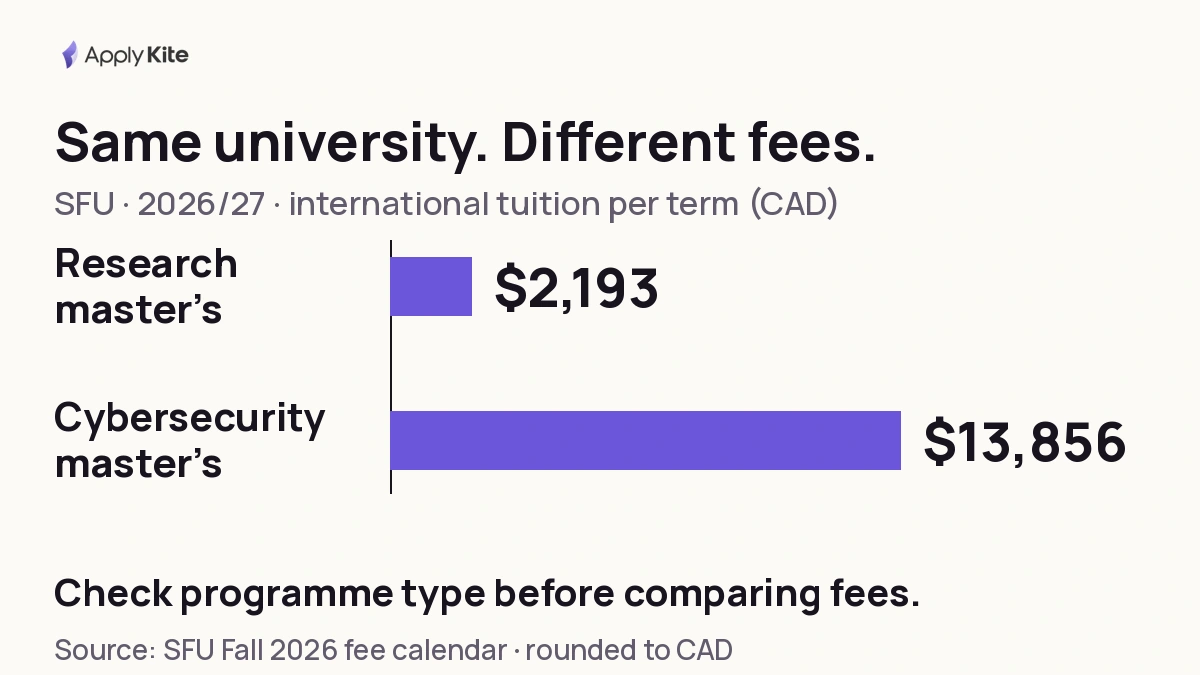
SFU shows the gap well. Its research programs charge a flat CAD 2,192.57 per term in 2026-27, and graduate students pay tuition in all three terms of the year: fall, winter and summer. That adds up to about CAD 6,578. SFU's course-based Master of Cybersecurity, on the other hand, charges international students roughly CAD 13,800 per term.
If you see master's courses listed as cheap, you need to check if they are research or course based. If you want to attend a course based master's course, you should expect to pay significantly more than shown in this table.
Why master's applicants have an easier route in 2026
Canada limits how many new study permits it issues. For 2026, the government planned for about 155,000 newly arriving international students, and most undergraduates also need a provincial attestation letter (PAL) before they can apply.
If you are starting a Masters or PhD at a public institution then you do not need to get a PAL. From January 1st 2026, Masters and PhD students are exempted from this cap. However, you will still be assessed by officers to ensure that you have the financial means to support yourself, and that you have appropriate plans. This exemption still lets you skip a step that slows many other applicants down.
Cheapest universities in Canada for undergraduate students
Undergraduate fees are higher everywhere, even at low tuition universities in Canada. Statistics Canada put the average for international undergraduates at CAD 41,746 in 2025/26. Each university below charges well under that for a standard degree.
Table 2: Cheapest universities in Canada for international undergraduates (2026-27)
| University | Province | Tuition per year (CAD, 2026-27) | Tuition + IRCC living funds (CAD) | Note |
|---|---|---|---|---|
| Université de Saint-Boniface | Manitoba | 14,345–16,455 | 37,793–39,903 | Taught in French; course fees only |
| Brandon University | Manitoba | 17,527–18,232 | 40,975–41,680 | Arts and humanities rate |
| University of Prince Edward Island | Prince Edward Island | 17,838 | 41,286 | Arts and humanities rate |
| Cape Breton University | Nova Scotia | 19,875 | 43,323 | Tuition plus international fee, 10 courses |
| University of New Brunswick | New Brunswick | 21,618 | 45,066 | Science degree |
| Memorial University of Newfoundland | Newfoundland and Labrador | about 22,500 | about 45,948 | New students |
| Mount Saint Vincent University | Nova Scotia | 23,215–23,667 | 46,663–47,115 | Includes fees; new students |
A quick word on Memorial. Some websites list Memorial's international undergraduate fee at around CAD 13,500. That's an older rate for students who started in 2021/22.

Also keep in mind that the Brandon and UPEI figures are for arts and humanities. Science, business and engineering programs often cost more, so look up the fee for your exact program.
How much money you need for your first year
Tuition is only one part of the cost of studying in Canada for international students in 2026. To get a study permit, you have to show IRCC that you can cover:
- one year of tuition
- one year of living costs
- travel to and from Canada
From 1 September 2026, the living-cost minimum for a single applicant is CAD 23,448. In Quebec, the figure is CAD 24,617. None of the universities in this guide are in Quebec.
At UPEI, the amount you'd need to show for one year (tuition plus the living-cost minimum) is about CAD 41,286, before travel. For a thesis-based master's at Memorial University, it's about CAD 28,281.
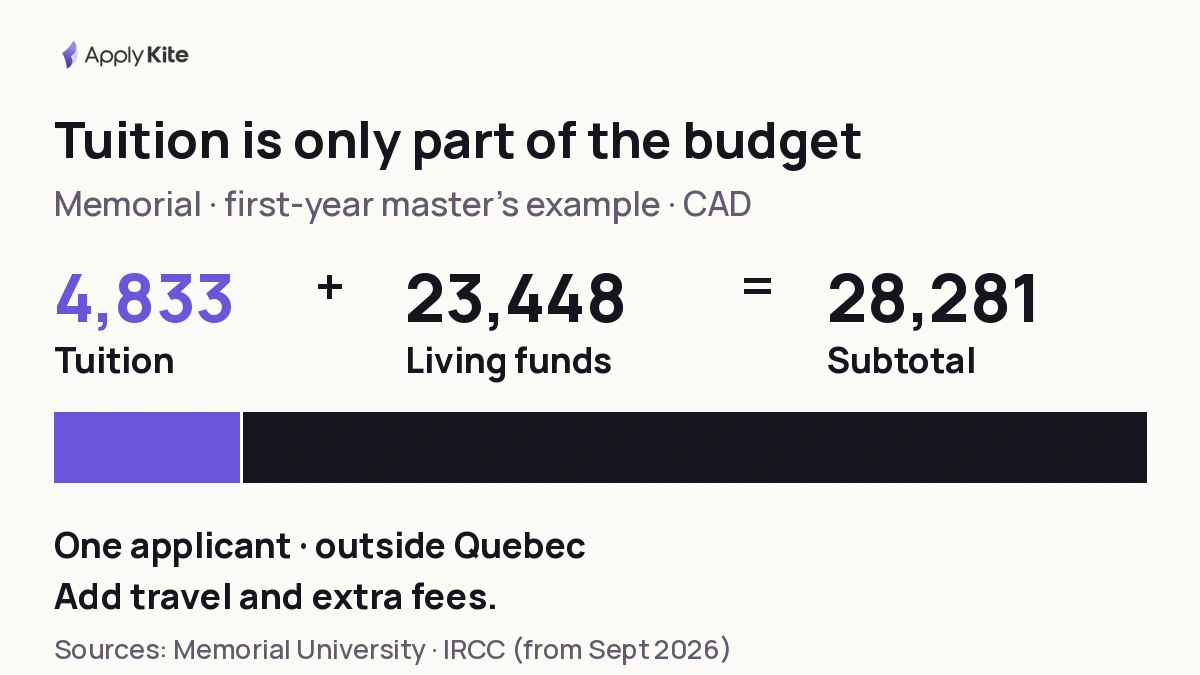
Therefore, even if there is a slight difference in tuition fees between two universities, it does not have as much of an impact. Although saving CAD 2000 can have a positive impact on costs, the remaining CAD 23,448 is the same if you are studying outside of Quebec. Additionally, the actual cost of living in a city may be higher than the minimum.
Deposits can catch you off guard too. Brandon University, for example, requires an upfront non-refundable payment of CAD 10,000 (undergraduate) or CAD 5,000 (graduate), before an offer is made. These payments are towards your tuition fees. You will therefore have to prepare this money many months in advance. Check refund and deposit policies at individual universities.
Here's a simple way to work out your own number for any university on your shortlist:
- Find the international tuition for your exact program on the university's fee page, and note the academic year it applies to.
- Check whether tuition is charged for two terms or three. Many graduate programs bill in summer too.
- Add CAD 23,448 for living costs, plus your return flight.
- Add any deposit or fees due before arrival, such as health insurance.
- Compare the total, not the tuition, against the money you can actually show.
If the total is close to your limit, look at the master's table again or at funded options. Being short on proof of funds is a common reason study permit applications run into trouble.
Cheap options to check before you apply
Lists of cheap universities in Canada rarely mention the catches. A low fee only helps if the program can take you where you want to go. If you want affordable universities in Canada with PGWP eligibility, check these three things before you commit.
1. Is the program in person?
Athabasca University has some of the lowest fees in Canada, but it's a distance university. According to their website, IRCC do not consider Athabasca University eligible to issue an acceptance letter for the study permit. Generally, if more than half of your program's courses are completed online, it won't count toward a post-graduation work permit (PGWP).
2. Can you study in the language of instruction?
Saint-Boniface is the cheapest option in our undergraduate table, but classes are in French. To apply for a PGWP after a bachelor's or master's degree, you need at least CLB 7 in English or NCLC 7 in French in all four language skills. If you choose a French-taught degree, plan to reach that level.
3. Is the low fee for your type of degree?
As the SFU example showed, cheap graduate fees usually belong to research programs, not course-based ones.
For undergrad degrees, the best value options are generally found in Manitoba and Atlantic Canada. For master's degrees, a funded research degree is often the best value, because funding can cover part or all of your tuition. The lowest listed fee isn't always the best deal.
Ways to pay less than the listed fee
Many research master’s degrees come with significant funding. At McMaster University, it is stated that most master’s research students get significant funding packages. This can come from research grants from your supervisor, working as a teaching/research assistant within a department, or scholarships. Reaching out to potential supervisors early can help significantly.
Some universities also offer fee exemptions. The University of Ottawa's Differential Tuition Fee Exemption Scholarship lets eligible international francophone and francophile students in bachelor's or master's programs pay a lower rate, closer to what Canadian students pay. There are specific criteria for each scheme, so make sure to check what they are!
How ApplyKite can help to study in Canada
Finding the cheapest universities in Canada for international students is one step. Getting in, and getting funded, is the harder part.
Use ApplyKite's opportunity search to look for funded positions, professors and scholarships at the bachelor's, master's, PhD and postdoc levels. If a research master's is your route to lower costs, finding the right supervisor is where it starts.
Through the ApplyKite mentor marketplace, you can choose a mentor based on where they studied, their degree level and their field. Mentors offer bookable services, such as help with converting your GPA, and their advice comes from having been through the process themselves.
Frequently asked questions
Cheapest universities in Canada?
If you're comparing the cheapest universities in Canada for international students, masters programs at Memorial University of Newfoundland stand out. In 2026-27, a thesis-based master's there costs around CAD 4,833 a year in tuition (published fees). However, if you want to study an undergraduate degree, then Université de Saint-Boniface offers the cheapest options in French. If you want to study in English, then consider studying at Brandon University or UPEI. Prices will vary depending on what degree you want to study.
Which province is the cheapest to study in Canada?
In 2025/26, Newfoundland and Labrador was the cheapest province to study in Canada for international students. International undergraduate students paid an average of CAD 18,867 and international postgraduate students paid CAD 6,964. Ontario had the most expensive tuition fees, where international undergraduates paid CAD 49,802. While the average fees may give you a general idea, there may be large differences between universities. For the best deals, consider checking the tuition fees of individual universities.
Is it cheaper to study in Canada than in the UK or Australia?
Yes, often. International students studying in Canada pay less than in other English speaking countries like the UK, USA and Australia. (EduCanada, 2026 data from Times Higher Education). However, it is important to consider the overall cost of studying. Many postgraduate courses in the UK are only one year long, whereas many postgraduate courses within Canada are 2 years.
Can international students study in Canada for free?
We could not find any public institutions in Canada offering free study to international students. However, if you choose a research-based masters or PhD, you may be able to earn scholarships or assistantships which may mean that your tuition is free. You would still need to prove that you have sufficient funds to support yourself (living costs) to obtain a study permit.
Are colleges cheaper than universities in Canada?
Sometimes. While diplomas at colleges can be cheaper, the requirements to obtain a PGWP may differ. In order to get a PGWP for a college graduate, you must score at least CLB 5. In addition, many college courses require you to be studying an eligible field of study. With university degrees, you do not need to study an eligible field of study. If you’re considering studying at a college in order to save money, make sure that you qualify for a PGWP with the course you are interested in.


