
The absolute best country to study abroad does not exist. The best country for you does. A prestigious degree is useless if you go bankrupt paying for your living expenses, or if your visa expires the day you graduate. You have to line up three specific things to make this happen. Your destination has to be dictated by your academic field, your total financial reality and your post-study career window. Here's the breakdown on how to find your match.
Short Answer
To choose a study abroad country, align your specific academic field with local employer demand, calculate the overall cost of attendance (tuition plus cost of living), and determine the length of post-study work visas available. Don’t pick a destination because it is highly ranked by universities. The best choice is the one that fits your budget and your legal right to stay and work after graduation.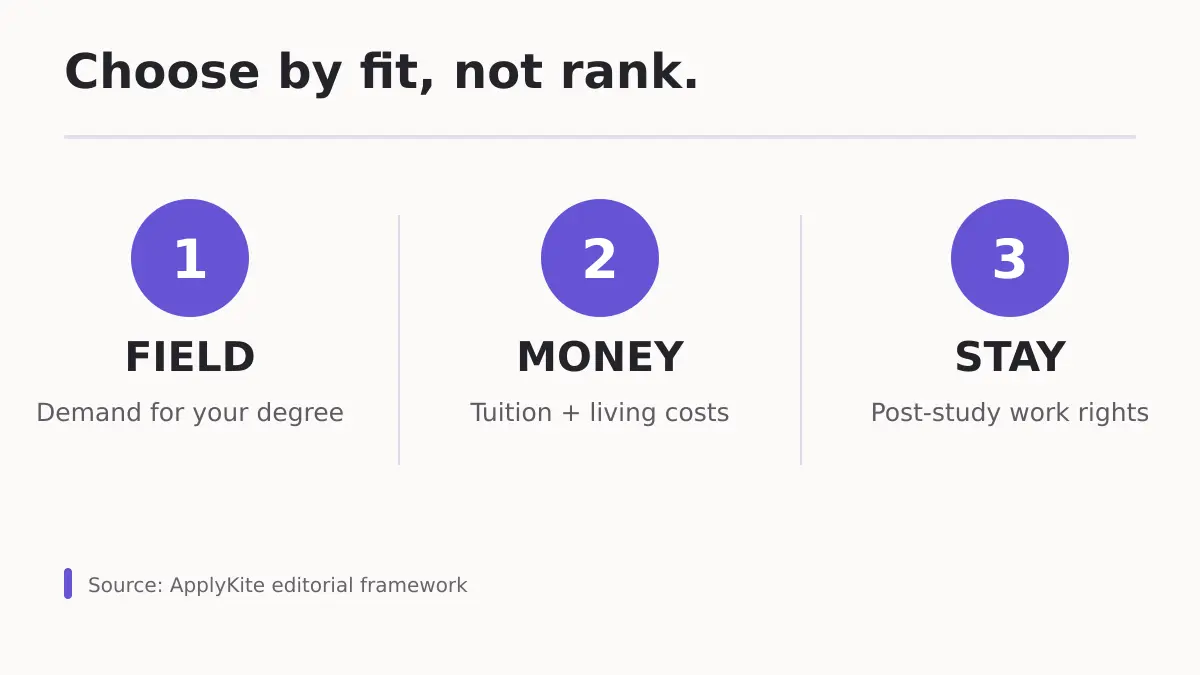
1. Let Your Field of Study Drive Your Destination
The rankings are so often deceptive. Your specific degree might be worthless in your local job market even if the university is internationally prestigious. The key is to identify a robust university-industry ecosystem. If you don’t have it, you’re fighting a losing battle.
- STEM and Engineering: The US and Germany typically dominate the landscape. Germany even lists IT, engineering, and medicine as critical shortage occupations directly on their Make it in Germany portal. That translates to structural hiring demand.
- Business and Finance: Business and finance operate differently. The UK and the Netherlands tend to offer the most extensive international networks. You'll find major financial and consulting hubs concentrated heavily in London and Amsterdam.
- Humanities: This gets tricky. Language creates a massive barrier. You will almost certainly struggle to secure a journalism or public administration position in France or Sweden without native-level fluency.
You need to see where the actual demand is. If you use the ApplyKite Positions tool, you can filter open academic opportunities specifically by Master's, PhD, or Postdoc levels across different locations. This shows you exactly which countries are actively funding and hiring in your exact field.

2. Crunch the Numbers: Tuition, Cost of Living, and Scholarships
Sticker price is rarely the total cost. A cheap degree is a bad investment if the rent is unpayable.
Public universities in countries like Germany and France heavily subsidize education. France charges non-EU students €2,850 to €3,941 annually for public university tuition. Germany often charges zero tuition, requiring only small semester contributions of €70 to €430. But rent in Munich or Paris will drain your budget fast.
On the other side, the US, UK, and Australia offer high career upside with steep tuition fees.
Total Cost Comparison (Estimates for 2026)
| Destination | Average Annual Tuition | Annual Proof of Funds Required |
|---|---|---|
| Germany | €0 - €1,500 (Public) | €11,904 (DAAD) |
| France | €2,850 - €3,941 (Public) | €7,380 (Campus France) |
| Canada | CAD $24,000 - $41,000 | CAD $23,448 (IRCC) |
| UK | £11,400 - £38,000 | £10,539 - £13,761 (GOV.UK) |
| Australia | AUD $20,000 - $55,000 | AUD $29,710 (Study Australia) |
Always budget your proof of funds amount or your actual rent, whichever is higher.
3. The Reality of Funded Opportunities: Match the Country to Your Readiness
Many students assume picking a destination is just about university prestige. But when you look at where the actual money is, the picture changes entirely.
Over the last 12 months, ApplyKite tracked thousands of fully funded academic openings worldwide. The data reveals a fascinating truth. Choosing a country is about matching your personal readiness to the specific demands of that market.
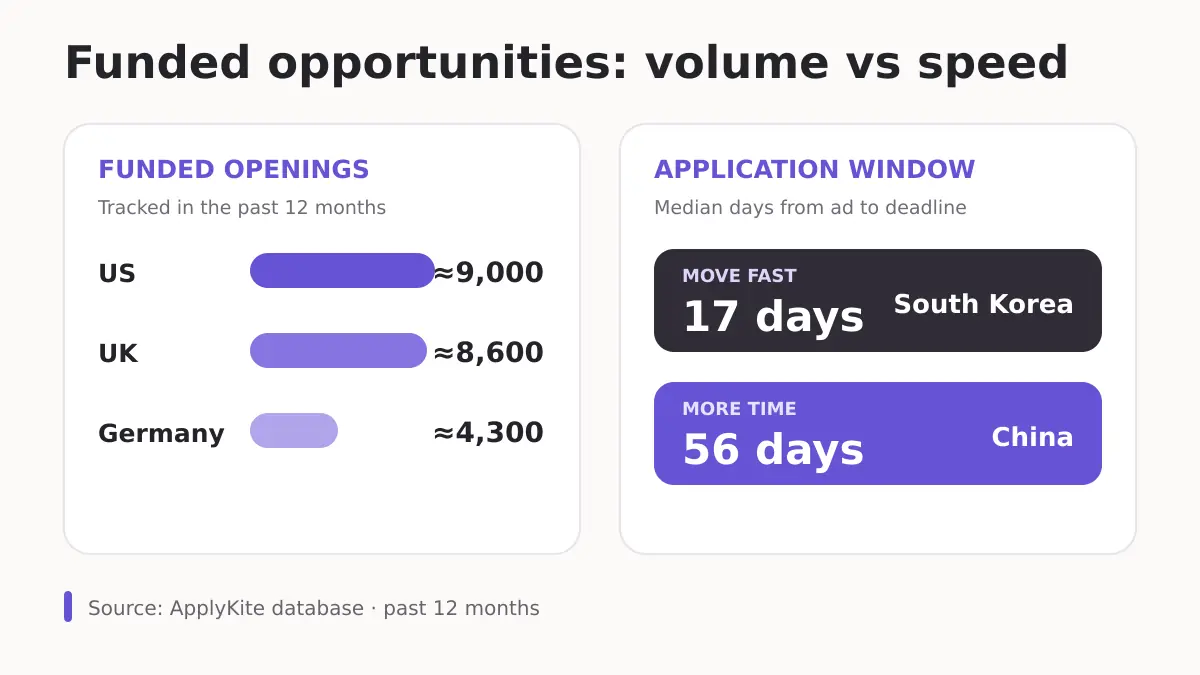
Look at the volume of opportunities. The US and UK dominate the supply, posting roughly 9,000 and 8,600 funded openings respectively. Germany follows with about 4,300. Smaller, wealthy markets like Luxembourg (522) and Singapore (302) offer fewer but highly concentrated spots.
But finding an open position is only half the battle. You have to consider how fast you need to move.
If you want to study in South Korea, your application needs to be ready today. The median time between a funded ad appearing and its deadline is a blistering 17 days. Ireland and Austria are right behind at 19 days. If you prefer a more patient process, China gives you 56 days to prepare your proposal, and Luxembourg offers a generous 50 days.
Then consider language tests. Haven't taken your IELTS or TOEFL yet? Look toward Switzerland or Austria. Only 2% and 3% of their ads demand an English test upfront. In contrast, 24% of UK advertisements require you to prove your English proficiency the moment you apply.
Finally, look at how long the funding actually lasts. In the Netherlands, advertised PhD funding averages four full years. France and Denmark lock you in for exactly three years. The UK is completely unpredictable, with funding periods split almost evenly between 3, 3.5, and 4 years.
4. Post-Study Work Visas: Can You Stay After Graduation?
A cheap degree is a bad investment if you are forced to leave immediately before gaining work experience. The graduate-to-career window dictates your long-term success.
Here is the 2026 landscape for staying after graduation:
- Germany: Graduates receive an 18-month job search permit. You can take any job while searching for qualified employment.
- United Kingdom: For applications submitted from January 1, 2027, the Graduate Route will be reduced to 18 months for Bachelor's and Master's students, down from two years. Doctoral graduates retain three years.
- Canada: The Post-Graduation Work Permit (PGWP) allows up to three years. Recent updates link college diploma eligibility to specific labor shortage fields, but university degree graduates remain exempt from field-of-study restrictions.
- United States: Standard Optional Practical Training (OPT) gives 12 months of work authorization. STEM degrees qualify for a 24-month extension, totaling 36 months.
- Netherlands: The Orientation Year visa offers 12 months of unrestricted work rights to find a sponsor.
Determine your end goal early. If immigration is your primary objective, prioritize Canada or Germany over the US.
5. Language Requirements: Do You Need to Speak the Local Language?
Many students think finding an English-taught degree solves everything. It doesn't.
You can study in English across most of Europe now. The Netherlands lists over a thousand English-taught Master's programs on their Study in NL portal, and Sweden is highly accessible for non-Swedish speakers. But what happens when you leave the classroom?
Buying groceries, signing a lease, or making local friends? That takes the local language. More importantly, landing a job usually requires it. We constantly see international students shocked that they cannot find a part-time job in Munich or Paris using only English.
If you plan to stay long-term, language learning isn't optional. It has to be part of your career strategy. If you know you struggle with languages, prioritize native English-speaking hubs like Australia, Canada, or Ireland.
6. A Quick Snapshot of Popular Study Abroad Destinations
Let's put the data into perspective. Here is how the major regions stack up based on recent immigration policies and international student data.
The US and UK (Maximum Academic Upside, High Cost)
These two dominate global academic rankings. They host the highest number of international students globally—over 950,000 in the US and 630,000 in the UK. Adaptability is incredibly easy for English speakers. But you pay a steep premium. Tuition is notoriously high, and the visa routes are fiercely competitive. The UK's Graduate Visa is shrinking to 18 months for non-doctoral students starting in 2027. The US H-1B system is basically a lottery.
Germany, France, and the Netherlands (Europe's High ROI)
This is where budget meets quality. Germany and France offer heavily subsidized tuition at public universities. The Netherlands is slightly more expensive for non-EU students but compensates with a massive English-speaking infrastructure. The catch? Housing shortages in cities like Amsterdam are severe. Plus, your long-term success in Germany or France depends heavily on reaching professional fluency in German or French.
Canada and Australia (Strong Pathways, Tightening Rules)
Historically, these were the absolute safest bets for permanent immigration. They still offer exceptional post-study work permits. But both governments are pulling back. Canada recently raised its single-student living funds requirement to CAD $23,448 and restricted spousal open work permits. Australia bumped its financial proof to AUD $29,710. They are fantastic options, provided you have the cash reserves.
Japan, South Korea, and Singapore (Asia's Tech Hubs)
Safety here is unmatched. According to global peace indexes, Singapore consistently ranks at the top. Japan and South Korea offer brilliant engineering and research facilities at a fraction of Western tuition costs. The tradeoff is cultural integration. The language barrier is high, and the corporate work culture is intense.

7. Your 5-Step Country Selection Checklist
Stop looking at random top-10 lists. Use this exact framework to eliminate options that do not fit your reality.
- Define your end goal immediately. Are you looking for a prestigious degree to take back home, a cheap way to get a Master's, or permanent citizenship? A country that satisfies one usually fails the others.
- Set a hard budget limit. Add average tuition, rent, groceries, and mandatory health insurance. Compare that total against the country's official proof of funds requirement. Drop any destination you cannot realistically fund for year one.
- Check local employability for your field. Don't look at national unemployment rates. Look at your specific degree. Does this country actively recruit foreign software engineers, or do they heavily protect local workers in your industry?
- Verify work visa rules. Can you work 20 hours a week while studying? How many months do you get to find a job after graduation?
- Assess the social reality. Check forums and speak to current students. Ask about loneliness, racism, and housing availability. A cheap country with zero available apartments is a nightmare.
8. Securing Your Spot: Connecting with Universities and Professors
Once you pick a country, the actual work begins. You have to find a program. For Master's and PhD candidates, you have to find a supervisor who actually has funding.
Cold emailing hundreds of random academics rarely works. You need to target people actively looking for researchers. You can use ApplyKite's Explore Professors and Research Supervisors database to filter academic staff globally based on your specific research interests and their active grants.
From there, your outreach needs to be flawless. Instead of staring at a blank screen, you can use kiteAI to help draft personalized email correspondence, customize your CV, and structure your Statement of Purpose (SOP) based directly on a specific professor's recent publications.
FAQ
Which country is the easiest to study abroad?
"Easiest" normally translates to good English skills, simple visa procedures, and straightforward university admissions. New Zealand & Ireland are ranked ridiculously high here. There is no language barrier and their immigration websites clearly state what the students need without all the bureaucratic nonsense.
Which country gives 100% scholarships?
No country hands out money unconditionally. However, government-backed programs provide fully funded rides. Look into the MEXT scholarship in Japan, DAAD in Germany, and the Eiffel Excellence Scholarship in France. Many US universities also offer full tuition waivers plus stipends for STEM PhD researchers.
What is the best country for studying abroad after 12th grade?
Bachelor’s degrees are hugely popular in the UK and Canada. In the UK you study for three years as an undergraduate, saving a year in tuition and living costs compared to the US. Canada has a very straightforward move from a bachelor’s degree straight into a Post-Graduation Work Permit.
Make Your Decision and Take the First Step
Look at the checklist above. Run your finances. Pick two or three countries that actually fit your profile, and stop worrying about the rest. The sooner you narrow your focus, the sooner you can start preparing a strong application.
If you feel stuck, you don't have to figure it out alone. ApplyKite provides Mentoring and Application Support, ranging from one-on-one consulting for university selection to full-service application management. You work directly with mentors who have real experience in your academic field. Find the right destination, get your documents in order, and send that first email.