CSC Scholarship 2027: Requirements, Funding & Deadlines
ApplyKite Editorial
Author

If you've looked into studying in China on a full scholarship, you've probably come across the CSC. But what exactly is it, and how do you apply?
The Chinese Government Scholarship (CSC) isn't one scholarship with a single application process. It covers several programs, including the Bilateral Program, Chinese University Program, Great Wall Program, and EU Program. Each has its own application route, deadlines, and selection criteria.
This guide breaks down the main options, explains what the scholarship actually covers, and walks you through how to apply for the 2027 intake without missing the deadlines that matter.

What Is the CSC Scholarship?
The China Scholarship Council (CSC) is the government body responsible for administering Chinese Government Scholarships for international students and scholars. But the CSC Scholarship isn't one single program with one application process.
There are several routes. The Bilateral Program (Type A) generally involves applying through a designated authority in your home country, such as a government scholarship agency or Chinese embassy. The Chinese University Program (Type B), by contrast, requires you to apply directly to a participating Chinese university. Other options include the Great Wall Program, EU Program, AUN Program, and schemes linked to specific regions or international organizations. Each has its own eligibility requirements and application channel.
Choosing the right route matters. Your nationality, intended degree, target university, and sometimes your field of study can determine which programs you qualify for.
Deadlines vary, too. There's no single date that applies to every CSC application. The timeline depends on the program and the authority or university handling your application, so the first step is to identify the right route for the 2027 intake.
Table 1: Chinese Government Scholarship programs: overview of the Main application categories
| Category | Program | Application route |
|---|---|---|
| Type A | Bilateral Program | Designated authority in your home country, such as a government scholarship agency or Chinese embassy |
| Type B | Chinese University Program | Directly to a participating Chinese university |
| Type C | Other or institution-specific arrangements | Follow the relevant university or scholarship authority's instructions |
Why Study in China?
There are four good reasons to consider studying in China.
- Its universities are gaining global recognition: Tsinghua, Peking, Fudan, and Shanghai Jiao Tong have built strong international reputations, with several ranking among the world's leading universities.
- Your money can go further: Living costs are generally lower than in the UK, US, and much of Western Europe, although expenses vary by city. A scholarship can make studying there even more affordable.
- You don't always need to speak Chinese: Many universities offer English-taught master's and PhD programs, particularly in fields that attract international students. Check the language requirements for your chosen course before applying.
- You can build experience that's useful beyond the classroom: China plays a major role in global trade, manufacturing, engineering, and technology. Studying there can help you understand the market and build connections relevant to careers in these areas.

CSC Scholarship Eligibility for 2027
To apply for a Chinese Government Scholarship, you generally need to be a non-Chinese citizen in good health and meet the academic, age, and language requirements of your chosen program. The exact criteria can vary by scholarship route and university.
Age limits commonly used in CSC scholarship notices are:
- Bachelor’s: Under 25
- Master’s: Under 35
- PhD: Under 40
- General Scholar: Under 45
- Senior Scholar: Under 50
You’ll also need the appropriate previous qualification: a high school diploma for a bachelor’s, a bachelor’s degree for a master’s, or a master’s degree for a PhD. Individual programs may set additional conditions.
- Academic performance matters, but there is no single GPA cutoff for every CSC scholarship. Universities assess grades according to their own admission standards, alongside factors such as research experience, recommendation letters, and your study or research plan.
- For language proficiency, Chinese-taught programs may require an HSK certificate, while English-taught programs may ask for IELTS, TOEFL, or other proof of English proficiency. Check the requirements for your specific course rather than assuming one score applies everywhere.
- An important update for undergraduate applicants is that the China Scholastic Competency Assessment (CSCA) has been introduced into the Chinese Government Scholarship application process for the 2026/27 cycle. If you’re applying for the 2027 intake, check the latest official scholarship notice and your university’s instructions to confirm the required subjects, test arrangements, and submission deadline.
- Finally, check the rules for your application route. Embassy-based scholarships may have country-specific quotas and deadlines, while university-based programs follow the participating university’s requirements. Previous scholarship status, nationality rules, and other eligibility restrictions can also affect your application.
What CSC Covers
Table 2: CSC Scholarship Funding at a Glance
| Component | Amount / Detail |
|---|---|
| Tuition | Full waiver |
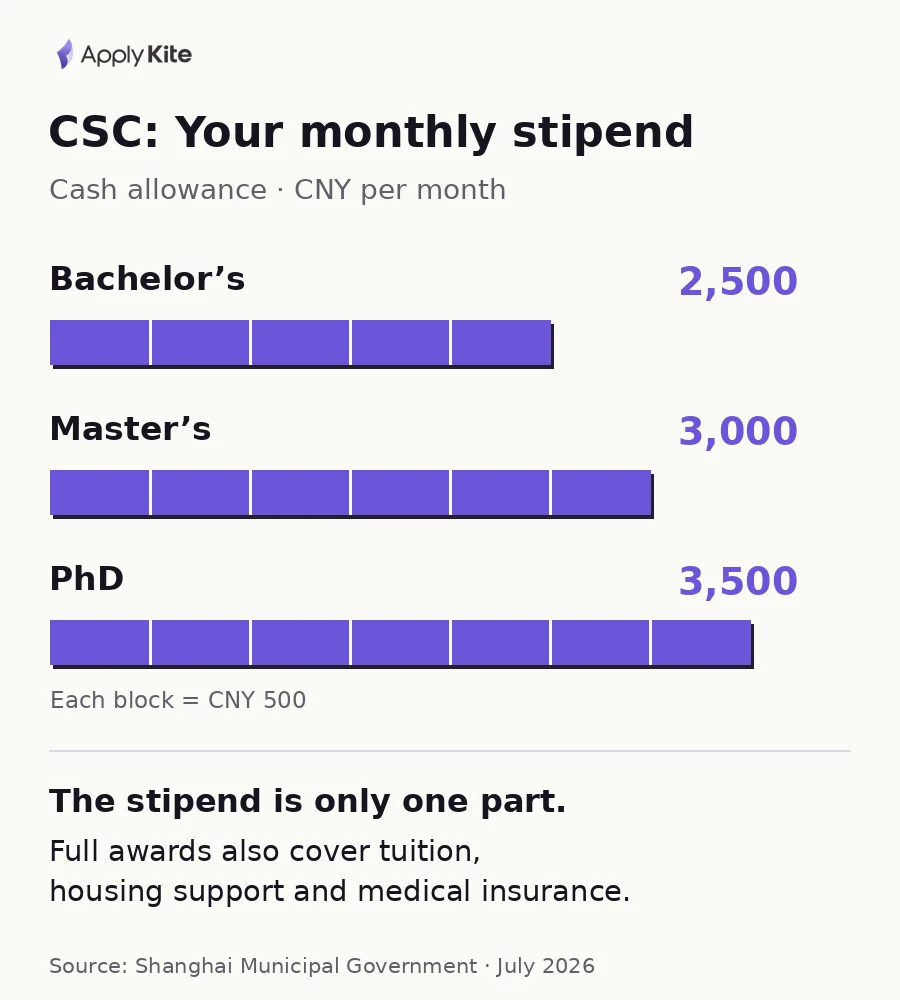
| Monthly stipend | CNY 2,500 (bachelor’s) / CNY 3,000 (master’s and General Scholar) / CNY 3,500 (PhD and Senior Scholar) |
| Housing | Free university dormitory, or an accommodation subsidy |
| Medical insurance | CNY 800/year (CNY 400 for programs under 6 months) |
| Flights | Not covered |
What the CSC Scholarship May Not Cover
Before you count on CSC to cover every expense, there are a few things to keep in mind.
MBA programs: MBA is the one people most often get wrong: CSC isn’t excluded from MBA study. You can apply for CSC funding for an MBA at some universities, including Tsinghua and Tongji. The problem is the cost. MBA tuition is often much higher than that of a regular master’s degree, and the scholarship may cover only part of the fees. You could still face a substantial bill, so check the university’s funding terms before applying.
MBBS and clinical medicine: Scholarships are available through some medical universities, but funding is limited. Many international students in Chinese MBBS programs pay their own fees. If you’re planning to study medicine, look for a confirmed scholarship specifically for your program rather than assuming CSC will cover everything.
Family expenses: CSC scholarships do not provide additional funding for a spouse, partner, or children. If you plan to bring your family to China, you’ll need to budget for their living costs separately. Visa and residence arrangements are also a separate matter.
Stipend during extended absences: Leaving China for a long personal trip can affect your stipend. Some universities suspend payments if you’re absent for more than about 15 days outside scheduled holidays, although the rules and how they’re enforced can vary. Check your university’s scholarship regulations before making travel plans.
What You’d Pay Without CSC (Tuition and Cost of Living)
Studying in China can be much cheaper with a CSC scholarship, but costs depend on where you study and what you study.
At public universities, standard bachelor’s and academic master’s programs typically cost around $2,500–10,000 a year without funding. Professional degrees and MBAs can cost considerably more. For example, Peking University’s Guanghua MBA and Tsinghua’s professional master’s programs sit well above standard tuition rates. Foreign-branded campuses are pricier still: NYU Shanghai’s published 2026–27 cost of attendance approaches $92,000 a year.
Living costs depend largely on your city and housing. Beijing, Shanghai, and Shenzhen are generally more expensive, while smaller cities can be easier on your budget. University dorms are usually the cheapest option, at roughly $150–400 a month. Private apartments can cost $300–1,000 or more, depending on location.

So, how far does the CSC stipend go? The monthly allowance of CNY 2,500–3,500 (roughly $350–500) can cover a modest, dorm-based lifestyle in many cities, but you may need extra money in Beijing or Shanghai. The tuition waiver is often the biggest saving, especially for expensive programs.
Treat these figures as a starting point. Once you choose a university, check its current tuition fees, accommodation costs, and local living expenses before setting your budget.
CSC Scholarship 2027 Deadlines
There’s no one deadline for the CSC Scholarship. Each application route follows its own schedule, and dates can differ by country or university. Use the timelines below to plan ahead, but always confirm the exact deadline with your local Chinese embassy or chosen university before submitting your application.
Table 3: CSC Scholarship 2027 Key Dates (by Program Type)
| Program | Typical Application Window |
|---|---|
| Bilateral Program (Type A) | January–February (some countries’ windows run as late as early April, check with your dispatching embassy) |
| Chinese University Program (Type B) | January–end of March (some universities open as early as November, so don’t assume a January start) |
| Great Wall / EU / PIF Programs | Early January–early April |
| AUN Program | November–January |
| Confucius Institute Scholarship | Opens March 1; deadline depends on intended start month (roughly mid-May for a September start, end of October for a March start) |
Note: Deadlines vary by year, country, and university. Confirm dates with both your Chinese embassy and target university, as Type A and Type B deadlines can differ significantly.
How to Apply for CSC Scholarship 2027: Step by Step
Applying for the Chinese Government Scholarship may seem complicated at first, especially if you’re unfamiliar with the application system. The good news is that the process becomes much easier when you break it down into manageable steps. This is how to get started and move from choosing a university to preparing for your studies in China.
- Choose your application route and university: Decide between the Bilateral Program (Type A), usually handled by an embassy or designated authority, and the Chinese University Program (Type B). Then select a participating university and suitable degree program.
- Contact a potential supervisor: If you’re applying for a master’s or PhD, reaching out to a professor in your field may strengthen your application. A pre-admission letter is not always required, but it can be an advantage.
- Register on the CSC portal: Create an account and enter the correct agency number provided by your embassy or chosen university.
- Prepare and upload your documents: These usually include academic transcripts, degree certificates, a study plan, recommendation letters, and language proficiency certificates. Check the specific requirements for your program.
- Submit before the deadline: Type A applications follow the designated authority’s instructions, while Type B applications are submitted through the university. Deadlines vary, so confirm them in advance.
- Wait for the results: Scholarship decisions are often announced around June or July, depending on the university and application route.
- Arrange your visa and travel: Once accepted, follow your university’s instructions to obtain your admission documents and apply for the appropriate student visa. X1 is generally for degree programs lasting more than six months, while X2 is for shorter stays.
Convert Your Grades to China's Grading System with Kite AI
If your target university asks for a GPA or percentile conversion as part of your transcript review, ApplyKite's Kite AI converts your existing grades into the scale your program actually uses, so you're not guessing at how your academic record reads to a Chinese admissions committee.
Table 4: Documents Required for CSC Scholarship 2027
| Document | Notes |
|---|---|
| Passport | Valid for the duration of your intended stay |
| Notarized diploma and transcripts | Translated if not already in Chinese or English; transcripts should cover every semester from your most recent degree onward |
| Study plan or research proposal | Typically needs to run at least 1,000 characters or words. Its better to confirm the current requirement with your program, since length rules do vary by degree level |
| Two professor recommendation letters | Required for postgraduate and Senior Scholar applicants, generally from professors or associate professors |
| Language certificate | HSK for Chinese-taught programs (commonly Level 3 or 4 depending on degree level), IELTS or TOEFL for English-taught programs. Some universities set a specific minimum score rather than leaving it open |
| Foreigner Physical Examination Form | Required for stays over 6 months |
| Non-criminal record certificate | Typically must be issued within 6 months of submission, from your local public security/police authority |
| Supervisor pre-acceptance letter | Strongly recommended (not always mandatory) for graduate applicants |
Getting Your Student Visa (X1 vs. X2)
For most students receiving a Chinese Government Scholarship (CSC) for a full-degree program, an X1 visa is required for studies lasting more than six months. After arriving in China, students must register with their university’s international student office within 30 days, complete the required medical examination, and apply to convert their visa into a residence permit.
Once the residence permit is issued, they can leave and re-enter China while it remains valid. In contrast, the X2 visa is intended for short-term study programs lasting no more than six months and does not require a residence permit. The permitted length of stay is determined by the visa itself. Therefore, students planning to pursue a full-degree program in China should generally apply for an X1 visa rather than an X2 visa, as these two visa categories are often confused.
Common Mistakes That Rule Applicants Out
- Ignoring the required application sequence: Certain scholarship routes require nomination by an embassy or sponsoring organization before you submit your university or CSC application. Skipping this step could lead to rejection.
- Providing unnecessary HSK certificates: Chinese proficiency certificates are generally required for Chinese-taught programs, whereas English-taught courses usually accept other proof of English proficiency.
- Accepting more than one scholarship: Although you may apply through multiple routes, you cannot hold two CSC scholarships simultaneously.
- Overlooking different application deadlines: Embassy and university deadlines often fall on different dates. Keep track of both carefully to avoid missing an essential submission window.
Frequently Asked Questions
1. What is the acceptance rate for the CSC Scholarship?
The CSC does not publish official acceptance rates. Unofficial estimates suggest an overall rate of around 20%, rising to 25–30% at some less competitive universities and falling to 10–15% at highly selective institutions such as Tsinghua and Peking University.
2. Can I work while receiving the CSC Scholarship?
Yes, international students may work on or off campus with the required university and immigration approvals. Eligibility, working-hour limits, and permit requirements apply, so students should confirm the latest regulations before starting employment.
3. How are CSC Type A and Type B applications different?
Type A applications go through the Chinese embassy or designated authority in your home country. Type B applications are submitted directly to a participating Chinese university. The best route depends on your nationality, chosen university, and available scholarship program.
4. Do I need to know Chinese to receive the CSC Scholarship?
No. Many programs are taught entirely in English. Chinese-taught programs require the relevant HSK qualification, while some universities offer preparatory Chinese language courses for eligible scholarship recipients.
5. When are CSC Scholarship results announced?
Results for the main Bilateral and Chinese University programs are generally announced in June or July. Timelines vary by program and university, so check with your sponsoring authority for the latest updates.
6. Can I apply to multiple universities for the CSC Scholarship?
Yes. The main CSC application system generally allows up to three university preferences, subject to program rules. For Type B, you typically need to submit a separate application to each university.
7. Is the CSC Scholarship renewed every year?
The scholarship usually covers the full program duration, but continued funding depends on an annual review of academic performance, attendance, and conduct. Failing to meet the requirements may lead to suspension or termination.
8. Which universities are best for the CSC Scholarship?
Popular choices include Tsinghua University, Peking University, Zhejiang University, Fudan University, Shanghai Jiao Tong University, USTC, and Harbin Institute of Technology. Competition can be intense, so consider universities that match your academic profile and research interests.
9. Can I bring my family to China on the CSC Scholarship?
Yes, eligible family members may accompany you, but their expenses are generally not covered by the scholarship. Depending on the length of their stay, they may need an S1 or S2 visa.
10. Can I apply again if my CSC Scholarship application is rejected?
Yes. You can generally reapply in a future application cycle. Use the experience to strengthen your academic profile, study plan, and recommendation letters, and always disclose previous scholarship awards when required.


