
F1 Visa Rule Updates for 2027; What International Students Need to Know
The days of open-ended student visas were supposed to be over. The Department of Homeland Security tried to rewrite the rulebook for international education, and the proposed shift was massive. If you hold an F-1 or J-1 visa, you probably saw the panicked headlines about fixed expiration dates.
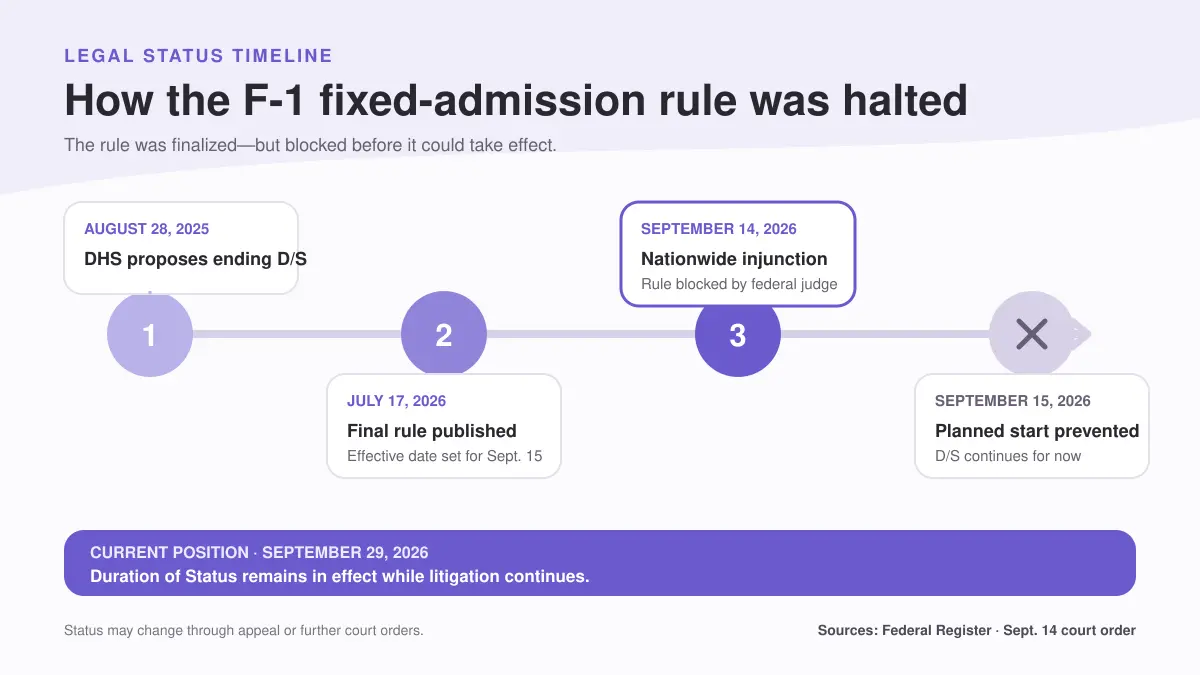
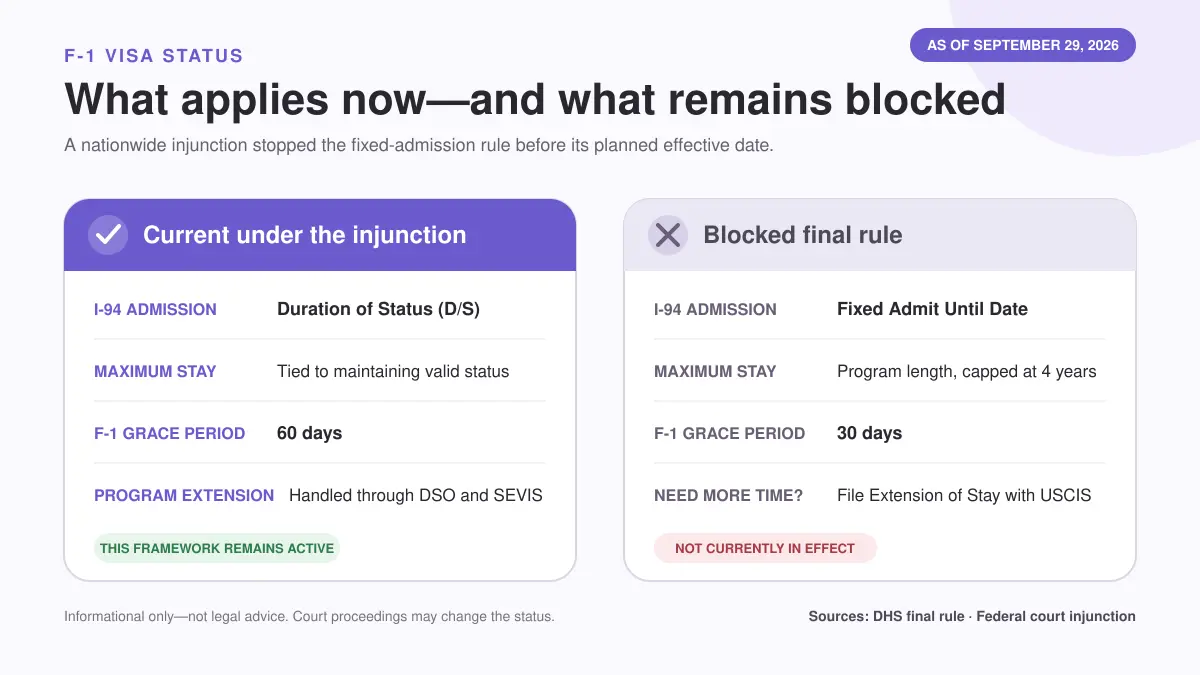
Take a deep breath. On September 14, 2026, just one day before the rule was set to take effect, a federal judge blocked the DHS rule nationwide (NAFSA's legal challenge and injunction update). As of right now, "Duration of Status" (D/S) is still fully in effect.
But lawsuits are unpredictable. If the government wins an appeal, the shift will be immediate. The government clearly wants more direct oversight over how long you stay in the United States. Let's break down exactly what is true right now, what was supposed to happen, and how to prepare your degree for the uncertainty.
Short Answer: What to Know (Major Changes at a Glance)
If you just want the bottom line on the DHS final rule and its current legal status, here is what is happening:
- D/S is still active (For now). A federal judge paused the rule on September 14. You are still admitted for Duration of Status.
- If the rule survives, D/S vanishes. It would be officially replaced by a Fixed Time Period of Admission.
- Stays would be strictly capped. Admission would be limited to your program length or a maximum of 4 years.
- The grace period drops. The post-graduation departure window would be cut from 60 days down to 30 days.
- Strict transfer bans. Graduate students would face strict bans on changing programs or transferring schools.
- No reverse degrees. Pursuing a new program at the same or lower educational level would be completely prohibited.
- Language programs capped. English language training programs would be strictly capped at a 24-month maximum.
Looking for fully funded?
Discover PhD, Master's, and Postdoc positions tailored to your goals with ApplyKite's smart AI tools.
The Proposed End of "Duration of Status" (D/S)
For decades, border agents stamped F-1 passports with "D/S." As long as you stayed enrolled full-time and your university kept your SEVIS record active, you were legally allowed to stay in the country.
The DHS final rule attempted to erase that system.
If the injunction is lifted, Customs and Border Protection (CBP) will assign a specific "Admit Until Date" (AUD) on your official I-94 record. You would be admitted strictly until your program end date, and they would never issue an AUD longer than four years. If you happen to change your status internally, USCIS will issue this date on your Form I-797A.
The Threatened 30-Day Grace Period
When you finish your degree, the clock ticks faster under the proposal. The standard 60-day departure window for F-1 students would drop to just 30 days. J-1 students already have a 30-day grace period, so that stays the same regardless.
Transition Rules: If You Are Already in the U.S.
Before the lawsuit paused everything, the rule stated that students entering the U.S. before September 15, 2026, would get a temporary pass. They would keep their D/S status until their program finishes, or until November 14, 2030, whichever happens first.
But there was a massive catch. If you traveled internationally at any point, you instantly lost that protection. When you re-entered the U.S., CBP would hit you with a fixed admission date. Keep watching the courts, if the rule takes effect, traveling could trigger these exact restrictions.
Could You Still Change Your Major or Transfer Schools?
Usually, students change their minds. You start a program, realize the lab culture is toxic, and switch to a different department.
Under the new regulations, that flexibility would be mostly gone.
Undergraduates would be completely locked from transferring schools or switching majors during their first year. For graduate students, the rules are even harsher. You would face a strict ban on changing educational objectives or transferring schools at any point during your degree, unless the Student and Exchange Visitor Program (SEVP) grants a rare exception.
Reverse progression would also be banned. You could not finish a Master's degree and then drop down to a Bachelor's degree, or even start a second Master's. You must progress upward to a higher degree level.
Because you would be essentially locked into your initial choice, finding a supervisor who actually has funding and aligns with your research goals is no longer just a preference. You can use ApplyKite's professor search to research potential supervisors before committing to a program. It is an immigration necessity.
If you are applying for grad school right now, guessing which professor has active grants is too risky. This is where personalized application guidance helps. You can use a service like ApplyKite to map out professors with open funding. They offer mentoring packages for Master's, PhD, and Postdoc applicants, meaning you can work with someone who has real academic experience to help you lock in a secure, compliant research path before you ever apply for your visa.
Special Considerations for PhD Students & J-1 Scholars
Most PhDs take five or six years. If the government caps admission at four years, what happens to doctoral students?
You wouldn't get kicked out automatically. Four years is simply the single-entry maximum. To finish your degree, you would have to actively apply for an Extension of Stay (EOS) before your I-94 expires.
This would apply equally to J-1 Exchange Visitors. Researchers, short-term scholars, and professors; along with their J-2 dependents, are all subject to these strict 4-year caps and the shortened 30-day grace period.
How to File for an Extension of Stay (EOS)
In the past (and currently), extending your stay just means asking your Designated School Official (DSO) to print a new I-20.
If the rule survives the courts, you have to ask the federal government.
You must file Form I-539 directly with U.S. Citizenship and Immigration Services (USCIS). And they don't approve these automatically. You need a compelling academic or medical reason, like unexpected research delays or a documented illness. If you need an extension because you were put on academic probation, USCIS will likely deny it.
Budgeting for 2027: New USCIS Premium Processing and Integrity Fees
Extensions are expensive. If you need a fast answer, premium processing for Form I-539 now costs $2,075. Premium processing for work authorization (Form I-765) sits at $1,780.
On top of that, a new law authorizes a $250 Visa Integrity Fee whenever a new visa is issued. Studying in the U.S. just became significantly more expensive, completely separate from the D/S lawsuit.
Handling OPT, STEM OPT, and Academic Training
So, how would the new F1 visa rule affect OPT?
If you want to work after graduation, the actual OPT program still exists. But if the fixed admission framework goes live, the paperwork doubles.
If you apply for OPT or J-1 Academic Training after the rollout (originally scheduled for March 18, 2027), you would have to submit an Extension of Stay (Form I-539) right alongside your work authorization request (Form I-765).
The 240-Day Employment Rule While Pending
USCIS is notoriously slow. What happens if your I-94 expires while you wait for your extension? You can check current case estimates on USCIS processing times.
If you file your EOS before your Admit Until Date expires, you can keep working (on-campus, CPT, or hardship employment) for up to 240 days while the application sits in processing.
But here is the catch. If you wait and file your EOS during your 30-day grace period, you must stop working immediately. You cannot resume employment until USCIS officially approves the extension.
The Return of Mandatory In-Person Consular Interviews
Unlike the D/S rule, this change is actively happening right now. Think back to the pandemic-era interview waivers. They are officially over.
Starting in late 2025, the government rolled back interview waivers, as reflected in the Department of State's September 2025 interview-waiver update. Almost all F-1 and J-1 applicants, even those just renewing the exact same visa, have to schedule and attend an in-person interview at a U.S. embassy or consulate.
What to Expect: Enhanced Social Media Vetting on the DS-160
Consular officers are looking closely at your digital footprint. When you fill out Form DS-160, you have to list every social media handle you used over the past five years. Officers will check to see if your public posts align with your stated academic goals.
Walking into a consulate with a vague admission letter is a bad idea. Having a highly targeted, fully funded offer from a specific professor makes proving your academic intent much easier. You can use ApplyKite's Positions search tool to find verifiable, funded opportunities. Their AI helps you generate highly specific, research-focused outreach emails, helping you build a solid paper trail of pure academic intent long before your interview.
Good News: USCIS Updates Policy on Dual Intent
We have covered a lot of heavy restrictions. Let's look at a genuine positive that is actually in effect.
For a long time, international students lived in fear of "immigrant intent." If a company filed a green card petition for you, the government usually assumed you planned to abandon your student status.
USCIS finally clarified this. The updated USCIS Policy Manual states that you can be the beneficiary of a pending permanent labor certification (PERM) or an I-140 immigrant petition and still maintain your F-1 status. You just have to show you still intend to leave at the end of your currently authorized temporary stay.
Warning: Consular and CBP Discretion Still Applies
Don't get careless. USCIS handles applications inside the U.S., but Customs and Border Protection (CBP) and the State Department operate independently. A consular officer abroad can still deny your visa if they suspect you secretly plan to immigrate. If you have a pending green card petition, talk to an immigration attorney before you board an international flight.
FAQ: Answers to Your Top F-1 and J-1 Visa Questions
Is there a lawsuit blocking the new F1 visa rules?
Yes. On September 14, 2026, a federal judge issued a nationwide injunction blocking the DHS fixed admission rule. As of today, "Duration of Status" (D/S) remains fully in effect. However, litigation is ongoing, so you must prepare your academic timeline in case the government wins its appeal.
When was this DHS rule officially published?
The government published the final rule in the Federal Register on July 17, 2026. It was supposed to take effect September 15, 2026, before the courts stepped in.
Which specific visa categories are impacted by these regulations?
If implemented, this overhaul hits almost everyone in the academic system. It applies to F-1 students, J-1 students, J-1 scholars, professors, and interns. It also completely applies to all F-2 and J-2 dependent family members.
How do leaves of absence or medical withdrawals work under the fixed admission rule?
University policies still dictate your academic leave, but if the rule survives, the immigration impact becomes much stricter. You must consult your international office immediately because taking a leave might force an early expiration of your Admit Until Date.
What is the 5-month rule for F-1 visa?
If you leave the U.S. for more than five months and fail to maintain active enrollment, your SEVIS record is terminated. See the SEVP travel guidance for the current re-entry rules. To come back, you have to get a new I-20 and pay the SEVIS fee all over again.
Does the new H1B rule apply to F-1 visa holders?
No. The F-1 and H-1B visa categories run on separate regulations. The good news? The "Cap-Gap" extension remains untouched, meaning your status is protected if you transition from OPT to a timely-filed H-1B petition.
What are the F-1 visa semester break rules?
You have to enroll full-time during the fall and spring semesters. Summer is generally considered an authorized break where you can work or rest, unless your very first semester at the university begins in the summer (which requires full-time enrollment immediately).