
You have a bachelor's degree, and now you want to specialize. You look at university websites, and suddenly you are drowning in acronyms. What is the actual difference between an MSc and an MRes? Does a Postgraduate Diploma even count as a master's?
Let's fix this confusion right now.
We need to look at what these degrees mean, which ones get funded, and what hiring committees actually demand. If you are trying to map out your next year, checking a master's application timeline post is a smart move. But first, let's pick the right degree.
MSc vs MA vs MRes vs Postgraduate Diploma at a Glance
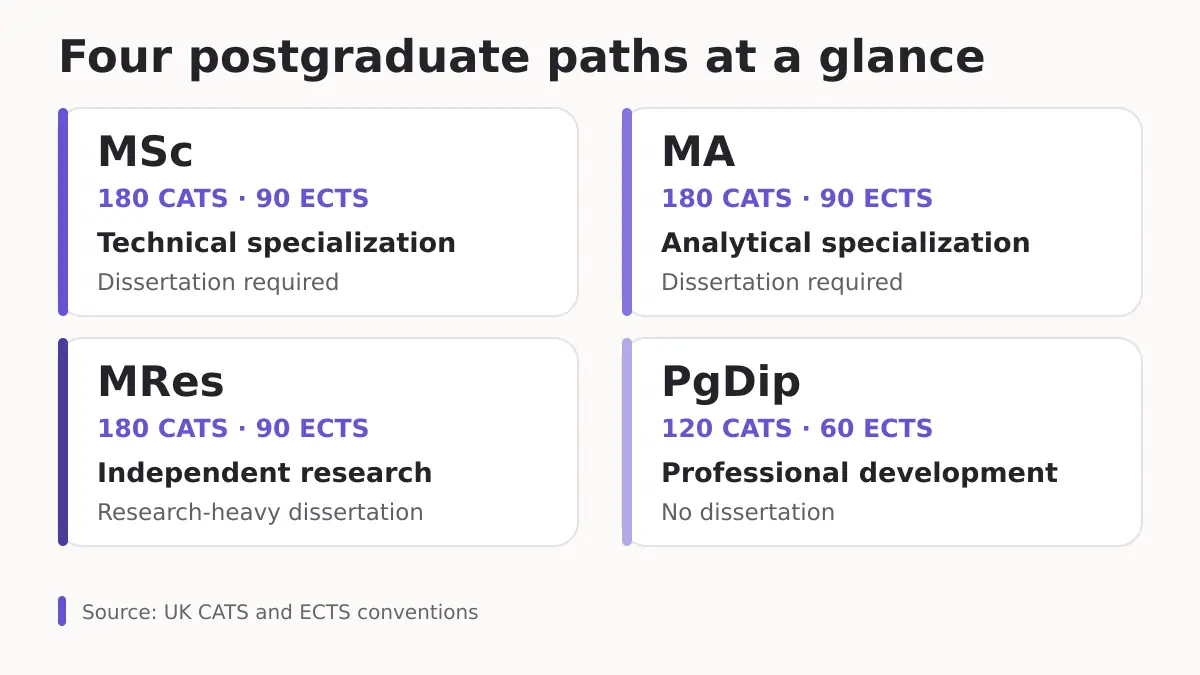
The UK and European systems use credit systems to measure the academic workload. In the UK you use the Credit accumulation and transfer system (CATS). In Europe, universities use the European Credit Transfer and Accumulation System, or ECTS for short. Two UK CATS credits equal exactly one ECTS credit.
Here is how the degrees compare:
| Award Type | Total UK Credits (CATS) | Equivalent ECTS Credits | Core Purpose | Dissertation Required? |
|---|---|---|---|---|
| Master of Science (MSc) | 180 | 90 | Advanced technical or scientific specialization | Yes |
| Master of Arts (MA) | 180 | 90 | Advanced analytical or theoretical specialization | Yes |
| Master of Research (MRes) | 180 | 90 | Training for substantial independent research | Yes (Heavy emphasis) |
| Postgraduate Diploma (PgDip) | 120 | 60 | Shorter postgraduate professional development | No |
What Each Degree Means (and How Long They Take)
Let's break down the practical differences.
Master of Science (MSc)
The focus is on science, technology, math and applied fields. To graduate with an MSc, 180 UK credits or 90 ECTS are required. In the UK it usually takes one year full-time and in mainland Europe often two years. You go to lectures, do assignments and end with a major research dissertation. It is the standard technical postgraduate route.
Master of Arts (MA)
The MA has precisely the same academic structure as the MSc. You still have to complete 180 UK credits or 90 ECTS and you still complete a final dissertation. The difference is the material. You’ll find MAs in the humanities, social sciences, fine arts and theoretical fields. You read more. Write more. Argue more.
Master of Research (MRes)
Here is where things shift. The MRes is a different beast. It carries the same credit weight as an MSc, but the balance changes completely. Instead of spending most of your time in classrooms, you focus on independent inquiry. A massive portion of your credits comes from a major research project. This degree exists to train future researchers.

Postgraduate Diploma (PgDip)
Think of the PgDip as a master's degree without the final dissertation. You complete 120 UK credits, or 60 ECTS. It takes about 8 to 12 months. You get the advanced taught knowledge, but you skip the heavy independent research phase. It is officially a Level 7 qualification according to the UK Quality Assurance Agency (QAA), but it is a shorter award than a full master's.
Which of These Degrees Actually Gets Funded?
You know the academic definitions. But which degree attracts actual scholarships?
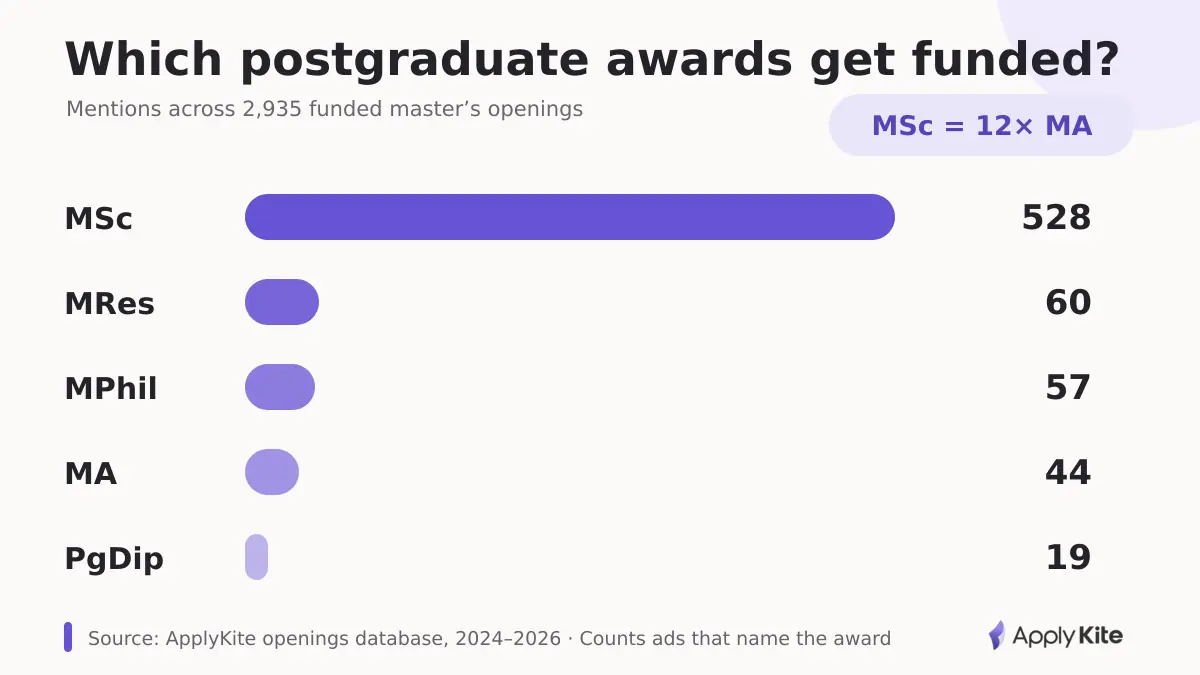
We looked at 2,935 funded master's openings in the ApplyKite database to see where the money goes. The numbers are heavily skewed.
When a funded advertisement specifies a degree type, the MSc appears 528 times. The MA appears just 44 times. That is a 12-to-1 gap. If you want someone else to pay for your education, the market overwhelmingly favors the Master of Science.
The MRes and MPhil hover around 60 mentions each. The Postgraduate Diploma barely registers at 19.
If you are hunting for these specific funded positions, you can use ApplyKite's Explore Academic Positions Worldwide (Positions) service. You just filter by your field and location to find fully funded MSc or MA opportunities that match your specific background.
Which Degree Opens the Door to a PhD?
When you apply for a doctorate, does a Postgraduate Diploma hold the same weight as a full master's degree?
We checked 33,703 PhD advertisements that stated specific entry requirements. Right away, 58 percent of those ads explicitly asked for a master's degree.
When hiring committees named a specific degree type, the results were incredibly clear:
- MSc: 3,116 mentions
- MRes: 251 mentions
- MA: 250 mentions
- Postgraduate Diploma: 9 mentions
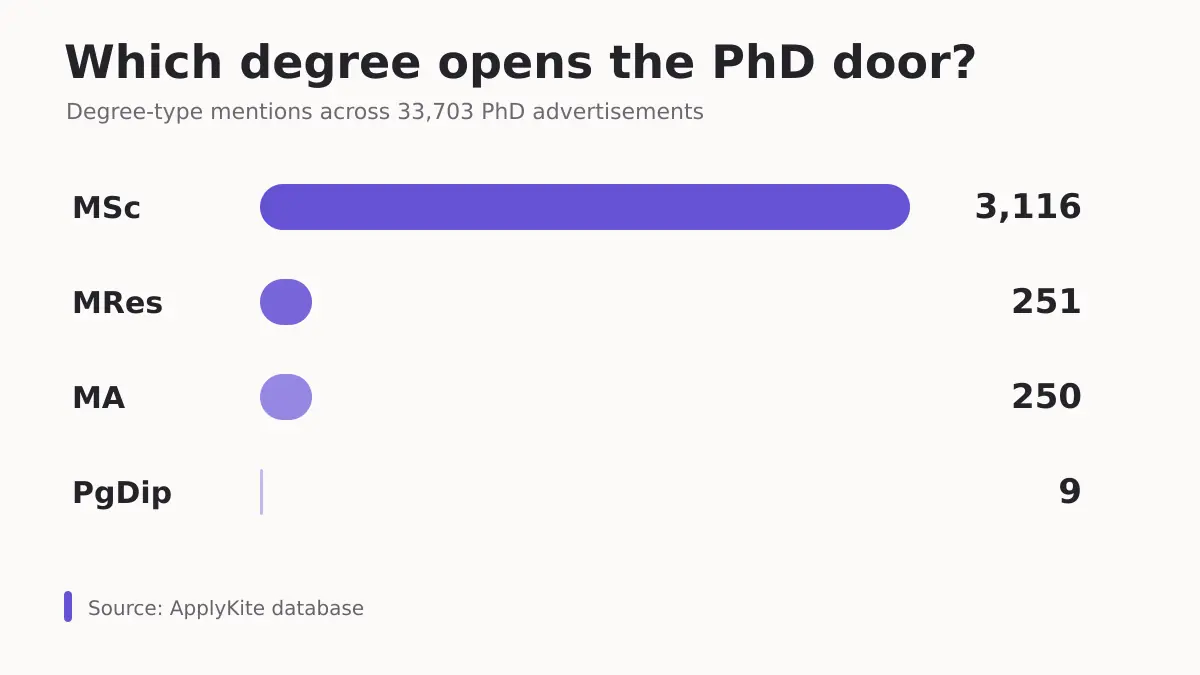
Across more than 33,000 PhD ads, a Postgraduate Diploma was named as an acceptable entry qualification exactly nine times. If your ultimate goal is a PhD, a Postgraduate Diploma is virtually invisible to the people doing the hiring.
The MRes, however, punches well above its weight. Despite being a rare degree globally, it gets requested just as often as the MA.
Once you secure the right degree, your next hurdle is finding an academic willing to take you on. You can use ApplyKite's Explore Professors and Research Supervisors (Professors) service to locate academics actively seeking candidates with your exact research background.
The MRes: A UK and Australia Specialty
You might look at the MRes data and think it is the perfect stepping stone for a doctorate. It is a fantastic research training program. But there is a geographic catch.
Funding for the MRes is heavily restricted by location. Out of the funded MRes openings in our database that specified a country, 23 were in the UK and 12 were in Australia. Almost nowhere else. If you want a funded MRes, you generally need to limit your search to those two educational systems. (You can check the Study UK government portal for official listings of British research degrees).
The Postgraduate Diploma: When It Makes Sense (And When It's a Dead End)
A PgDip saves you time and money. You skip the grueling dissertation months. You still get advanced, graduate-level knowledge. For professionals looking to upskill quickly for an industry job, it makes perfect sense.
But for academia, it is a dead end. As the data shows, PhD committees do not look for it. Plus, recognition varies wildly by country. A PgDip is common in the UK and New Zealand. In countries like Germany or Finland, it simply does not map well to their strict two-tier Bologna process system.

Which One Fits You? A Quick Quiz to Choose Your Path
Let's make this practical. Your choice depends entirely on what happens after graduation.
- Industry job focus: The MSc or MA provides standard, recognized credibility.
- Strict budget and no PhD plans: A PgDip saves tuition fees and living costs.
- PhD track in the UK or Australia: An MRes gives you a massive research advantage.
- Career change: A taught MSc or PgDip helps you bridge knowledge gaps quickly.
If you are still deciding your broad academic level, our bachelor-vs-master-vs-PhD post breaks down the long-term career impacts of each stage.
Every applicant's situation is completely unique. You might hold a PgDip and wonder how to bridge the gap to a PhD. Or maybe you have an MA but want a science-heavy doctorate. If you need personalized guidance to strategize your next move, Mentoring and Application Support connects you with mentors who have firsthand experience with PhD admissions. They evaluate your background and help you build a realistic roadmap.
When you do decide on a path, your application materials have to match what that particular degree is looking for. With kiteAI you can directly tailor your CV and Statement of Purpose to either emphasize your course work or independent research experience depending on the needs of the program.
FAQ: Answering Your Biggest Questions
Is an MRes better than an MSc for a PhD?
Not necessarily better, but highly efficient. An MRes proves you can handle independent research, which is exactly what a PhD requires. However, the MSc is requested far more often in global PhD ads.
Can you upgrade a PgDip to a master's?
Usually, yes. Many universities allow you to return later, complete a dissertation, and convert your diploma into a full master's degree.
Is an MA less valuable than an MSc?
No. They hold the exact same academic weight (90 ECTS). The value depends on your field. An MA is perfect for sociology or literature, while an MSc is expected for engineering or data science.
Is a Postgraduate Diploma the same as a master's?
No. A PgDip is a postgraduate qualification, but it lacks the final dissertation. It is shorter and carries fewer academic credits.
What is the difference between an MS and an MA degree?
An MS (or MSc) focuses on scientific, technical, or mathematical subjects. An MA focuses on arts, humanities, and social sciences.
Are MA and postgraduate the same?
An MA is a type of postgraduate degree. "Postgraduate" is the umbrella term for any study you do after finishing your bachelor's degree.
Getting accepted starts with knowing exactly what you are applying for. Pick the degree that aligns with your actual career goals, not just the one that sounds impressive. Your future self will thank you for making the practical choice today.