Erasmus Mundus Scholarship 2027: Complete Application Guide
Applykite
Author


Erasmus Mundus Scholarship 2027: Complete Application Guide
Updated for the 2027 intake: This guide reflects the current Erasmus Mundus Joint Masters rules and the 2026–27 application cycle. The European Commission selected 37 new Joint Master projects in July 2026, which are expected to open applications in autumn 2026 for cohorts starting in September 2027. As of October 2026, the official Erasmus Mundus catalogue lists around 220 Joint Master projects. Scholarship availability varies by programme and intake, so applicants should always verify funding on the individual programme website.
Studying in Europe can be expensive, but Erasmus Mundus Joint Masters offer one of the EU's most comprehensive funding opportunities for international Master's students. The EU provides funding for these integrated transnational study programmes and offers competitive scholarships to the best students worldwide.
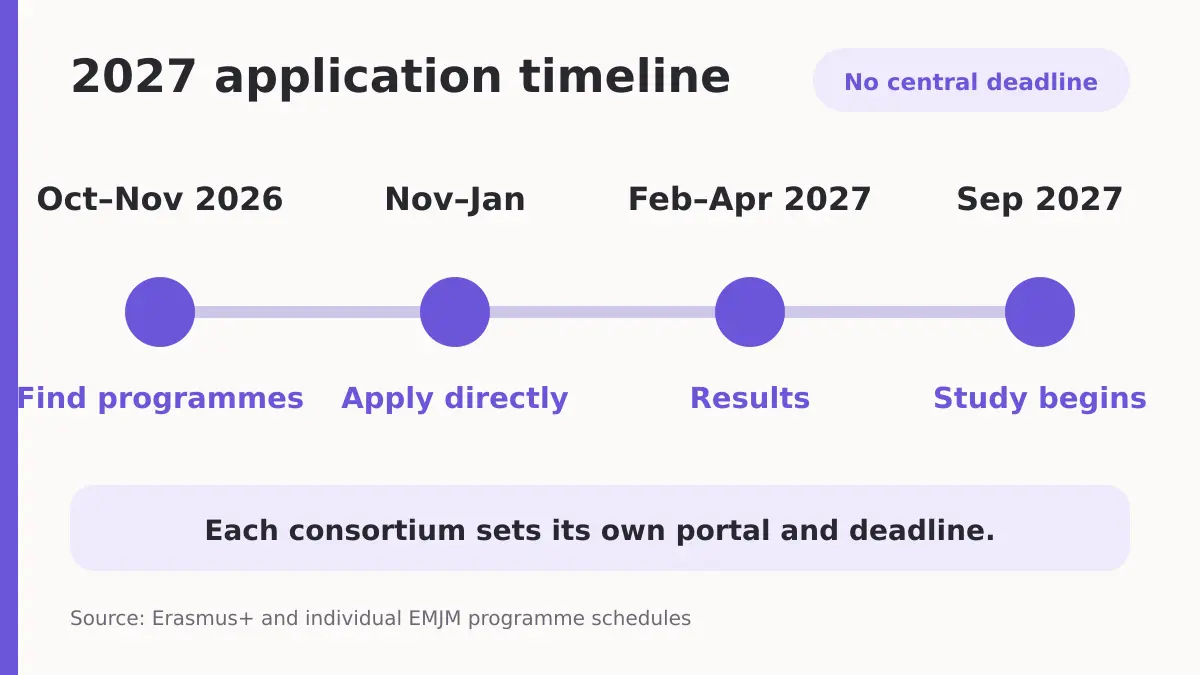
Applications are generally submitted between October 2026 and January 2027 for courses starting the following academic year. However, there is no central application and no single deadline; you must apply directly to each consortium through its own portal.
Read more: GREAT Scholarships
Erasmus Mundus Scholarship 2027 at a Glance
| Item | 2027 Information |
|---|---|
| Degree level | Master's degree. |
| Scholarship | €1,400/month. |
| Maximum duration | 24 months. |
| Maximum scholarship amount (24 months) | €33,600. |
| Tuition | No tuition or mandatory participation fees for scholarship holders. |
| Application fee | €0 for EMJM applications. |
| Eligible nationalities | All nationalities. |
| Academic requirement | Bachelor's degree/first higher-education degree or a recognised equivalent; final-year Bachelor's students may apply if they graduate before the Master's starts. |
| Typical application period | October 2026–January 2027. |
| Application method | Apply directly to the institution/consortium running the chosen programme. |
| Study mobility | Compulsory physical mobility in at least two countries. |
What's New for Erasmus Mundus 2027?
The European Commission selected 37 new Erasmus Mundus Joint Master projects in July 2026. These newly funded programmes include fields such as medical image analysis, semiconductors, law, artificial intelligence, infectious diseases, and animation.
What Is the Erasmus Mundus Scholarship?
To put it simply, an EMJM is a developed international master's programme delivered by a consortium of universities. The consortium must involve at least three higher education institutions (HEIs) from three different countries.
Instead of staying in one city for two years, this programme mandates compulsory physical mobility. Current rules require at least two study periods in two countries, both different from the student's country of residence at enrolment, and at least one must be an EU Member State or associated country. Normally, each mandatory period corresponds to at least one academic semester. Upon successful completion, you receive either a joint degree (one single diploma awarded by at least two HEIs) or multiple recognised degrees.
Erasmus Mundus Scholarship Amount: What Does It Cover?
The €1,400 Monthly Scholarship
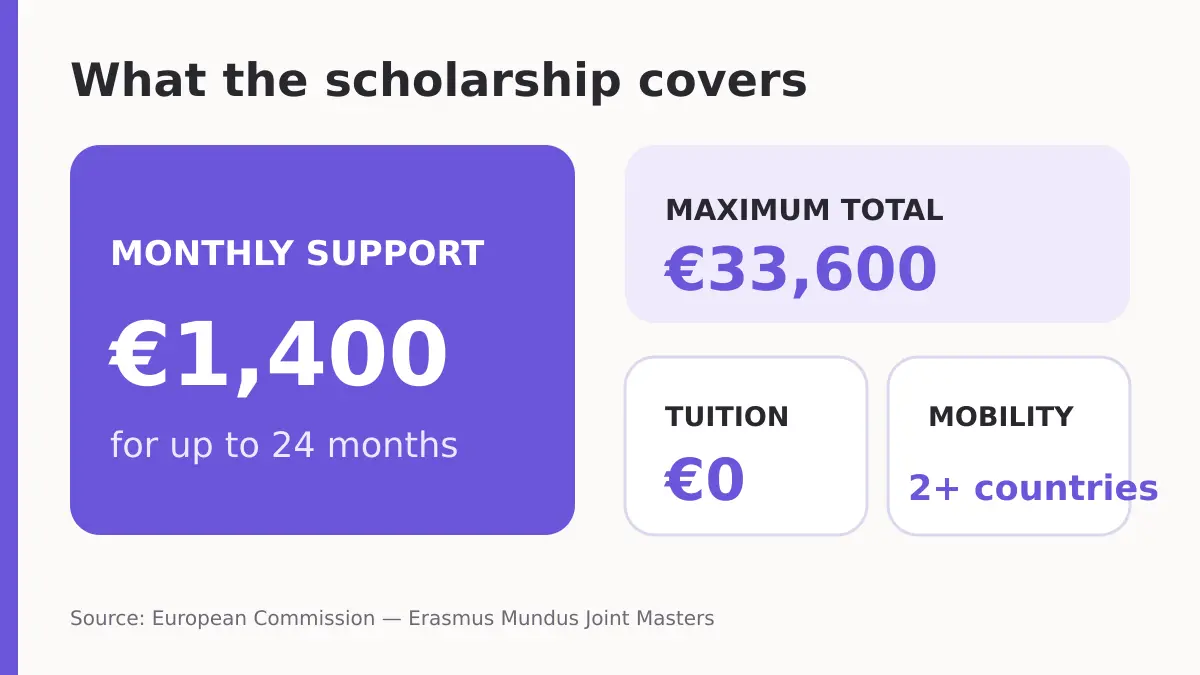
The scholarship is calculated based on a monthly unit cost of €1,400 for the entire period needed to complete the study programme, up to a maximum of 24 months.
- 12 months (60 ECTS): €16,800.
- 18 months (90 ECTS): €25,200.
- 24 months (120 ECTS): €33,600.
Tuition, Insurance, Travel and Visa Costs
The monthly €1,400 allowance is intended as a contribution to cover your living costs, accommodation, travel, visa, and installation expenses. Under current rules, there is no separate or additional travel and installation allowance on top of this monthly amount.
Additionally, scholarship recipients are not liable for any tuition fees or other mandatory participation costs. Full health and accident insurance coverage during your stay is paid from the consortium's institutional share of the grant, not out of your pocket.
Erasmus Mundus Eligibility & Requirements
Bachelor's Degree / Final-Year Students
You must have a bachelor's degree/first higher-education degree or a recognised equivalent. Final-year undergraduate students can apply with proof of expected graduation, provided they graduate before the master's programme begins. Individual programmes can impose more specific academic requirements.
Read more: phd opportunities in italy
Nationality
Students from all over the world can apply for EMJM scholarships.
How the 10% Nationality Balance Rule Works
To ensure cohort diversity, consortia must ensure geographic balance. This does not mean every intake must contain exactly 10% or less of one nationality. The limit applies across scholarships awarded during the project's implementation, except targeted-region top-up scholarships.
Previous Erasmus Mundus Scholarship Holders
Students who have previously received an EMJM scholarship cannot receive another EMJM scholarship. However, recipients of scholarships under the older Erasmus Mundus Joint Master Degree (EMJMD) scheme (2014-2020 or before) may still apply for an EMJM scholarship under the current rules.
Erasmus Mundus Scholarship 2027 Deadlines
There is no single Erasmus Mundus Scholarship 2027 deadline. Each Erasmus Mundus Joint Master sets its own application and scholarship deadline. Applications usually take place between October and January for courses beginning in the following academic year.
For programmes beginning in September 2027, applications run from autumn 2026 to winter 2027.
How to Find Erasmus Mundus Programs for 2027
You cannot apply to "Erasmus" in general. You must browse the official Erasmus Mundus Joint Masters catalogue on the Erasmus+ website to find specific programmes. You apply directly to each consortium, through its own portal, on its own timetable.
How to Apply for an EMJM Scholarship
- Browse the EMJM catalogue: Filter by field, country, and duration.
- Check programme-specific requirements: Each programme sets its own eligibility criteria, required documents, language proficiency standards, and deadlines.
- Prepare your documents: Gather certified copies of transcripts, degree certificates, proof of language proficiency, a CV, a motivation letter, and recommendation letters.
- Submit your application: Apply directly through the programme's own application portal, ensuring you indicate that you are applying for an EMJM scholarship.
- Await selection results: Each consortium publishes its own selection schedule. Many scholarship decisions are announced during spring, but applicants should check their programme's official timeline.
Documents Required for Erasmus Mundus Applications
Because applications are managed by individual consortia, documentation varies.
| Document | Usually required? | Notes |
|---|---|---|
| Bachelor's diploma | Yes | Or proof of expected graduation. |
| Academic transcripts | Yes | Translation may be required. |
| CV | Usually | Requirements vary (Europass often requested). |
| Motivation letter | Usually | Often programme-specific. |
| Recommendation letters | Often | Number varies. |
| English-language proof | Often | Programme-specific. |
| Passport/ID | Often | Check consortium requirements. |
| Proof of residence | Programme-dependent | Not universally required. |
| Other documents | Programme-dependent | Portfolio, work experience, research proposal, etc. |
How Are Erasmus Mundus Scholarship Candidates Selected?
Each consortium runs its own selection process. The current Programme Guide explicitly assigns student selection to the consortium and requires it to be transparent, impartial, and equitable.
Individual programmes may assess:
- Academic achievement
- Fit with the Master's curriculum
- Motivation
- Relevant experience and background
- Recommendations
- Language proficiency
- Interviews, where applicable

Need Help Preparing Your Erasmus Mundus Application?
Erasmus Mundus programmes have different eligibility rules, deadlines and document requirements. If you'd like personalised support with programme selection, your CV, motivation letter or application strategy, you can work with an ApplyKite academic mentor.
👉 Find and Reserve Your ApplyKite Mentor Here
Frequently Asked Questions (FAQ)
Is the Erasmus Mundus Scholarship fully funded?
Yes. Erasmus Mundus scholarship holders are not charged tuition or other mandatory participation costs, receive full insurance coverage through the programme, and receive €1,400 per month as a contribution toward travel, visa, installation and living costs.
Is there an application fee for Erasmus Mundus?
No. Under the current EMJM rules, selected projects cannot charge students an application fee.
EMJM vs. EMDM: What's the Difference?
Students should not confuse Erasmus Mundus Joint Masters (EMJM) with Erasmus Mundus Design Measures (EMDM). EMJM refers to the fully developed international master's programmes to which students apply for admission and scholarships. EMDM is a separate funding lot that enhances the capacities of universities to design and set up new joint master programmes; it is not the scholarship itself.
Does the Erasmus Scholarship have an age limit or minimum GPA?
Erasmus Mundus publishes no age limit and no single grade bar[cite: 4, 18]. Each specific consortium committee assesses grades, academic profiles, motivation, and references to rank candidates.
Is there an Erasmus Mundus programme for bachelor's students?
No, Erasmus Mundus Joint Masters are strictly master's level programmes[cite: 6, 9]. Searches for "Erasmus Mundus for bachelor's" reflect a common confusion; while bachelor's students can do a short Erasmus+ exchange, EMJM is only for postgraduate study.
Can you do a PhD with Erasmus Mundus?
Currently, the Erasmus Mundus action under Lot 1 (EMJM) strictly supports high-level integrated transnational study programmes at the Master level[cite: 2, 6, 7].
Can I apply without IELTS?
English language requirements, accepted certificates, and minimum scores are set by each individual consortium, not by a central Erasmus authority. You must check the official website of your chosen programme to see their specific language requirements[cite: 4, 18].


