Romanian Government Scholarship 2027/28: How to Apply, Real Costs & Deadlines
ApplyKite Editorial
Author

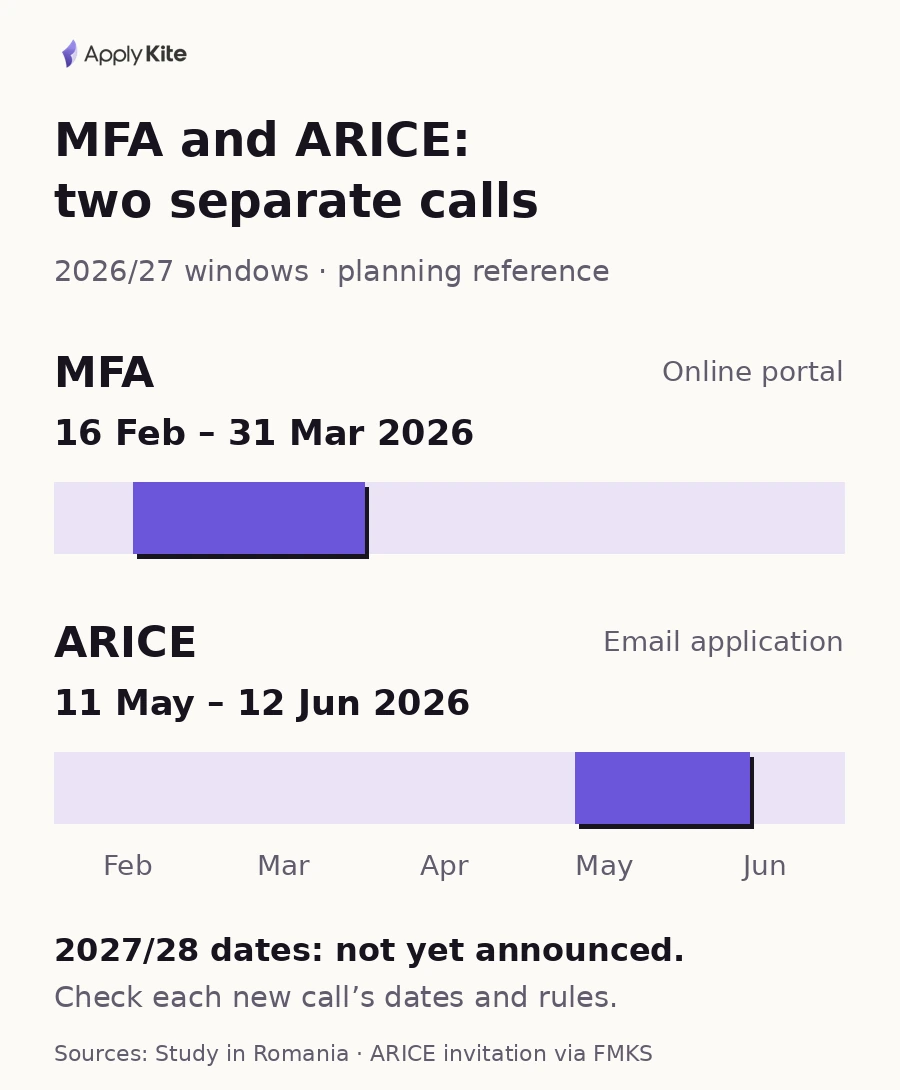
2027/28 Application Status & Key Dates at a Glance The 2027/28 MFA call is not yet officially announced as of late 2026.
- Expected MFA Opening: February 2027.
- Expected MFA Deadline: Late March 2027 (based on the Feb 16 – Mar 31 window from 2026; keep in mind the 2025 cycle closed Mar 12).
- ARICE Track Deadline: Typically runs May 11 – June 12.
- Official Portals: MFA Study in Romania | ApplyKite MFA & ARICE Listings

The Short Answer: What You Need to Know in 60 Seconds
- Who is eligible: Non-EU citizens with a minimum 7.00/10.00 GPA (or equivalent) from their last graduated school.
- What it covers: 100% of tuition, a 1-year Romanian language prep course, a subsidized dorm room (if available), and a €65–€85 monthly stipend.
- What you pay for: Flights, visa document prep, and food. The stipend only covers a fraction of actual monthly living costs.
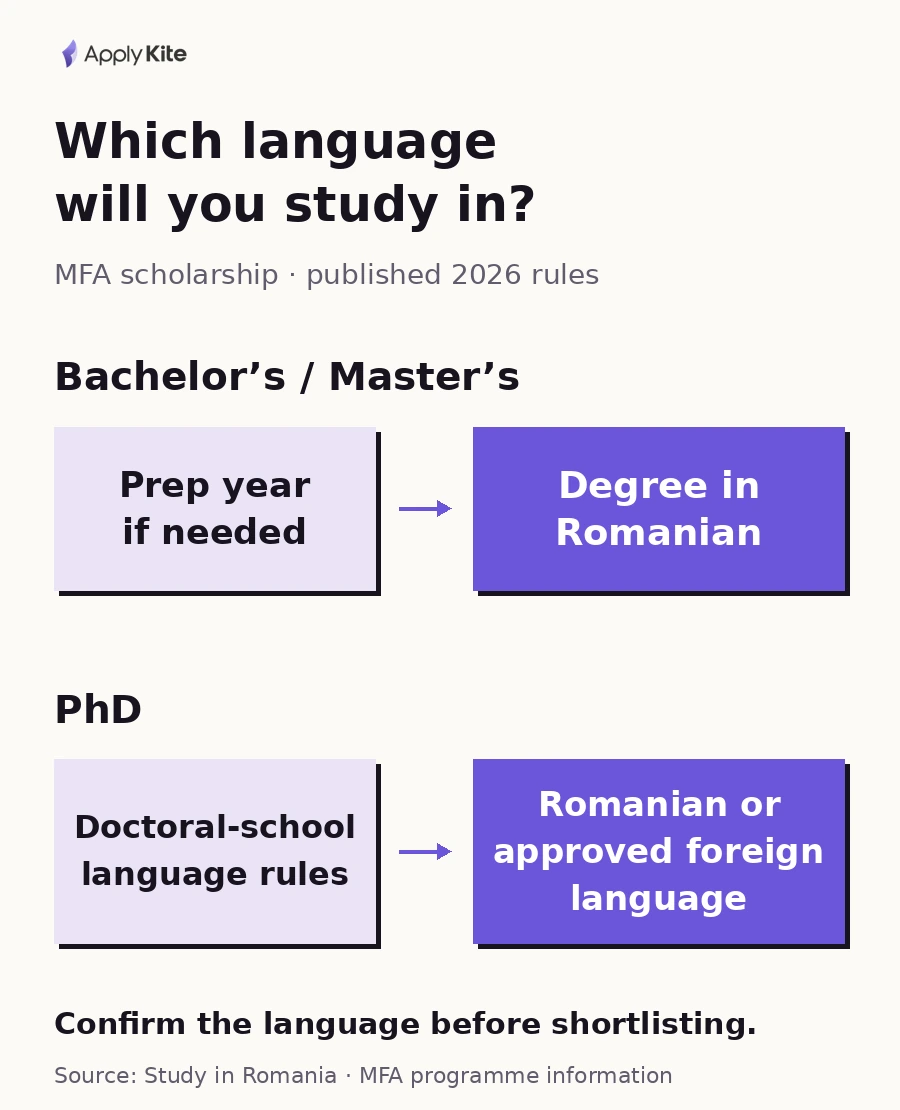
- Language rules: Bachelor's and Master's degrees must be studied in Romanian. PhDs can be studied in English (or another foreign language) if approved by the doctoral school.
Excluded fields: Medicine, Dental Medicine, and Pharmacy are strictly excluded from the scholarship.
What Is the Romanian Government Scholarship for International Students?
Thousands of international students treat this program as a simple, single-track application. It is not. Romania's state-funded programs for non-EU citizens, operating under Government Decision No. 288/1993 and H.G. No. 1653/2024, actually run through two completely different tracks.
You have the flagship MFA Scholarship (Ministry of Foreign Affairs) and the specialized ARICE Scholarship (Agency for Investments and Foreign Trade). Knowing the difference between them gives you two chances to apply instead of one.
If you want to compare how these Romanian programs stack up against other European opportunities, you can use the Explore Academic Positions Worldwide tool on ApplyKite to filter open Master's, PhD, and Postdoc positions by field, location, and funding level.
Romanian Government Scholarship ARICE vs. MFA Track
| Feature | MFA Scholarship Track | ARICE Scholarship Track |
|---|---|---|
| Administering Body | Ministry of Foreign Affairs | Agency for Investments & Foreign Trade |
| Total Quota | Variable (often 245–500 spots) | 40 spots |
| Application Method | scholarships.studyinromania.gov.ro portal | PDF email to burse[year]@arice.gov.ro |
| Timeline | Feb–Mar | May–June |
| Eligible Fields | All except Medicine, Dentistry, Pharmacy | Prioritizes Economics, Business, Agriculture, Tech, Oil & Gas. Allows medical residency only in Emergency Medicine/Cardiology |
| Recommendations | Optional | Mandatory from trade/diplomatic entity |
Romanian Government Scholarship Benefits: What It Actually Covers (And What It Doesn't)
Calling this a "fully funded" scholarship is only half the story. Let's be transparent about your actual budget.
What the government covers:
- 100% tuition for your degree.
- 1-year Romanian language preparatory course.
- Application, language testing, and doctoral admission fee waivers.
- Subsidized university dorm accommodation. This is subject to space—you must contact the host university to secure it.
- Basic medical assistance (free under age 26; expect a €15–€30/month social health insurance fee if you are 26+).
- Local transport subsidies and consular visa fee waivers.
- Monthly Stipend (paid in RON): €65/month for Prep year & Bachelor's, €75/month for Master's, €85/month for PhD.
What you must self-fund:
- International flights and domestic transit from the border to your university city.
- Food and groceries. A basic grocery budget runs ~€120–€220/month. The €65–€85 stipend covers only part of your food.
- Private rent if dorms are full, which costs €150–€400/month.
- Visa document translation and authentication costs.
Keeping the scholarship: You keep these benefits only by maintaining passing grades annually, which is required to renew your residence permit and your stipend.
Part-Time Work Tip: Non-EU students with a valid study residence permit can legally work up to 6 hours/day (30 hours/week) without applying for a separate work permit. If you need lower living cost alternatives or English-taught options, browse our guide to Tuition-Free Universities in Europe.
Romanian Government Scholarship Eligibility Criteria & Requirements
Check your profile against these strict cutoffs before preparing any documents:
- You are a non-EU citizen. (ARICE also excludes EFTA citizens, giving priority to countries without bilateral cultural agreements).
- You hold a minimum academic average of 7.00 out of 10.00 in the Romanian grading system (or a "Good" equivalent) for your last completed degree.
- Your prior institution is officially recognized and accredited.
- Excluded profiles: Romanian citizens, heritage communities, asylum seekers in Romania, stateless residents, diplomatic families stationed in Romania, and previous Romanian state scholarship holders for the exact same study cycle.
- Excluded majors: Medicine, Dental Medicine, and Pharmacy.
Romanian Government Scholarship Bachelor, Master's, and PhD Rules
Degree cycles take 3–6 years for a Bachelor's, 1–2 years for a Master's, and 3–4 years for a PhD.
The Romanian Language Prep Year (Anul Pregătitor): Bachelor's and Master's degrees are taught exclusively in Romanian. If you don't speak Romanian, the state funds a 1-year preparatory course. You can only skip this if you hold a B1 Romanian certificate, pass a university language test, or prove 3–4 consecutive years of prior study in Romanian.
The No-IELTS Advantage: Because Bachelor's and Master's tracks require the Romanian prep year, IELTS is not required. PhD candidates are the only applicants allowed to study in English (if the doctoral school approves), and they skip the prep year. Want more options like this? Check out our list of Scholarships Without IELTS.
The PhD Supervisor Rule: PhD applicants must independently contact a Romanian professor and get a signed written agreement from a doctoral supervisor before submitting their application.
Age Limit: Myth vs. Official Rules
Many third-party blogs repeat an outdated rule claiming a strict age cap of 35 years for Bachelor's/Master's and 45 for PhD. That is false. The official 2026 MFA eligibility rules state no upper age limit. They also explicitly allow applicants under 18 to apply, provided they upload notarized parental consent.
Romania Government Scholarship for Bangladeshi, Pakistani & Global Non-EU Applicants
Search volume from South and Southeast Asia is massive. The rules are the same for everyone: all non-EU nationals face the same grade conversion floor (7/10) and document apostille requirements. The real bottleneck is the embassy. Consular visa appointments (Type D/SD) have notoriously long wait times in South Asia. Book your appointment on eviza.mae.ro the exact day you receive your Letter of Acceptance in July.
Romanian Government Scholarship Documents Required & CV Format
Prepare these PDFs early. Each document must be scanned individually from the original (max ~4MB per slot) with authorized translations into English, French, Spanish, or Romanian. Apostilles are strictly required.
- Diplomas (High school/Baccalaureate, Bachelor's, Master's) and transcripts for all years.
- Birth certificate.
- First 3 pages of your valid passport (2 pages for the ARICE track).
- Conditional documents: Proof of name change, final-year graduation exam certificate (if the diploma isn't printed yet), parental consent for minors, and a medical certificate. (MFA requires the medical certificate at enrollment; ARICE requires it issued within 90 days of your file submission).
CV Format: You must submit a Europass CV in English, French, or Romanian. PhD applicants must also upload a detailed Letter of Intent (Research Proposal) alongside their supervisor's consent. You can format your Europass CV and draft your proposal using kiteAI, or book a 1-on-1 Consulting session for expert CV/SOP feedback before you lock your submission.

If building a Europass CV or writing a PhD research proposal from scratch feels overwhelming, you can lean on ApplyKite Twin. Think of it as your personal application agent. It drafts your CV to European standards, writes cold outreach emails to potential Romanian supervisors in your own voice, and realistically assesses your chances based on your academic background. It also builds a visual roadmap to track your tasks and deadlines, so you aren't scrambling the night before the application portal closes.
Romanian Government Scholarship 2027/28: How to Apply Step-by-Step
Do not email your documents to the Romanian embassy for the MFA track. They will delete them. The MFA application is 100% digital. You get one application. Once you click submit, you cannot edit a single comma.
If managing apostilles, translations, and PDF compression feels overwhelming, you can work with a dedicated mentor via ApplyKite Full Service for document preparation and complete application handling.
Portal & Login Walkthrough (scholarships.studyinromania.gov.ro)
Here is how the portal actually works:
- Account Creation: Register at scholarships.studyinromania.gov.ro, complete the CAPTCHA, and activate via email. Check your spam folder.
- Step 1 & 2 (Personal Data & Address): Match your passport characters exactly. Click "Save and Verify" on every tab.
- Step 3 (Studies & File Uploads): Select your degree level, tick "Yes" for the Romanian Preparatory Year if you need it, enter your converted GPA, and upload your separate PDFs.
- Step 4 (Select Universities): Choose your Option 1 and Option 2 preferred universities and study domains.
- Step 5 (Review & Lock): Preview every PDF. Hit submit before the March deadline.
University List: How to Choose Your 2 Study Options
There is no static PDF list of universities. You use the searchable Study in Romania directory inside the portal to pick two public universities in order of preference. Popular choices include the University of Bucharest, Babeș-Bolyai University, Politehnica University of Bucharest, and Alexandru Ioan Cuza University.
Warning: Do not pick an English-taught Bachelor's or Master's program from the general catalog. The MFA only funds Romanian-taught tracks at those levels. If you need help finding the right faculty, book a University Selection Consulting session.
When Does the Romanian Government Scholarship Open? Timeline & Deadlines
Ignore the blogs claiming this scholarship opens in December. Here is the actual operational timeline based on recent cycles:
| Action | MFA Track | ARICE Track |
|---|---|---|
| Portal Opens | Mid-February (e.g., Feb 16) | May (e.g., May 11) |
| Application Deadline | Late March (e.g., Mar 31) | Mid-June (e.g., June 12) |
| Results Announced | Mid-July (e.g., July 15) | Late July / August |
| Enrollment in Romania | October 1 | October 1 |
Romanian Government Scholarship Acceptance Rate & 2026 Results
How Competitive Is It Really? What ApplyKite Data & Official Selection Numbers Show
If you search for the Romanian Government Scholarship online, dozens of websites make it sound like an easy backup plan for studying in Europe. The numbers tell a very different story.
In the 2026/27 Ministry of Foreign Affairs (MFA) cycle, the official Study in Romania portal recorded 88,798 applications from 152 countries. According to a July 29, 2026 statement reported by Romania's national news agency AGERPRES, inter-institutional validation resulted in just 245 students being selected from roughly 88,800 applications. That puts the implied 2026/27 MFA selection rate at approximately 0.28%—roughly 1 selected scholar for every 360 applicants. Even in the 2024 cycle, when Romania awarded 500 scholarships from 81,914 applications, the implied selection rate was roughly 0.61% (after exceeding 50,000 applications for 500 spots the year prior).
Yet thousands of students miss a second state-funded door simply because they stop searching after March.
In ApplyKite's proprietary search and platform dataset—which tracked 33,288 search impressions and 305 clicks across Romanian Government Scholarship queries this year (including 2,250 impressions per quarter on core terms like 'romanian government scholarship' at 1,242 impressions and '...2026' at 570 impressions)—nearly all early-year search traffic spikes around the MFA window, which closed on March 31 in the 2026 cycle. However, ApplyKite's curated scholarship records highlight a second official government track: the ARICE scheme (Romanian Agency for Investments and Foreign Trade), which offers 40 fully funded scholarships across all degree levels and logged its last cycle deadline on June 12 (opening May 11, 2026).
What this means for your application strategy: Relying solely on a minimum 7.00/10.00 GPA in the March MFA round leaves you competing against nearly 89,000 applicants. Preparing your apostilled documents early lets you apply for the MFA track in February–March and gives you a second runway to submit for the ARICE track before the mid-June deadline.
Beyond the GPA: Technical screening immediately deletes incomplete files. After that, the MFA evaluates academic excellence alongside geographical diversity, gender balance, and foreign-policy priorities (giving heavy preference to non-EU countries without existing bilateral cultural agreements). Winners download the Letter of Acceptance, confirm their spot, apply for the Type D/SD visa, bring original documents and medical certificates to campus for October 1 enrollment, and register for an IGI residence permit within 30 days.
Why Study in Romania? Student Life & Living Costs by City
Romania offers globally recognized EU degrees in highly safe, vibrant student cities. Living costs vary dramatically depending on where your university is located. Iași is widely considered the most affordable major student hub, requiring a self-funded budget of about €300–€400 a month outside the scholarship.
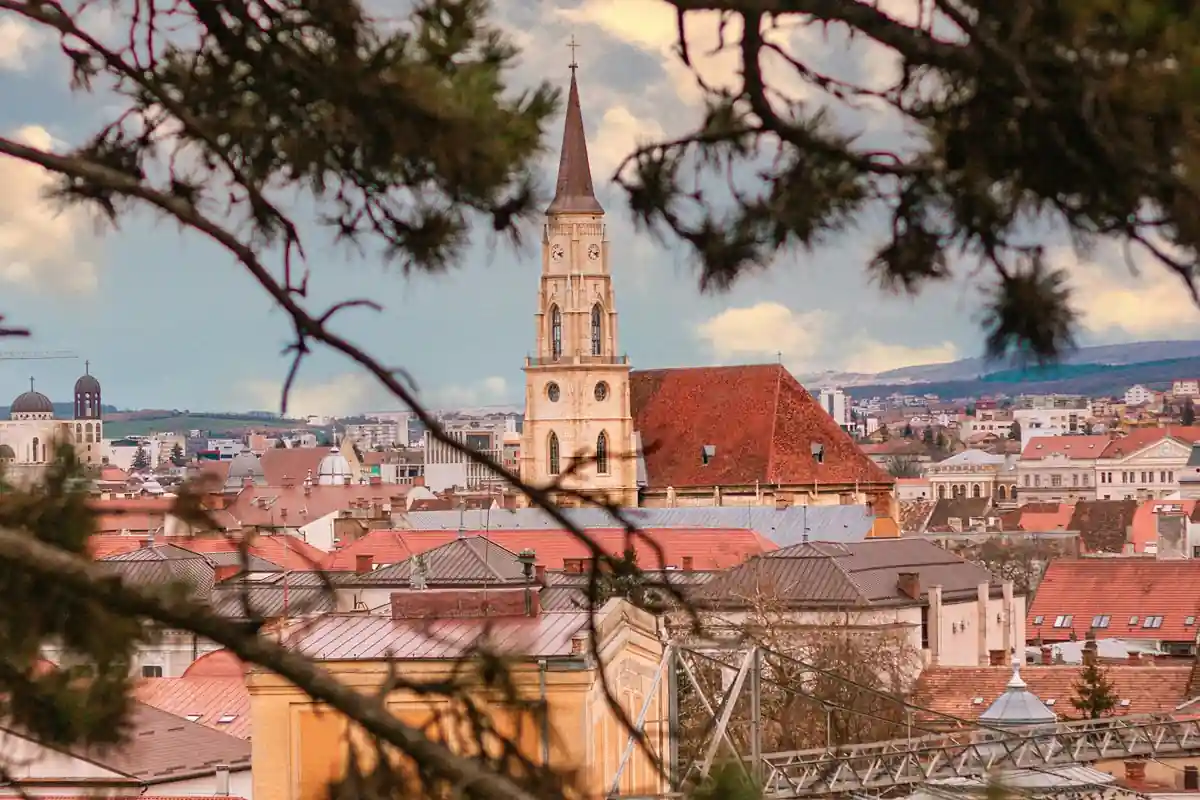
Timișoara runs closer to €400–€500 a month. If you are placed in Bucharest or Cluj-Napoca and the university dorms are full, expect your private rent alone to hit €200–€400 monthly. You can compare these cities by checking our Tuition-Free Europe living cost indexes or browsing the active Romanian scholarship listings.
Frequently Asked Questions (FAQ)
When does the 2027/28 application open?
Not yet announced as of late 2026. Based on the 2026/27 cycle (Feb 16 – Mar 31, 2026), expect the MFA portal to open around mid-February 2027 and close in late March 2027. The ARICE track typically runs May to mid-June.
Is it fully funded?
It covers 100% of tuition, the Romanian language prep year, application/visa fees, a subsidized dorm spot (if available), and a €65–€85/month stipend. You must self-fund food, flights, and personal expenses.
Does it cover flights?
No. International airfare to/from Romania and domestic transport from the border to your university are 100% self-funded.
Do I have to study in Romanian?
Yes for Bachelor's and Master's degrees (a free 1-year Romanian preparatory course is included if you don't speak it). Only PhD students can choose English or another foreign language approved by their doctoral school.
Can masters/PhD students apply?
Yes. Both MFA and ARICE scholarships fund Bachelor's, Master's, and PhD degrees. Keep in mind that PhD applicants must secure written supervisor consent before applying.


