Tuition-Free Universities in Europe in 2027: Country Rules, Hidden Costs, and Non-EU Exceptions
ApplyKite Editorial
Author

- Germany (Best English-Taught Free Option): In 15 out of 16 German states, all public universities charge no tuition for EU or non-EU students, except for Baden-Württemberg (€1,500 per semester) and a few universities in Bavaria, i.e. TUM and FAU (€2,000 - €6,000 per semester). All other public universities in Germany charge between € 97 - € 350 per semester.
- Norway (No Longer Free for Non-EU): From 2023, all non-EU students will be charged between NOK 60,000 to NOK 295,000 (€5,100 to €25,000+) per year for Bachelor’s and Master’s degrees. Only EU/EEA students, exchange students and Ph.D. students with salary are exempt.
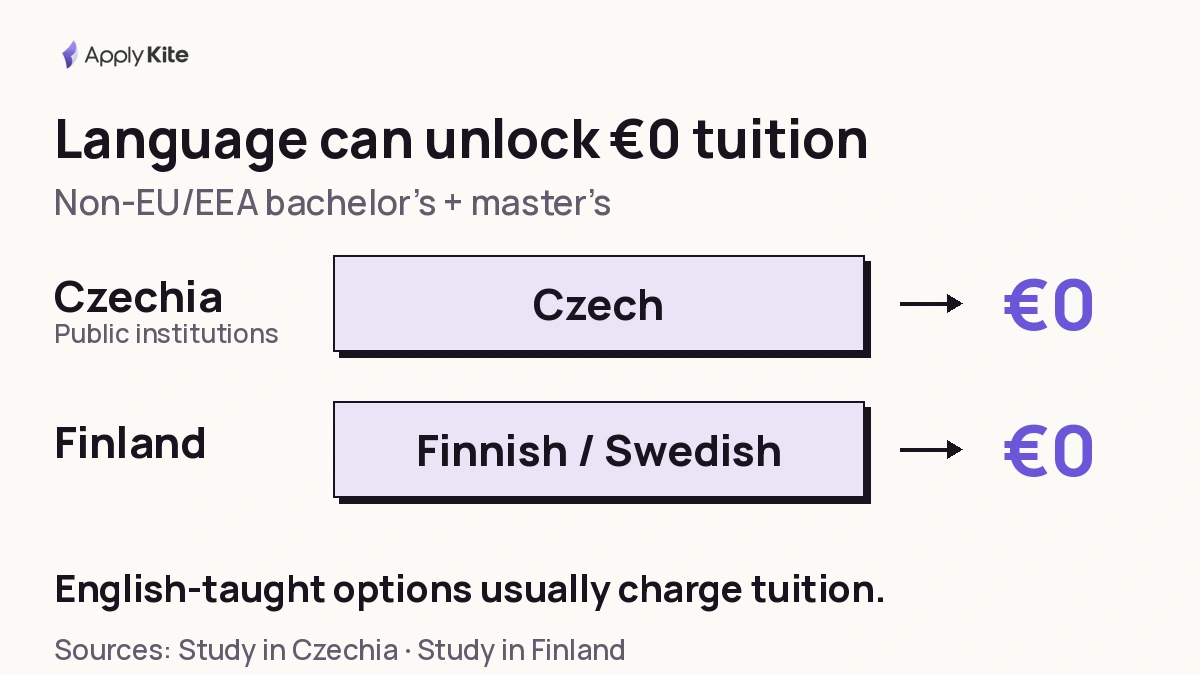
- Only free in local language: Public universities in Czechia (Czech), Finland (Finnish/Swedish) and Greece (Greek undergraduate tracks) are €0 for non-EU students. English taught programs can vary between €1,020 and €24,330 per year.
- Low-Fee Public Systems (Not Free): Austria charges non-EU students €726.72 per semester plus a €26.20 student union fee. France charges differentiated fees of €2,902 per year for a Bachelor's and €3,950 per year for a Master's (2026-27 rates) plus a €105 CVEC fee.
- Visa Proof of Funds Reality: Even if “tuition-free” doesn’t mean there are no costs to study there. In Germany, students are required to have a blocked account with a minimum of €11,904 per year. In Austria, the amount is between €8,670 and €15,700 per year. Costs are waived only for students who win fully funded scholarships.

Which European Countries Are Actually Tuition-Free for International Students in 2027?
European public higher education is strictly divided by citizenship. EU, EEA and Swiss citizens can study free of charge at about half of Europe.
There are four different models for non-EU international students:
- unconditional free tuition (Germany),
- language-conditional free tuition (Czechia, Greece, Finland),
- subsidised low fees (Austria, France)
- and full-cost international tuition with free PhD exceptions (Norway, Sweden, Finland).
| Country | Free for Non-EU? | Semester / Admin Fees | Free in English? | 2027 Policy & Visa Proof Rule |
|---|---|---|---|---|
| Germany | Yes (15 of 16 states) | €97 to €350 per semester | Yes | Must show €11,904 per year in a blocked account. |
| Norway | No | NOK 600 to 1,000 per semester | PhD only | NOK 170,368 visa proof required. |
| Austria | No (Low-Fee) | €726.72 + €26.20 per semester | No | Prove €8,670 to €15,700 per year. |
| Czechia | No (Unless in Czech) | CZK 400 to 1,000 application fee | PhD only | Free for all nationalities if taught in Czech. |
| Greece | No (Unless Greek BA) | Variable by faculty | PhD only | English BA costs €1,500 to €15,000 per year. |
| France | No (Low-Fee) | €105 CVEC annual fee | PhD only | €877.50 per month required for living costs. |
| Iceland | Yes (Currently) | ISK 75,000 to 100,000 annual fee | Yes | Planning non-EEA tuition from Autumn 2027. |
| Finland | No (Unless Finnish) | €70 to €100 student union fee | PhD only | English tracks average €6,000 to €18,000 per year. |
| Sweden | No | Minor student union fees | PhD only | Strict 15-hour weekly student work cap active. |
Why Outdated Guides Get Norway and Iceland Wrong
Many older study-abroad lists still advertise Norway as tuition-free for everyone. That policy ended in Autumn 2023.
A June 2026 legal update gave Norwegian public universities, including the University of Oslo and the University of Bergen, flexibility to set fees below full cost recovery, so you must check each department's 2027 tariff before applying.
Iceland is going through a similar transition. For the 2026-27 academic year, public universities such as the University of Iceland charge no tuition and require an annual registration fee of ISK 75,000 to ISK 100,000 (roughly €500 to €670), plus an ISK 8,000 application fee for international applicants. However, planned policy changes introduce tuition fees for non-EEA students starting in Autumn 2027. Confirm the current fee status directly with your chosen Icelandic department before paying any application fee.
Tuition-Free Universities in Germany: 2027 Rules, Semester Fees, and State Exceptions
Germany remains the most reliable option for non-EU students seeking an English-taught degree without tuition.
Across 15 of Germany's 16 federal states, public universities charge €0 tuition for Bachelor's degrees, consecutive Master's degrees (Master's programs that build directly on your undergraduate field), and PhD programs.
Non-consecutive or executive Master's degrees, such as MBAs, charge tuition nationwide.
Every student still pays a mandatory semester contribution (Semesterbeitrag) of €97 to €350 per semester. According to DAAD's official financing overview, this contribution funds student union services and usually includes a regional public transport pass (Semesterticket).
Tuition-Free Public Universities vs. Fee-Charging Exceptions in Germany
Do not assume every German public university is free for non-EU citizens. You need to watch two specific regions:
- Tuition-Free Public Research Universities (€0 Tuition): LMU Munich (38 English Master's programs and a €97 semester contribution), FU Berlin, Humboldt University of Berlin, TU Berlin, and RWTH Aachen all charge €0 tuition to non-EU students, with semester contributions typically between €300 and €350 in Berlin and Aachen.
- Baden-Württemberg (€1,500 per Semester): Under state law enacted in 2017-18, all public universities in Baden-Württemberg, including KIT, Heidelberg University, the University of Freiburg, and the University of Tübingen, charge non-EU students €1,500 per semester (€3,000 per year) plus a €150 to €200 semester fee.
- Select Bavarian Universities (TUM and FAU): Bavaria allows individual public universities to decide whether to charge non-EU tuition. The Technical University of Munich (TUM) charges newly enrolling non-EU students €2,000 to €3,000 per semester for Bachelor's degrees and €4,000 to €6,000 per semester for Master's degrees. FAU Erlangen-Nürnberg has also announced non-EU tuition fees of €2,000 to €6,000 per semester starting in Summer 2027. Right across Munich, LMU Munich remains €0 tuition, which shows why you must verify fees at the university level rather than relying on state-wide assumptions.
Conditional Free and Low-Fee Countries: Czechia, Greece, Austria, and France
To budget accurately, you need to separate countries that waive tuition on a language condition from countries that simply subsidise public tuition to a low rate.
Public systems are affordable in comparison to the UK or US, but they are not free, and fees are low.
Czechia, Greece, and Finland: Free Only in the Local Language (or for PhDs)
- Czechia: Public universities charge €0 tuition to all nationalities across Bachelor's, Master's, and PhD levels only when the program is taught in Czech. English-taught degrees cost between €1,020 and €24,330 per year (with a median around €6,000 per year). You will also pay university application fees of CZK 400 to CZK 1,000 and must complete nostrification (formal recognition of your prior foreign diploma).
- Greece: All 24 public universities offer €0 tuition for Greek-taught Bachelor's degrees regardless of nationality, and eligible students can access free campus canteen meals. English-taught undergraduate programs aimed at non-EU students carry tuition fees ranging from €1,500 to €15,000 per year depending on the university and field.
- Finland and Sweden: Non-EU students pay tuition for English-taught Bachelor's and Master's degrees, averaging €6,000 to €20,000 per year in Finland and SEK 80,000 to SEK 295,000 per year in Sweden. You avoid these fees only by studying in Finnish or Swedish (in Finland) or by securing a PhD position, which is tuition-free in Finland and normally a salaried employment contract in Sweden.
Austria and France: Low-Fee Public Universities (Not Free)
- Austria: Regular duration of study and two semesters thereafter are provided free of charge for EU/EEA citizens at public universities, including the University of Vienna and TU Wien. Students from outside the EU pay the regular tuition fee of 726.72 euros per semester (1,453.44 euros per year) and the mandatory Austrian Student Union (ÖH) fee of 26.20 euros, totalling 1,505.84 euros per year. Statutory waivers are available to citizens of designated least developed countries. If your Bachelor’s program requires C1 German and you need a preparatory course (Vorstudienlehrgang, or VWU), plan on spending an additional €612 per semester.
- France: Public universities are subsidized, not free. While EU citizens pay national rates (€170 to €178 for a Licence/Bachelor's and €243 to €255 for a Master's), roughly 60% of public universities charge non-EU students differentiated fees (droits différenciés). Under the 2026-27 schedule, that comes to €2,902 per year for a Bachelor's and €3,950 per year for a Master's (up from earlier €2,770 and €3,770 schedules published by Campus France), plus the mandatory €105 annual CVEC student life fee. Do not count on automatic fee waivers: Decree 2026-385 caps institutional Category II exemptions at 30% of non-EU students in 2026-27 and tightens the cap to 25% for 2027-28. One major exception remains: PhD registration fees stay at €380 to €397 per year for all nationalities.
The Living Costs Reality Check: Visa Proof of Funds and Upfront Fees
A €0 acceptance letter is not enough to clear immigration. European embassies require non-EU students to demonstrate beforehand that they have the means to pay for housing, food and health insurance for the first 12 months, without relying on public assistance or on part-time work that cannot be guaranteed.
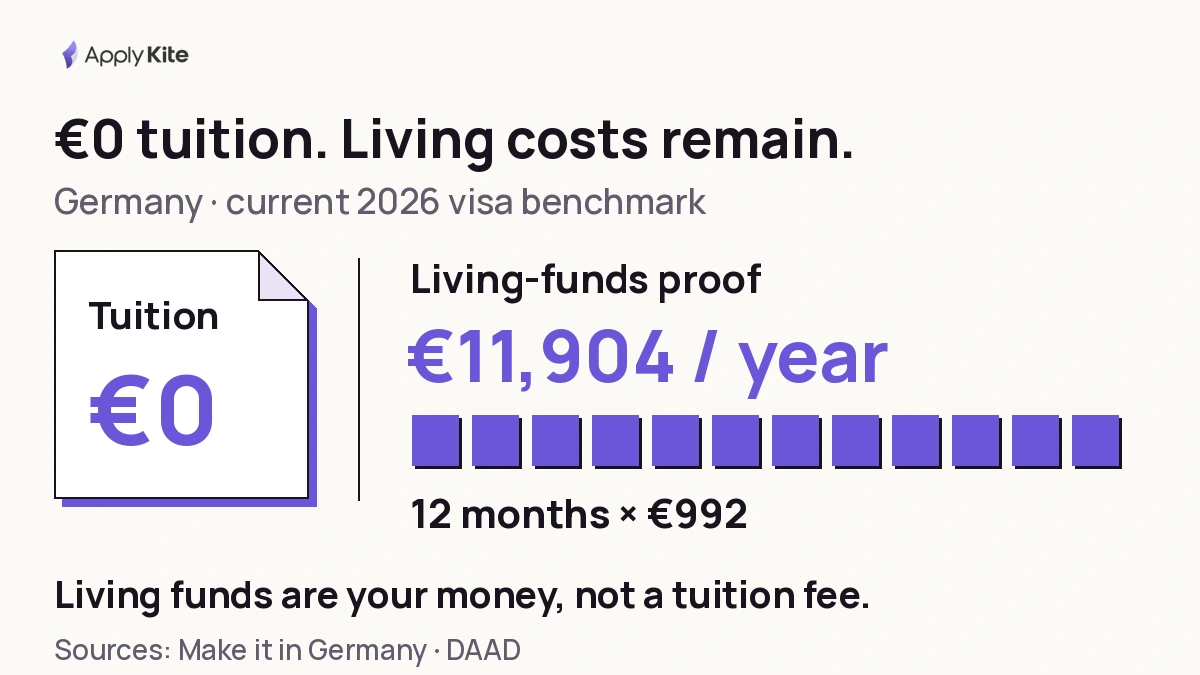
- Germany: You must deposit €11,904 into a German blocked account (Sperrkonto), which releases a maximum of €992 per month once you arrive. Licensed digital providers charge setup and monthly fees (for example, Fintiba charges €159 setup plus €9.90/month; Expatrio charges €119 plus €9/month; Care Concept charges €50 plus €4.90/month). Add a €75 national visa fee and roughly €130 to €151 per month for mandatory statutory health insurance.
- Austria: To obtain a student residence permit (Aufenthaltsbewilligung Student, €218 permit fee plus €195 Visa D fee), students under age 24 must prove €722.58 per month (€8,670.96 per year). Students aged 24 and older must prove €1,308.39 per month (€15,700.68 per year). If your monthly rent exceeds €386.43, you must show additional funds to cover the difference. Public student health insurance (ÖGK) adds €78.84 per month.
- Czechia: According to the Czech Ministry of the Interior, you must document liquid funds of roughly CZK 115,810 to CZK 124,500 (about €5,000 per year) in a personal bank account linked to an internationally recognized payment card, plus a CZK 2,500 visa fee and comprehensive health insurance (CZK 2,000 to CZK 5,000 per month).
- France and Norway: France requires €877.50 per month (€10,530 per year) in living funds in addition to tuition. Study in Norway and the University of Oslo confirm that non-EU students must document NOK 170,368 per academic year (NOK 15,488 per month) on top of their tuition bill, plus a study permit fee of roughly NOK 5,900.
Do not build your budget around covering visa costs through part-time employment. Embassies reject future wage estimates, and work rules are tightening across Europe. In June 2026, the Swedish Migration Agency implemented stricter higher-education residence rules, including a 15-hour weekly work cap for non-EU students.
Tuition-Free Universities vs. Scholarship-Funded Degrees: When a Scholarship Beats Free Tuition
A "free" public Master's degree at LMU Munich costs €0 in tuition, €194 in annual semester fees, and €11,904 upfront in a blocked account. If your family cannot freeze €11,904 in liquid cash, a zero-tuition admission letter is unusable.

By contrast, a fully funded scholarship or a salaried PhD position eliminates both tuition and the personal blocked account deposit because the official funding letter satisfies embassy proof-of-funds rules. In many cases you also get a monthly living stipend of €800 to €1,400. If you don’t have a lot of cash up front, prioritise these four funded routes over unfunded tuition free universities:
- DAAD Scholarships and Deutschlandstipendium (Germany): DAAD Master's scholarships pay roughly €934 per month along with health insurance and travel allowances, replacing the €11,904 blocked account deposit. Once enrolled, international students can also apply for the merit-based Deutschlandstipendium (€300 per month).
- Stipendium Hungaricum (Hungary) and Romanian Government Scholarships: Both government programs cover 100% of tuition at public universities, provide free dormitory housing or a housing contribution, include health insurance, and pay a monthly living stipend for eligible partner-country nationals.
- Erasmus Mundus Joint Masters (EU-Wide): These EU-funded programs waive 100% of non-EU participation fees across multiple partner universities and pay a monthly living stipend that covers relocation and visa maintenance requirements.
- Italy Income-Based Waivers (ISEE) and Salaried European PhDs: At Italian state universities, tuition is tied to documented family income (ISEE). Students with an ISEE up to €22,000 pay €0 tuition and only cover the regional tax and €16 stamp duty. At the doctoral level, PhD positions in Germany, Norway, Sweden, and the Netherlands are frequently structured as paid research jobs rather than fee-paying degrees.
Frequently Asked Questions About Tuition-Free Universities in Europe
Is university really free in Germany for international students?
Yes, both EU and non-EU students pay €0 tuition for Bachelor’s, consecutive Master’s and PhD degrees at public universities in 15 out of Germany’s 16 federal states. You will still pay a compulsory semester fee. Exceptions are made in Baden-Württemberg and some Bavarian universities such as TUM and FAU.
Is Norway still tuition-free?
For students from the EU, EEA and Switzerland Norway continues to be free. If you are an international student from outside the EU and EEA free tuition ended in autumn 2023. Students on exchange from other universities and working PhD candidates still pay no tuition.
Which European countries teach free in English?
Germany is the primary country offering English-taught public degrees with €0 tuition. Iceland also charges €0 tuition (only an annual registration fee) for 2026-27, though non-EEA tuition is planned from Autumn 2027. At the PhD level, English-taught doctoral research is tuition-free, and often salaried, for non-EU candidates in Germany, Norway, Sweden, Finland, and Austria.
Are there application fees?
Direct applications to many German and Austrian public universities are free, but third-party processing and portal fees still apply. In Germany, applying through uni-assist costs €75 for your first program and €30 for each additional application, and applicants from India, China, or Vietnam must pay for mandatory APS academic verification. Czech public universities charge CZK 400 to CZK 1,000 (about €16 to €40) per application, Iceland charges ISK 8,000 (about €53) for international applicants, and Sweden charges SEK 900 (about €80) for non-EU applicants.


