Erasmus Mundus for PhD Students: Joint Doctorates and MSCA (2027)
ApplyKite Editorial
Author

There’s no Erasmus Mundus PhD programme today. The classic Erasmus Mundus PhD programme now funds master’s degrees only. If you’re looking for an EU-funded doctorate, the main option is the Marie Skłodowska-Curie Actions (MSCA) Doctoral Networks, including their joint Doctorate versions, which replaced the old Erasmus Mundus Joint Doctorates.
It's easy to see why applicants often get confused. Erasmus Mundus once supported both joint doctorates and joint masters. However, its last doctoral intake was in 2013. In 2014, the MSCA joint doctorate took over, while Erasmus Mundus continued under Erasmus+ as a master’s programme. That is why searching for an Erasmus Mundus PhD often brings up master’s programmes instead.
Another key difference is how you receive funding. MSCA doesn’t provide a traditional scholarship. Instead, participating universities and other organizations hire doctoral candidates through salaried contracts.
If you’re planning to pursue a PhD scholarship in Europe in 2027, this guide will help you understand what replaced Erasmus Mundus Joint Doctorates, how MSCA pays, who is eligible to apply, and where to find open positions.

What Replaced Erasmus Mundus Joint Doctorates?
Erasmus Mundus began in 2004 as a higher education cooperation programme and ran until 2013. During its second phase, from 2009 to 2013, the programme expanded beyond master’s courses to include joint programmes at doctoral level. These Erasmus Mundus Joint Doctorates offered fellowships that covered up to three years of doctoral activity, and students applied directly to the consortium responsible for running each programme.
Things changed in 2013 when the Erasmus Mundus Joint Doctorates scheme closed. From 2014 onwards, the European Commission supported joint doctorates through the Marie Skłodowska-Curie actions under Horizon 2020. These were introduced as European Joint Doctorates, allowing doctoral candidates to work towards joint, double or multiple doctoral degrees. Each programme had to involve at least three beneficiaries entitled to award doctorates, bringing universities and other eligible institutions together to deliver the degree.
The same pathway continues today under Horizon Europe, through the MSCA Doctoral Networks. There are three types of networks, and the Joint Doctorate is one of them. Depending on the programme, a joint doctorate fellowship may last anywhere from 3 to 48 months.
So, where does Erasmus Mundus fit in today?
Under the current Erasmus+ programme, its focus is on master’s level education through two lots: Erasmus Mundus Joint Masters and Erasmus Mundus Design Measures. Both are described in the Erasmus+programme Guide. This distinction is worth remembering if you are searching for a PhD opportunity in Europe.
Eligibility and the MSCA Mobility Rule
Before applying for an MSCA-funded PhD, you need to meet the programme’s eligibility requirements. These are different from those of many traditional scholarships because MSCA Doctoral Network positions are employment-based and eligibility is assessed on your recruitment date.
The Two Main Eligibility Requirements
1. You must not already hold a PhD: MSCA Doctoral Networks are designed for researchers who are starting their doctoral studies. You cannot already hold a doctoral degree when you’re recruited. If you have defended your thesis but your doctorate has not yet been formally awarded, you may still be ineligible under the programme rules.
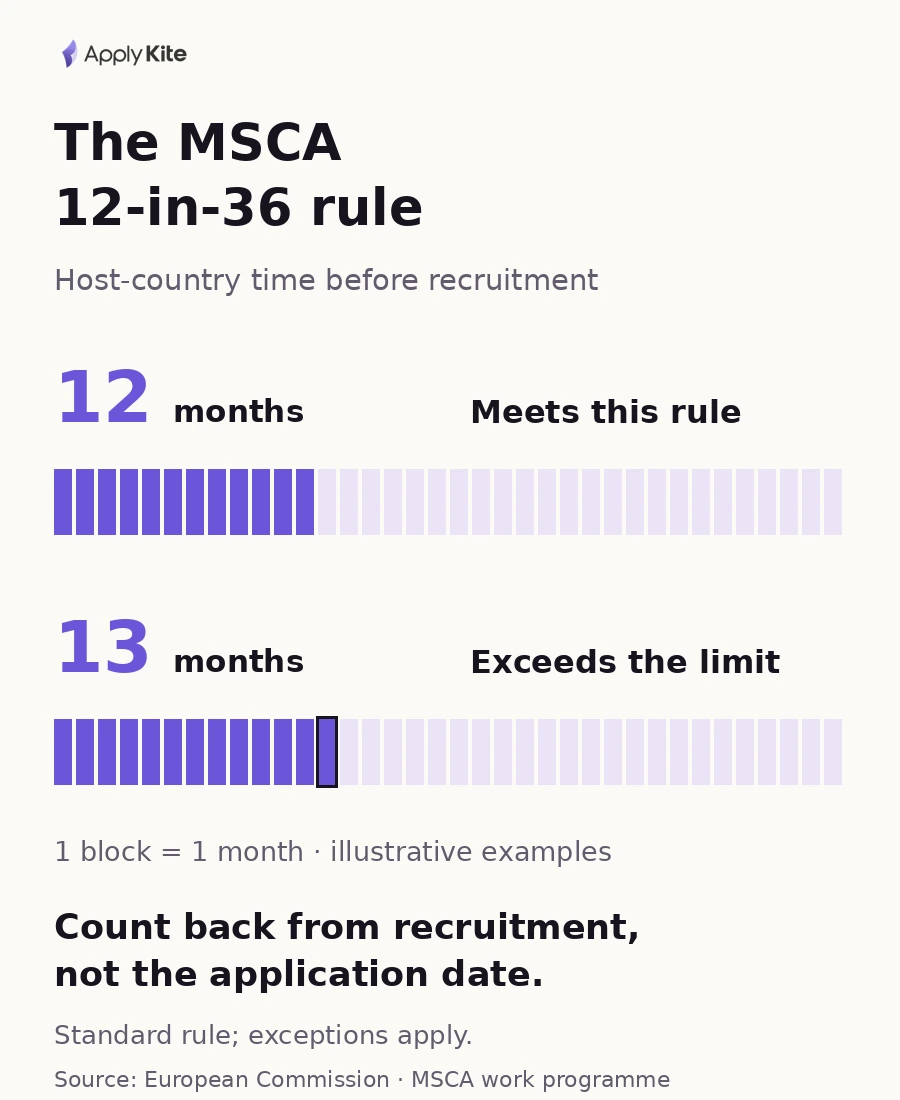
2. You must meet the MSCA Mobility Rule: You cannot have lived or carried out your main activity, such as work or studies, in the country recruiting you for more than 12 months during the 36 months immediately before your recruitment date.
There are also two important conditions:
- You must enroll in a doctoral programme in an EU Member State or a Horizon Europe associated country.
- Applicants of all nationalities can apply, provided they meet the eligibility requirements.
On top of the EU rules, each network sets its own requirements. Most ask for a Master’s degree in a relevant field, or one you will have by your start date. Always read the vacancy notice, because it has the final word.
The mobility rule says you must not have lived in the recruiting organization's country, or carried out your main activity there (work, studies and so on), for more than 12 months in the 36 months immediately before your recruitment date. This is how it works in practice:
Table 1: How the 12-in-36-Months Rule Works
| Your question | The answer |
|---|---|
| When does the 36-month window end? | On the day your contract starts, not the day you apply. |
| Which country counts? | Only the host country. Time elsewhere and secondments don't matter. |
| What time is ignored? | Compulsory national service, short stays such as holidays, and refugee-status procedures. |
| When is it checked? | Once, at your first recruitment. It doesn't change if you're later re-recruited by another partner. |
| Can I work in my home country? | Yes. The rule looks at residence, not nationality. |
Application Timeline Erasmus Mundus for PhD Students
There is no single application date for an MSCA PhD. Each network sets its own closing dates, and some run one call for several positions. Apply when a vacancy that fits you is open.

You may see 24 November 2026 quoted online. That is the EU deadline for organizations submitting network proposals. The EU's call dates are for organizations, and the closing date in a vacancy notice is yours.
Table 2: The EU calendar
| Date | What happens | Who it affects |
|---|---|---|
| 24 Nov 2026 | Proposal deadline, 2026 call | Organizations |
| April to September 2027 | Results, grant signing, first projects start | Organizations, then you (new vacancies) |
| 26 May to 23 Nov 2027 | 2027 call opens and closes | Organizations |
Table 3: Your calendar for application
| When | What to do |
|---|---|
| Now, and ongoing | Check EURAXESS regularly for new vacancies. |
| Before you find a post | Prepare your CV, transcripts, references, and a dated record of where you've lived, so you can apply within days. |
| When you find a fit | Read the closing date in the notice and apply early. Some posts close on a fixed date, and others stay open until filled. Submit every document requested, because incomplete applications may not be reviewed. |
| After you apply | Typically, your application is screened for eligibility, then shortlisted candidates are interviewed. Timelines differ by network. |
| Around and after September 2027 | Watch for new vacancies from networks funded by the 2026 call, as their projects begin. |
How to Find MSCA PhD Positions
Finding an MSCA-funded PhD position is easier when you know where to look and what to check. Although the EU funds the programme, individual research networks and universities recruit PhD candidates directly. This means you need to apply for a specific vacancy.
ApplyKite makes it easier to browse MSCA-funded PhD opportunities from one place. Check the Marie Skłodowska-Curie Actions page for the latest vacancy details such as host institution, country, deadline, funding, and application instructions. You can create a free account to view the complete list.
Always check the original vacancy announcement before applying to confirm the information. You can also explore the PostDoc positions on the same page.
New MSCA positions are published throughout the year, so checking regularly can help you avoid missing opportunities. If you’re interested in other PhD and funding opportunities, ApplyKite also has a wider search tool for scholarships and research positions.
Useful Application Tools on ApplyKite
Preparing several PhD applications can take time. ApplyKite offers a few tools that help you to prepare your application and manage the process easier.
- Eligibility checker: See how your profile compares with a position’s requirements.
- CV matcher: Check how well your CV fits a vacancy.
- SOP generator: Get help drafting your application statement.
- Supervisor finder: Search for potential supervisors and available professors in your field.
- Application Tracker: Keep your application organized.
You can also contact a mentor for personal guidance on choosing positions or preparing an application. Get in touch with people in your field and use their experiences and guidance for a better outcome and a more efficient application process.
What to Expect When Applying for MSCA PhD Positions
For prospective PhD students, one detail is especially important. You’re actually applying for an advertised position, not directly for EU funding. The EU provides funding to the network, and the participating organization uses it to recruit doctoral researchers. Vacancies are filled through an open, transparent, merit-based selection process. If you’re selected, the recruiting organization employs you.
Once you join a network, you enroll in a doctoral programme and carry out research linked to the network’s wider research goals. Your training may involve collaboration with several partners, including organizations outside academia, such as businesses. You also develop research expertise and transferable skills, which can be useful whether you plan to stay in academia or explore careers in industry and other sectors.
The range of opportunities is broad. The MSCA Doctoral network cover all fields reasearch , so you can search for positions that fit your subject, background and career plans.
Before exploring vacancies, it helps to know that MSCA Doctoral Networks come in three types: standard, industrial, and joint. The main differences between them concern how doctoral training is organized and the kinds of experiences candidates gain.
One final distinction that will help you find the right opportunities is how MSCA Doctoral Networks support researchers who are pursuing a doctorate, while MSCA Postdoctoral Fellowships are intended for researchers who have already completed one. If your goal is to start a PhD, focus on Doctoral Networks and their advertised doctoral positions.
How MSCA Pays: Salary, Not Stipend
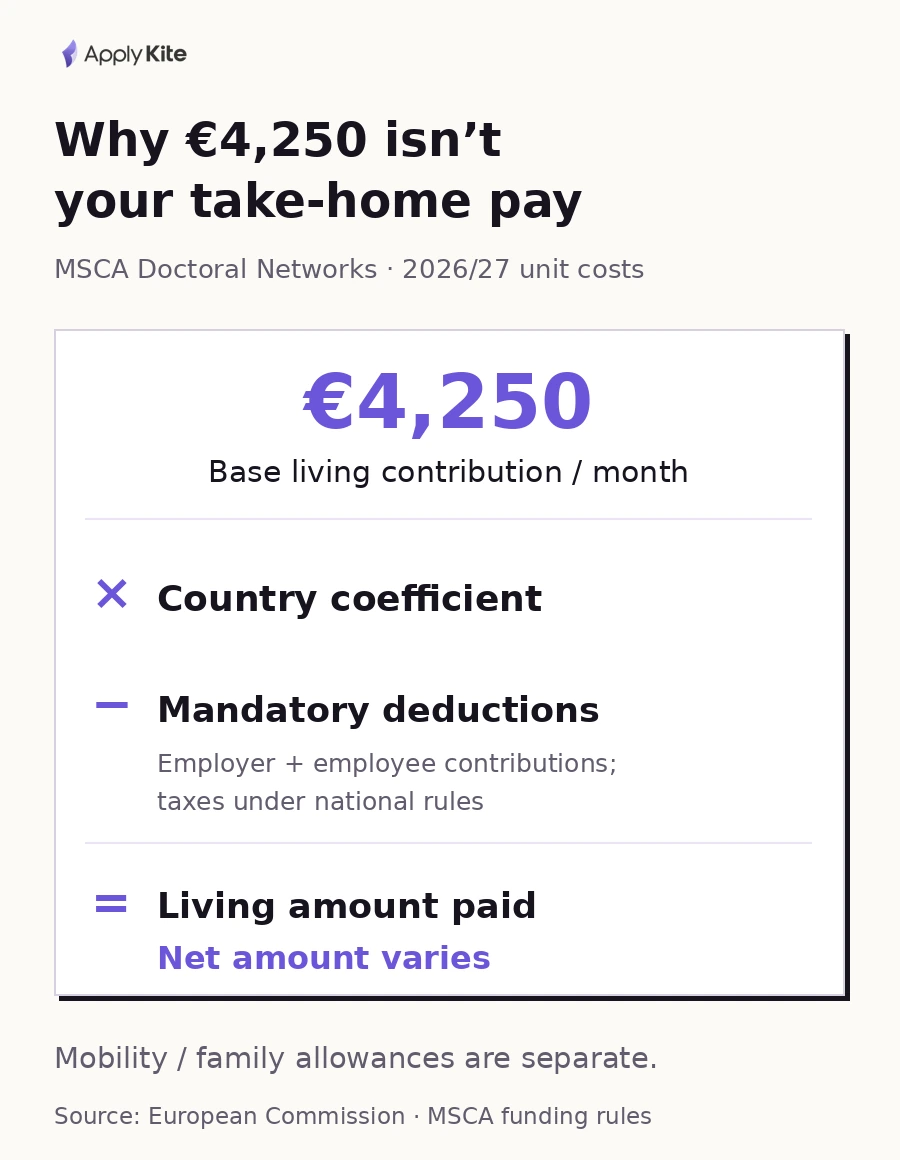
MSCA is sometimes described as a PhD scholarship, but the funding model works differently from a traditional scholarship. As a doctoral researcher, you’re recruited by one of the organizations in the network, usually under an employment contract or an equivalent direct contract that provides full social security coverage. Instead of receiving a stipend, you earn a salary paid through the EU funding awarded to your employer for your position.
Certain cases, such as when the host organization may offer a fixed-amount fellowship instead. When this arrangement is used, the living allowance is reduced by half. The EU determines the funding through fixed monthly amounts for each researcher.
Table 4: What the EU pays per doctoral candidate per month (2026 call)
| Component | Amount per month | What it covers |
|---|---|---|
| Living allowance (before country coefficient) | €4,250 | Your gross salary costs, including employer and employee contributions |
| Mobility allowance | €710 | Your private mobility costs; paid to every candidate |
| Family allowance (if applicable) | €660 | Family-related costs; paid to you |
| Research, training and networking | €1,600 | The host’s research and training costs for you |
| Management and indirect costs | €1,200 | The host institution’s general costs |
Frequently Asked Questions
Does Erasmus Mundus offer PhD Scholarships?
No. Erasmus Mundus Joint Doctorates ended in 2013, and the programme now funds only Joint Master degrees. EU-funded PhDs are available through MSCA Doctoral Networks.
What replaced Erasmus Mundus Joint Doctorates?
MSCA joint Doctorates, introduced in 2014 with Horizon 2020. They sit inside MSCA Doctoral Networks and lead to joint or multiple degrees.
How much funding do MSCA doctoral candidates receive?
For the 2026 call, the EU contribution includes a monthly living allowance of €4,250, adjusted by a country correction coefficient, plus €710 for mobility and an additional €660 for eligible candidates with family obligations. Actual gross salaries depend on the host country and recruitment institution.
What is the MSCA mobility rule?
Applicants must not have lived or carried out their main activity, such as work or studies, in the host country for more than 12 months during the 36 months immediately before recruitment.
Can applicants from outside the EU apply?
Yes. MSCA Doctoral Networks welcome candidates of all nationalities, provided they meet the mobility requirements and do not already hold a doctoral degree.
Can students apply directly to the 2026 MSCA Doctoral Networks call?
No. The funding call is intended for organizations forming research and training consortia. Prospective PhD candidates must apply directly to vacancies advertised by funded networks.
Is the funding long enough to finish a PhD?
MSCA funds each doctoral fellowship for up to 36 months (up to 48 for Joint Doctorates). If your host’s doctorate takes four years, ask how the extra time is financed before you accept.
What is a Cotutelle PhD?
A Cotutelle PhD is a doctoral programme jointly organized by two universities, usually in different countries. The student has a supervisor at each institution and divides their research time between both countries. They receive either one joint doctoral degree or separate degrees from each university. Funding and eligibility depend on the specific programme.
What is the difference between an MSCA Industrial Doctorate and a Joint Doctorate?
Both are MSCA-funded doctoral programmes involving at least three organizations from different countries and offering a salary. An Industrial Doctorate involves joint academic and non-academic supervision, with at least 50% of the research time spent outside academia. A Joint Doctorate involves a jointly organized doctoral programme and shared supervision, leading to either one joint degree or multiple doctoral degrees.


