South Korea has become a top-tier destination for international master's graduates and doctoral degree candidates due to numerous advanced educational institutions and excellent universities such as KAIST (Korea Advanced Institute of Science and Technology) and Seoul National University (SNU), which consistently rank among the world's elite. These universities have been offering high-quality research environments and a thriving community of talented scholars, comparable to those at institutions in North America or Western Europe.
In this article, we are going to explore the Cost of a PhD in South Korea 2026, analysing the latest fees, the often-overlooked housing deposits, and the best funding avenues explicitly designed for international researchers.
If you are dreaming of a perfect country with vibrant universities and a flourishing environment, this article is for you. Plus, we will guide you with ApplyKite’s services, making your journey easier and helping you decide faster and more effectively. Understanding the key factors that determine the cost of a PhD in South Korea is the first step toward securing an affordable, high-return doctorate.
Read more: Global Korea Scholarship (GKS)

2026 Tuition Breakdown: Public vs. Private Universities
When it comes to pursuing a doctoral degree, many still dream of a position at an American or European university or institution. However, over the past two decades, the world has witnessed South Korea's rise as a global research and development (R&D) powerhouse across various fields. But what has made South Korea so popular and widely known among PhD candidates?
In simple terms, a blend of a high-quality education system, a promising career path, and affordable fees has made South Korea a desirable destination for a PhD. There is a wide range of excellent institutions well-known for their dedication to modernising education and research across many areas and fields. Plus, there are many financial aid programs helping students to cover the cost of a PhD in South Korea in 2026.
Regardless of your academic background or subject you have studied, there are many valuable opportunities available in South Korea, with an incredible curriculum and training that prepare students for the market and future careers. On top of high-ranking universities and cost-effective fees, South Korea is also home to many well-known companies with a strong global presence, making it a perfect place to live and pursue a professional path after graduation.
Low-cost Fees with Strong Research Environment, From Humanities to Engineering
Affordable tuition is not limited to popular fields like engineering. Various subjects, from the arts to urban studies and even sociology, are available at top universities. South Korea is the ultimate destination for international students in STEM and Humanities seeking affordable, high-impact research. South Korea presents an undeniable value proposition.
It should be noted that this affordability is conditional and varies based on each student's situation, resume, and other circumstances. Many factors impact tuition fees and make them affordable, including the country’s unique housing deposit system and the specifics of government-backed scholarships, which are critical for financial success.
The most crucial financial variable when assessing Tuition fees in South Korea is the institutional category: public or private. So you need to be careful when choosing a university. If you are looking for a reliable source to find the most recent position for a doctoral degree in South Korea, check on the ApplyKite’s website now and see the differences and available choices. ApplyKite can work as a guide and help you understand better how to afford the Cost of a PhD in South Korea 2026.
National universities, which receive substantial government subsidies, remain the most cost-effective option, as in many other European countries, including Germany, France, and even the UK. These include institutions like Pusan National University, Chonnam National University, and all four campuses of the Korea National University of Education. Private universities, conversely, have the autonomy to set higher rates. The prestige and rank of the university often correlate directly with the tuition charged.
Read more: PhD opportunities in south korea
What is the Estimated Cost of a PhD in South Korea in 2026?
Although many funded and low-cost fee positions are available for doctoral degrees across various subjects, students should note that the field of study significantly affects overall costs. Generally, STEM fields, particularly Engineering, Medicine, and Biotechnology, typically charge 15–20% more than Humanities and Social Sciences.
This system of budget allocation is similar to those in many other advanced education countries. It may seem odd, but the main reason behind fund distribution is the higher operational costs of maintaining labs, equipment, and cutting-edge facilities.
However, students should not be discouraged and disappointed by higher sticker prices in STEM. A crucial mitigating factor is that these higher-cost programs almost universally offer more lab-based funding opportunities.
One of the most critical factors to know here is that many research labs often secure external contracts and grants that can fully offset or dramatically reduce the stated Tuition fees in South Korea. We will explain this factor further in the funding section and options available for international students to make the cost of PhD in South Korea 2026 more affordable.
So don't be scared of the high tuition fees in these STEM fields, because the final out-of-pocket cost is often minimal for a driven researcher. On the other hand, the humanities and arts are more affordable and cost-effective than STEM, but funding mechanisms are typically fewer and more competitive.
The estimated costs for the 2026 academic year are summarised in the table below, reflecting a projected 3–5% increase from the 2025 rates.
Read more: How to Apply for a PhD in South Korea
Looking for fully funded?
Discover PhD, Master's, and Postdoc positions tailored to your goals with ApplyKite's smart AI tools.
Living Expenses: The "Seoul Premium" and the Key Money Trap
Although scholarships can cover or even eliminate fees and educational costs, day-to-day living expenses remain a significant challenge. When it comes to living expenses, accommodation and rent are the most critical components of the overall Cost of a PhD in South Korea 2026. Let's check the most attractive city for doctoral study in South Korea: Seoul, the capital, with excellent universities and a major economic centre. The cost of living in Seoul is naturally higher than in other cities, though the job opportunities and career prospects are also more promising.
If you are looking for an estimated number of living expenses in Seoul, you should know that your lifestyle and budget are highly effective on the overall monthly costs. In Seoul, a realistic amount is around $1,200 per month or higher. This includes housing (outside of dorms), food, transportation, and utilities, on average.
In contrast, regional science hubs known for their R&D output, such as Daejeon (home to KAIST) or Pohang (home to POSTECH), offer lower living costs, averaging $800–$1,000 per month. Keep in mind that these are only estimated average costs, and the situation may vary by each student's circumstances and financial support.
The main difference between an expensive city like Seoul and a less expensive one like Busan is housing prices. While Busan is a large metropolitan city, it falls somewhere between these two extremes, often offering housing at 20-30% less than in Seoul.
Navigating the Key Money (Deposit) System in South Korea
Each country has its own financial system, which students should understand before applying. In South Korea, the most significant financial hurdle for incoming international students is the Wolse system. Although it's not uncommon, many other countries, such as Germany, require this type of financial approval. South Korea's system is based on a mandatory Key Money or deposit system.
This is a vital hidden cost that is rarely covered by standard scholarships. So it's better to consider it before making the final decision. Now, let's get into the details of this key money. Wolse is the standard rental agreement in South Korea for international students, which mandates tenants to pay a low monthly rent (often $400–$600 for a small studio) but requires them to provide a large, one-time, refundable security deposit, known as key money.
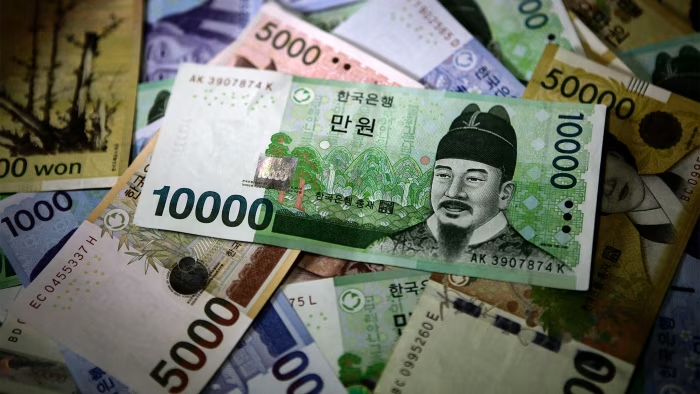
This deposit, which is a substantial part of the cost of studying as a PhD candidate in South Korea, typically ranges from ₩5,000,000 to ₩10,000,000 KRW ($3,800–$7,500 USD). These are just estimated amounts, and the cost can easily rise much higher in prime areas of Seoul. While this money is returned to the tenant at the end of the contract (assuming no damage), it must be paid up front. So you have to include it in your primary expenses even if you receive grants or scholarships.
This substantial upfront payment requires significant savings before arrival for international students, and they must be prepared to provide a budget sufficient to cover this massive initial outlay, even if their accommodation and other monthly expenses are low.
The Golden Ticket: GKS Scholarship 2026 We can't talk about the cost of a PhD in South Korea 2026 without mentioning one of the most popular scholarships known as the GKS (Global Korea Scholarship, formerly KGSP), which is the gold standard of Korean academic funding. This scholarship offers one of the best financial aid systems with an end-to-end funding package. The budget and support for this scholarship play a massive role in reducing and eliminating the final financial burden on international doctoral candidates seeking to study in South Korea. Let's check some of the advantages and details of this fully funded research journey. Recipients of the GKS in South Korea benefit from: Full Tuition Coverage: Tuition is paid directly to the university. Monthly Stipend: A generous stipend (typically ₩1,000,000 KRW, or ~ $770 USD) to cover living expenses. One-Year Korean Language Training: Mandatory pre-degree language courses. Airfare: Round-trip economy class tickets to and from Korea. Settlement Allowance: A one-time payment upon arrival. Just as with many other grants and scholarships at top universities around the world, applying for the GKS Scholarship 2026 is highly competitive due to its exceptional benefits and a secure academic path that minimises financial burden. Applications for the university track typically open in February or March of the academic year and require meticulous preparation of transcripts and letters of recommendation. If you need to know more about this scholarship and whether you fit into it or not, use ApplyKite’s AI search tool. All you need to do is submit your resume or simply explain your academic journey, and you'll get detailed, specific feedback tailored to your unique situation and needs. Instead of endlessly wandering the web and checking unreliable sources, use this super-fast, simple tool designed exclusively for international students. Besides GKS, another popular funding avenue, primarily designed for STEM and highly funded humanities labs, is BK21 FOUR (Brain Korea 21 Phase 4). This is one of the most competitive funding and financial aid programs, designed to inspire talented individuals to pursue their dreams at world-class graduate schools and to fund research teams at top institutions in South Korea. The process differs from that of other scholarships. First, you need to find a supervisor or professor’s lab or department that is officially established for BK21 FOUR participants to offer a stable and effective source of research funding that directly benefits graduate students. Students who enrol and are accepted in a BK21-affiliated program are guaranteed a monthly research allowance adequate to cover educational and living expenses. This is one of the best opportunities for international PhD candidates seeking flexible and reliable programs to afford the Cost of a PhD in South Korea 2026. When emailing professors to secure supervision, explicitly ask if their lab is a BK21 participant. The Research Engine: BK21 FOUR Funding
Where to Start the Application Process for a PhD in South Korea?
If you are applying for a PhD position in South Korea, you need to define a clear path and a practical approach. Your first step should be to check the universities and find your field of interest. Then you have to check the positions and programs.
Depending on the university and the requirements, finding a supervisor in your subject is also a significant challenge. The good news is you can do all three steps on a single platform. All you need to do is check on the ApplyKite solution service and filter it based on your needs, interests, and situation.
Plus, it's essential to start the financial planning now, while choosing the city and university, before filing any application. Start preparing your GKS Scholarship 2026 application materials in February 2026 or, for the most direct route to funding, identify and contact BK21 FOUR funding labs directly. These are the most effective strategic methods to completely offset the cost of a PhD in South Korea in 2026.
Conclusion
South Korea offers an exceptional, high-return-on-investment (ROI) opportunity for international master's graduates. Compared to the five- and six-figure tuition costs in many Western countries, the Cost of a PhD in South Korea 2026 is already competitive, with annual tuition often falling below $15,000 even at the most elite private institutions.