Taught vs Research Master’s: Funding, PhD Entry & an 8-Question Checklist
ApplyKite Editorial
Author

The wrong master’s can cost you thousands of dollars, derail a visa timeline, or leave you in coursework when you needed lab and publication time. An MSc or MPhil also means different things in London, Toronto, Melbourne, and Amsterdam.
Taught or research comes down to how you learn, who pays, and where you want to work afterward. Here’s how both tracks work in the main study destinations.

The Short Answer
- Want a PhD or an R&D research job? Pick a research master's (PGR), or a taught master's that includes a substantial, separately graded thesis.
- Want practical skills for industry or to switch into a new field? Pick a specialised taught master's (PGT), it's the most common route for a reason.
- Want to qualify for a regulated profession? Pick a professional taught master's, and confirm that the licensing body in the country where you want to work officially recognizes that exact course.
- Need funding to study? Check research master's routes first, especially in Canada or within UK 1+3 doctoral pathways, unless you're applying for taught-only government awards like Chevening.
| Feature | Taught Master's (PGT / Coursework) | Research Master's (PGR / Thesis-Based) |
|---|---|---|
| Core Structure | Fixed schedule of modules, lectures, and seminars plus a final project. | Independent research project under faculty supervision; minimal classes. |
| Typical Length | 1 year (UK) or 1.5–2 years (Europe, Canada, Australia). | 1 year (UK MRes) or 1.5–2 years (MPhil, Canada, Australia, EU). |
| Thesis Weight | Usually ~25%–33% of total credits (e.g., 60 of 180 UK credits; 30 of 120 ECTS). | Usually 60%–100% of credits (e.g., 105–180 UK credits; 50–90 ECTS). |
| Assessment | Written exams, essays, group work, presentations, and a capstone dissertation. | Extended thesis (up to 30,000–35,000 words) and sometimes an oral exam (viva). |
| Funding Reality | Mostly self-funded or loans; eligible for major schemes like Chevening. | More access to TA/RA stipends, supervisor grants, and 1+3 PhD studentships. |
| PhD Progression | Accepted if your dissertation is rigorous, though you apply for PhD funding separately. | Direct training for a PhD; sometimes bundled into a funded 1+3 or MPhil upgrade track. |
| Typical Careers | Corporate roles, management, consulting, and accredited professions. | Academic research, PhD track, industrial R&D, biotech, AI, and policy labs. |
Understanding the Core Difference: Taught vs. Research Master’s Degrees
Postgraduate taught (PGT) and postgraduate research (PGR) differ in how you spend your week and how you’re assessed.
According to the UCAS postgraduate definitions, PGT works much like a bachelor’s: a set timetable of core and elective modules led by professors.
In PGR, your main job is to generate new knowledge or test a specific question on your own, guided by one or two supervisors.
Is postgraduate taught the same as a master’s?
Not always. Taught and research master’s both sit at Level 7 in England, Wales, and Northern Ireland, and at Level 7 in the European Qualifications Framework. But “postgraduate taught” also covers shorter Level 7 awards: the Postgraduate Diploma (PGDip, usually 120 UK credits) and the Postgraduate Certificate (PGCert, usually 60). Those usually skip the dissertation and may not meet a PhD’s research-entry requirements.
Can’t tell how a program is classified? Open ApplyKite Twin beside any opportunity in your dashboard to see how its requirements match your profile before you spend hours applying.
Taught vs. research master’s: structure and learning
Both take roughly the same total hours. The difference is where those hours go.
Credit split
“180 UK credits” or “90 to 120 ECTS” on a course page won’t tell you whether a degree is taught or research-based. Two UK credits equal about one ECTS credit, so a 1-year UK master’s (180 credits) is 90 ECTS, and a standard 2-year European master’s is 120 ECTS. What separates the two types is how the credits are sliced.
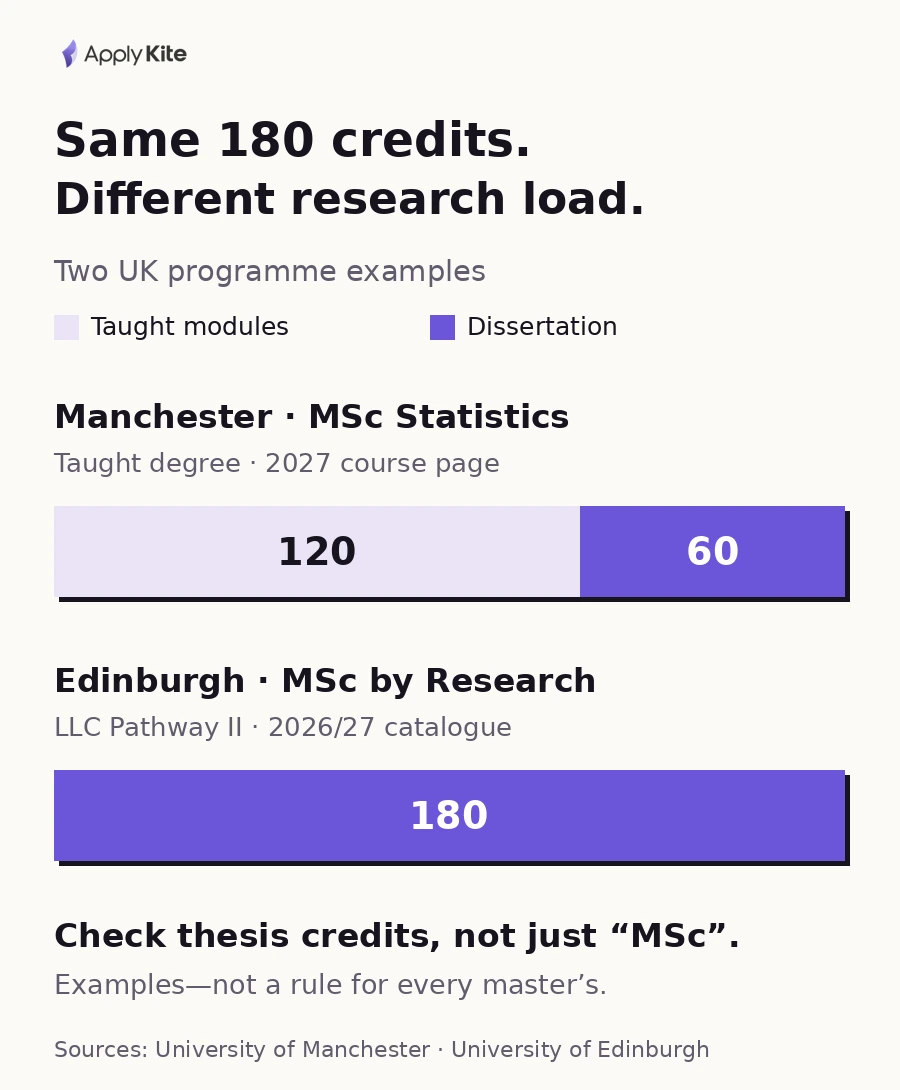
- Taught: A 180-credit UK MSc, such as the model at the University of Manchester, has eight 15-credit units (120 credits) across autumn and spring, then a 60-credit summer dissertation, one-third of the degree. A 2-year European taught master’s (120 ECTS) puts about 90 ECTS into classes and exams and 30 into the thesis.
- Research: In UCL’s 180-credit MRes, the research project must take 105 to 150 credits, leaving a small fraction for research skills modules. Edinburgh’s MSc by Research can put all 180 credits into one 30,000-word dissertation. A 120 ECTS European research master’s puts 50 to 90 ECTS into lab work and thesis.
Module names can mislead. Many taught master’s include a compulsory “Research Methods” class, but it only helps you write your summer report. It doesn’t make the degree a research master’s.
Classroom vs. independent research
Neither is harder overall, but they suit different habits.
- A taught master’s is social and externally paced: lectures, seminars, lab groups, a cohort. The pressure is absorbing heavy material fast and juggling overlapping deadlines. Conversion courses can assume background knowledge you’ll have to catch up on yourself.
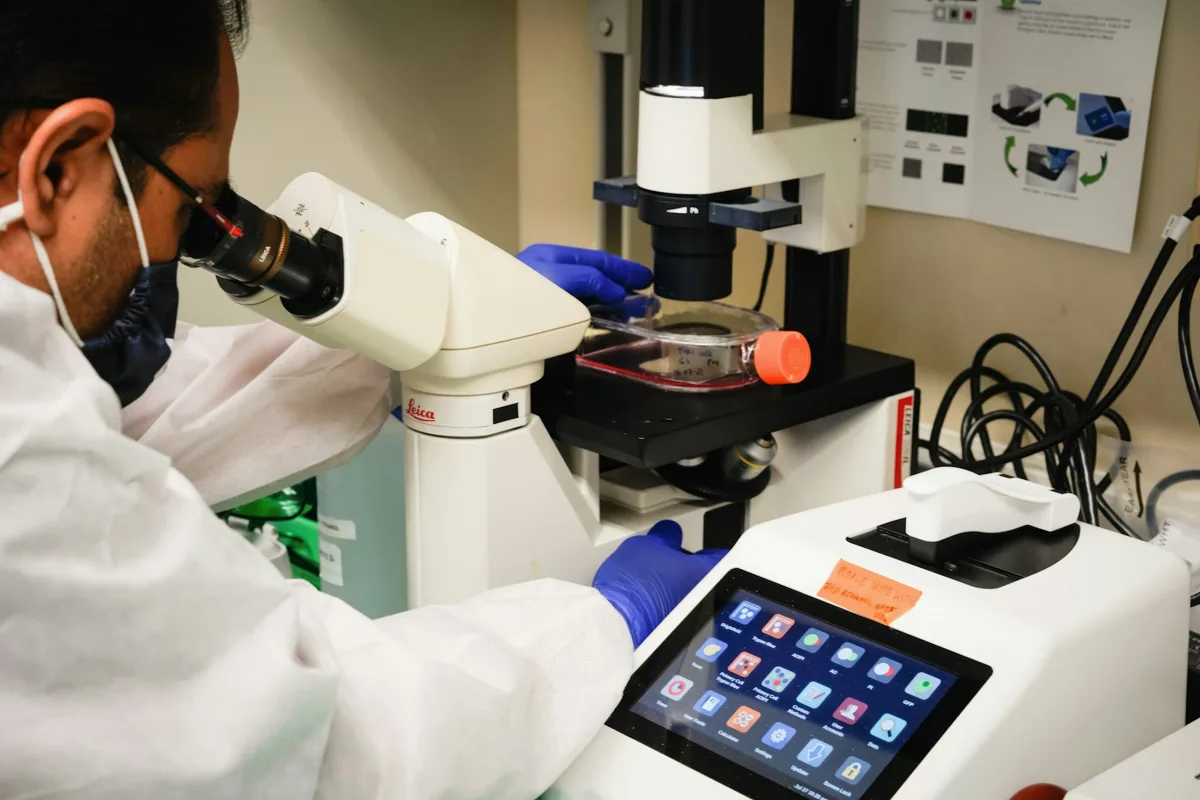
- A research master’s is quiet, sometimes uncomfortably so. With few fixed classes, you structure your own week, troubleshoot failed experiments, and push the project along with periodic supervisor check-ins. That’s liberating if you like autonomy, and isolating if you rely on weekly deadlines.
Assessment
Taught: Continuous assessment through unseen exams, term essays, group projects, lab reports, and a shorter capstone or dissertation.
Research: Your grade rests on one or two major outputs, usually a 20,000 to 35,000-word thesis, plus any graded methods units. Depending on the university and degree, especially for an MPhil or a Canadian thesis master’s, you may also defend it orally in a viva voce.
Degree titles: MA, MSc, MRes, MPhil, and professional degrees
The UK’s QAA Master’s Degree Characteristics Statement warns that master’s abbreviations have no nationally regulated definitions, so MSc and MA appear across several categories.
Taught and specialised (MA, MSc, MEng, LLM, MBA): Built to deepen subject knowledge or let you switch fields from a different bachelor’s. They combine advanced modules with a final project worth about a third of the credits.
Research-focused (MRes, MSc by Research, MPhil): Even here, abbreviations vary by university.
- MRes: In many UK departments, it’s a 1-year structured research training degree (about 20% to 33% taught methods, 67% to 80% placements or thesis) for future PhD applicants or industrial R&D researchers. Some universities use MRes, MbyRes, or ResM for a pure research degree with almost no classes.
- MSc/MA by Research: Usually 1 to 2 years of thesis work on a set topic, with little or no teaching.
- MPhil: Typically 1 to 2 years of pure research (0% to 10% taught), with more autonomy than an MRes. In the UK, Australia, and parts of Europe it’s either a standalone degree or the first-year registration stage of a PhD, where a confirmation review after year one upgrades you to full PhD status. If the project doesn’t continue, you may exit with an MPhil if its requirements are met.
- Cambridge exception: Don’t assume an MPhil is pure research. Most Cambridge MPhils are 1-year taught courses, and only a smaller group are assessed solely by thesis and oral exam.
Professional and executive (MBA, LLM, MEng, MEd, MSW): Coursework-heavy programs for career advancement or licensing, often built with industry accrediting bodies. They include clinical placements, internships, or case studies rather than lab research.
Funding: TA/RA grants vs. self-funded degrees
Why research master’s get more funding
A research master’s isn’t automatically cheaper, and fees vary by university and subject. MRes tuition can be lower in management at Liverpool and economics at Bristol, while Lancaster (management) and Northumbria (psychology) can charge the same for both tracks. In humanities an MRes often costs less than a taught MA. In STEM it may match an MSc and add lab bench fees. Check current fees before comparing offers.
Research master’s win on stipends and integrated pathways:
- UK 1+3: UKRI councils like the ESRC don’t fund standalone master’s, but they heavily fund 1+3 DTPs and CDTs. A 1-year MRes and 3-year PhD are funded as one 4-year studentship covering tuition and a stipend.
- Canada: Thesis-based master’s students are routinely offered funding stacks of TAs, RAs, and supervisor grant stipends. Course-based students are almost always excluded.
- University awards: Some schools fund MRes entrants, such as the joint scholarship for Vietnamese applicants at the University of Southern Queensland.
To spot funded master’s studentships and 1+3 programs as they’re posted, filter 100,000+ verified openings by level, field, and location on Explore Academic Positions Worldwide.
Government scholarships
- Research wins (Canada): The Canada Graduate Research Scholarship – Master’s (CGRS-M), run by CIHR, NSERC, and SSHRC, pays CAD $27,000 for 12 months to eligible citizens, permanent residents, and protected persons. The program needs a significant, merit-reviewed research component, so pure course-based master’s are ineligible.
- Taught wins (UK international scholarships): Chevening and Commonwealth Master’s Scholarships require a 1-year taught master’s and explicitly ban MRes and research-focused degrees.
- Equal (UK domestic loans): England’s Postgraduate Master’s Loan, up to £13,206 for courses starting on or after 1 August 2026, covers any full standalone 180-credit master’s, taught or research.
Self-funding
Outside competitive awards like Chevening or DAAD, most international taught master’s students pay out of pocket, from family savings, or with private loans.
Even a funded Canadian thesis master’s needs a careful read of the offer letter. Tuition may be deducted from your gross package, an external scholarship can reduce an internal award, and funding may cover only one year of two. Check these in the exact departmental offer, whether it’s OISE/University of Toronto, McGill, or elsewhere.
Does your choice affect your PhD chances?
Students often ask whether a taught master’s ruins their PhD chances. It doesn’t. A master’s is Level 7 in England, Wales, and Northern Ireland, while a doctorate (PhD/DPhil) is Level 8 and requires an original contribution to knowledge. Integrated and professional doctorates may include classes, but the PhD stays a research degree.
England’s LEO release for 2019/20 shows that five years after graduation, 16.6% of UK-domiciled Level 7 research master’s graduates were in further study, against 10.1% of taught graduates. The 2018/19 release found roughly 40% of research master’s graduates in further study at one and three years. Further study isn’t a PhD-only count, so these figures don’t measure PhD admission chances.
A taught master’s is often the smarter pre-PhD choice if you’re switching subjects, say from undergraduate zoology to animal welfare science, and need the fundamentals first. Just make sure it has a substantial dissertation. Entering the University of Melbourne’s PhD (Arts) requires a master’s with a research component worth at least 25% of one full-time year. In some UK departments, such as Economics at Nottingham, an MRes/PhD is a normal integrated entry route, so check the department’s direct-entry requirements. See our PhD application timeline guide for how the routes connect.
What ApplyKite data shows
In ApplyKite’s dataset of funded university openings:
- MSc outnumbers MRes almost 9 to 1: MSc appears 528 times, MRes 60.
- MRes is concentrated: Funded MRes openings sit almost entirely in the UK and Australia.
- MRes still counts for PhD entry: PhD listings name it as an eligible route as often as an MA.
An MSc is the most common funded route, and funded MRes listings are scarce but well recognized for PhD entry.
Why a research master’s helps your PhD application
- Proof you can work unstructured: A substantial thesis shows you can design a methodology, handle failed experiments, and finish a long project without weekly hand-holding.
- A stronger reference: In a taught cohort of 150, a lecturer may know mainly your exam grades. A research advisor works with you all year and can speak to your readiness.
- Conditional progression: In integrated MRes-to-PhD programs like UCL’s Security Science pathway, you move into the MPhil/PhD stage once you hit threshold marks, such as 60% in the research project and 50% in taught modules.

Contacting supervisors
For a taught master’s you almost never contact professors first, since admissions grades your transcripts and Statement of Purpose centrally.
For a research master’s, and for PhDs in the UK, Australia, and Canada, finding a supervisor comes first. In Cambridge Pharmacology and Oxford science departments, research-route applicants are expected to contact a supervisor before or during the application. Taught MPhil applicants pick supervisors after they arrive.
A cold email works best at 150 to 200 words. Put your research topic in the subject line, cite one or two papers from the last three to five years, and tie your past thesis or lab work to the professor’s current research. Search 800,000+ profiles on Explore Professors and Research Supervisors, then use ApplyKite Twin to draft a tailored email.
Post-Study Work Visas & Global Immigration Policy Differences
| Country | Post-Study Visa | Taught Master's Stay | Research Master's Stay | Key Visa & Dependant Differences |
|---|---|---|---|---|
| United Kingdom | Graduate Route | 2 Years (18 months if applied on/after Jan 1, 2027). | 2 Years (18 months from Jan 1, 2027; 3 years for PhDs). | Student visa dependants only allowed for government-sponsored students or CAS-verified research degrees. |
| Australia | Temporary Graduate (Subclass 485) | Up to 2 Years. | Up to 3 Years. | Generally 35 or under for Coursework Master's; under 50 for Master's by Research and PhDs, with exceptions. |
| Canada | Post-Graduation Work Permit (PGWP) | Up to 3 Years. | Up to 3 Years. | Master's graduates qualify for up to a 3-year PGWP even on 1-year courses (if program rules are met). |
| United States | OPT / STEM OPT | 12 Months (36 Months for STEM). | 12 Months (36 Months for STEM). | STEM extension depends on the CIP subject code, not whether the degree is taught or thesis-based. |
United Kingdom: Graduate Route and dependant rules
Under current UK Home Office rules, the big split comes during study. For courses starting from January 2024, taught master’s students generally can’t bring dependants unless they’re government-sponsored on a course longer than six months. Eligible postgraduate research students on courses of at least nine months may bring dependants, so confirm the research classification on your CAS. For sensitive STEM subjects, ATAS clearance can apply to either route and asks whether the course is Taught or Research.
After graduation, taught and research master’s graduates get the same Graduate Route duration shown above: two years for applications before 1 January 2027, then 18 months. PhD graduates keep three years.
Australia: 485 visa age limits
Australia separates the routes under AQF Level 9 and immigration law. The Subclass 485 table above shows the standard stays. Coursework applicants generally must be 35 or under, while master’s-by-research and PhD graduates can apply under 50. Different stay periods and exceptions apply to eligible Indian nationals under AI-ECTA and to Hong Kong/BNO passport holders.
Canada: PGWP and PR
Both routes can qualify for a PGWP of up to three years at eligible institutions, subject to program and language requirements. Canadian skilled work experience can then support Express Entry (Canadian Experience Class) or provincial nomination. A thesis-based degree also supports applications for funded Canadian PhDs.
United States: OPT, STEM extensions, and H-1B
Eligible F-1 graduates get 12 months of OPT. The extra 24-month STEM extension depends on the degree’s eligible CIP code and other requirements, not on whether you wrote a thesis. Staying longer often means switching status, such as to an employer-sponsored H-1B, including qualifying cap-exempt academic roles.
Global comparison
Here’s how the two routes are organized in the main destinations:
- UK: Mostly intensive 1-year master’s (12 calendar months full-time, 180 UK credits) for both taught MSc/MA and MRes, while MPhils take 1 to 2 years. Our 1-year UK master’s guide explains the 12-month calendar.
- Canada: “Thesis-based” (2 years, funded through TA/RA/supervisor grants, a common route into a Canadian PhD) or “course-based/professional” (1 to 2 years, self-funded, built for industry jobs).
- US: Most standalone master’s (MS/MA/MBA) run 1.5 to 2 years, are coursework-heavy, and are self-funded, though occasional TA/GA roles exist. Students who want research training usually apply straight to a 5-year integrated PhD from their bachelor’s.
- Australia and New Zealand: Regulated under AQF Level 9 (NZQF in New Zealand) as “Master’s by Coursework” or “Master’s by Research.” Monash University’s Science Master’s by Research, for example, is a 2-year full-time investigation ending in a 35,000-word thesis.
- Mainland Europe and the Netherlands: Commonly 2 years and 120 ECTS. In the Netherlands, “Research Master’s” (2 years, 120 EC) is an official label accredited by the Dutch-Flemish Accreditation Organization (NVAO), and only programs listed with “(research)” in the register count. In Germany, public universities are often tuition-free or low-cost, and let you choose an “application-oriented” or “research-oriented” profile within a 2-year master’s.
How to Choose: Decision Framework & 8-Question Checklist
| Your Main Goal After Graduation | Best Master's Route to Pick | What to Prioritize on the Course Page |
|---|---|---|
| Start a PhD soon in the same field | Research Master's (MRes, MPhil, Thesis MSc) or a 1+3 integrated pathway. | Supervisor publication fit, thesis credit weight, and bundled PhD funding. |
| Keep PhD and industry options open | Taught Master's with a substantial thesis (at least 25%–33% of annual credits). | Lab-based dissertation options and electives in research methodology. |
| Step straight into a corporate job | Taught / Coursework Master's (MSc, MA, MiM, MBA). | Industry placements, practical modules, company-linked capstones, and cohort networking. |
| Switch into a new academic field | Taught Conversion Master's. | Whether the curriculum teaches core fundamentals from scratch without assuming prior modules. |
| Qualify for a regulated profession | Professional Master's (LLM, MEng, MSW, MEd). | Official accreditation by the national licensing body in the country where you'll work. |
| Study abroad on a tight budget | Thesis-Based Research Master's (in Canada/1+3 UK) or Scholarship-Backed Taught Master's. | Guaranteed TA/RA stipends (after tuition deductions) or Chevening/Commonwealth eligibility. |
The 8-question checklist for course pages
Before you pay an application fee, check these against the university’s official program page:
- Classification: Is it listed as PGT/coursework or PGR/thesis-based in the registrar’s handbook? For the UK, does it count as a research degree on the CAS?
- Thesis weight: Is the dissertation 60 of 180 credits (taught) or 105 to 180 (research)?
- Assessment: Does your final mark rest on written module exams, or on an independent thesis and viva?
- Supervisor: Do you need a supervisor’s agreement and a research proposal with your application, or are advisors assigned in spring?
- Prerequisites: Does the course take conversion students, or require an honours bachelor’s in the same discipline (like German consecutive master’s)?
- Accreditation: In engineering, law, psychology, or finance, does the local chartered body recognize this specific track?
- Funding: Is a TA/RA package guaranteed? How much is left after international tuition and bench fees?
- PhD progression: Is it standalone, or part of a 1+3 pathway or MPhil-to-PhD upgrade? What minimum grade is needed to progress (UCL’s research mark is 60%)?
Tip: Read the Programme Specification or Module Handbook, not just the degree title. Count the dissertation credits, check whether the project is compulsory, and see whether staff publish on your topic.
Torn between a taught MSc and a research track? Book a session through Mentoring and Application Support, where a mentor who has studied in your target country can review your shortlist and funding math. For end-to-end help, see Apply For Me for eligible programs.
Tailoring your SOP and motivation letter
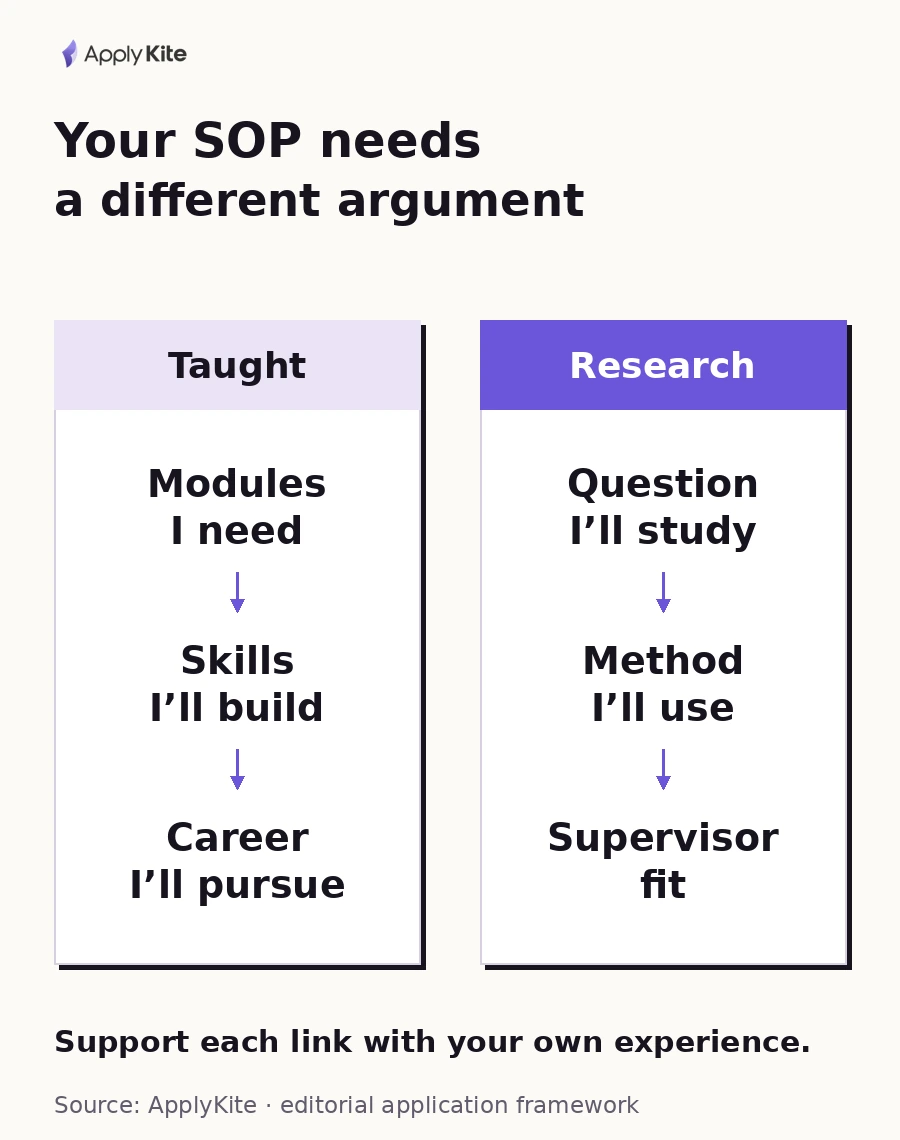
Taught master’s: Focus on breadth, career direction, and why you need structured modules.
Research master’s: Treat it like a mini-PhD application. Center the letter on a specific research problem or literature gap, show your methodology and lab skills, and name the supervisor whose recent papers match your question.
Use ApplyKite Twin to draft an SOP from your CV and story, or a proposal backed by real papers, then edit it line by line.
FAQ
Is a taught master’s worse for PhD admission?
No. A taught master’s with a substantial, separately graded dissertation and strong marks can meet doctoral entry requirements. A research master’s gives you a longer thesis sample and a closer supervisor reference, but check the target department’s rules.
Are research master’s funded?
Often, depending on the country. Canadian thesis-based programs may offer TA/RA and supervisor funding, and UK research training may be funded in an integrated 1+3 package. Standalone research degrees are harder to fund through Chevening and Commonwealth, which back taught master’s.
Which is better for jobs?
Taught degrees suit corporate careers, consulting, finance, management, and accredited professions, through practical modules and teamwork. Research degrees can fit industrial R&D, biotech, pharma, quantitative finance, AI, and policy labs. Your curriculum and experience matter more than the label.
Can I switch from taught to research?
Sometimes, if the department offers both routes or a research-heavy option. You’ll need approval, strong early grades, a viable proposal, and an available supervisor. Ask the coordinator in writing before enrolling. It’s never guaranteed.
Is a research master’s harder?
Neither is inherently harder. Taught degrees test how you handle a packed timetable and overlapping assessments. Research degrees test independence, uncertainty, failed experiments, and sustained writing.
Do I need a research master’s before a PhD?
No. Both routes can lead to a PhD if they meet the program’s research and grade requirements. Melbourne Arts, for example, asks for a research component worth at least 25% of a full-time year. Some departments treat an integrated MRes/PhD as the normal route, so check whether direct entry exists.
Is postgraduate taught the same as a master’s?
Not always. PGT includes full taught master’s degrees and shorter Level 7 PGDip and PGCert awards, which usually omit the dissertation and aren’t full master’s degrees.


