US Universities With No Application Fee: Your Guide for 2027 Admission
ApplyKite Editorial
Author

What if you could apply to ten US universities without spending $500 or more on application fees? It's not a dream; it's actually true. You just need to know where to apply.
Applying to universities in the USA can get expensive before you even receive an admission decision. With application fees often ranging from $50 to $100 per university, applying to several universities can cost you more than $500. This is a significant barrier, especially for students with financial challenges.
However, there are several well-known and reputable universities in the USA that charge no application fee at all. Others offer fee waivers, allowing eligible students to apply without paying. This guide lists universities in USA without application fees for 2027 admission that offer free applications, and recognized universities where you can request a fee waiver.
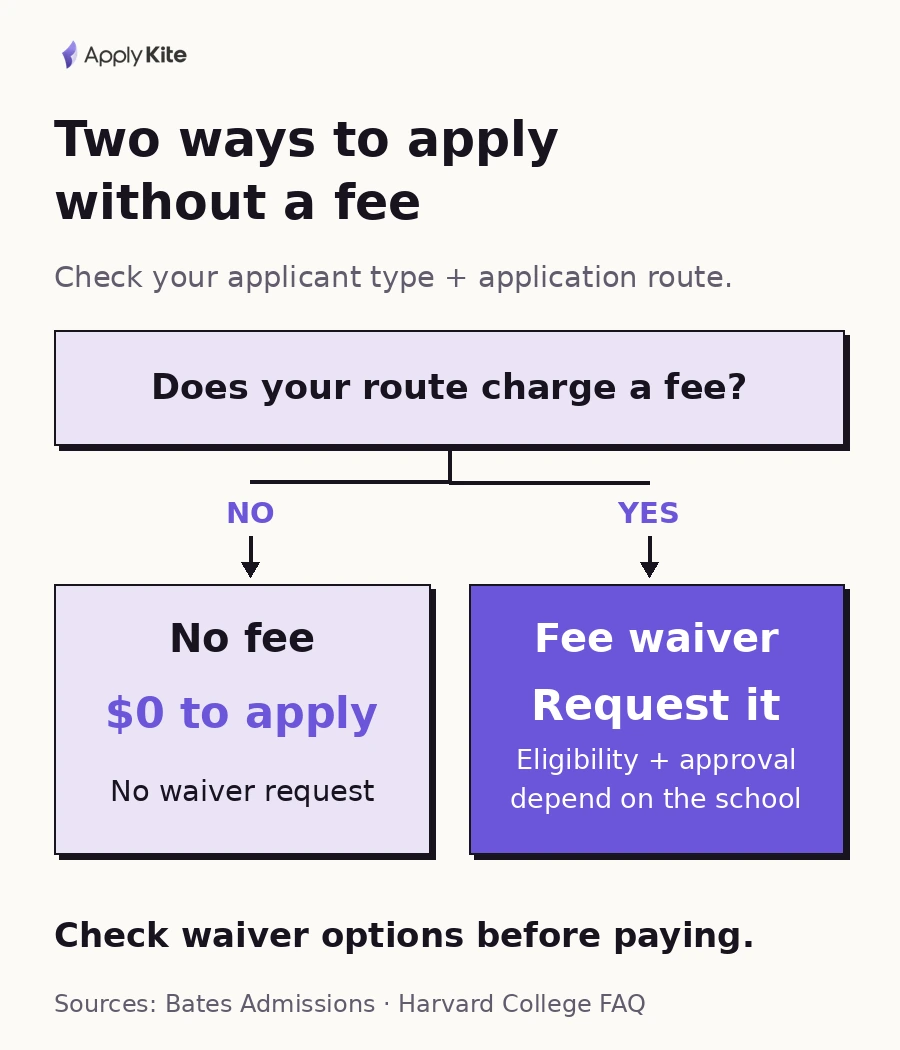

No Application Fee vs Fee Waiver: What's the Difference?
Not all free university applications work the same way. Some don’t charge an application fee at all, while others allow you to skip the payment if you qualify for a waiver. The distinction matters especially if you’re an international student trying to keep application costs under control.
- No application fee: The university does not charge an application fee. You can complete and submit your application without making a payment or requesting a waiver. There is no financial eligibility requirement.
- Application fee waiver: The university normally charges an application fee but allows eligible students to skip the payment. Depending on the institution, you may need to demonstrate financial need, attend an admission event, enter a waiver code, or meet other requirements.
Harvard and Yale are well-known examples. Both charge application fees but offer waivers to students who would have difficulty paying. You generally need to request the waiver before submitting your application. Once you’ve paid, getting a refund is unlikely.
Some universities have more flexible arrangements. For instance Middlebury allows students to request a waiver directly through its application.
Table 1: Quick review of the difference between fee waiver and no fee applications
| Question | No application fee | Fee waiver |
|---|---|---|
| Is there a fee? | No | Yes, but it can be cancelled |
| Do you need to request it? | No | Usually yes |
| Is it guaranteed? | Yes | No, it depends on approval |
| Does it apply to international students? | Usually, but check: some schools are free only for domestic applicants | Often only US citizens and permanent residents |
| When do you act? | No action needed | Usually before you submit or pay |
| Does it affect admission or reputation? | No | No |
US Universities With No Application Fee for International Students
The universities below don’t charge an application fee for first-year undergraduate applicants, including international students.
Table 2: Undergraduate universities in USA with no application fee
| University | State | Note | |
|---|---|---|---|
| 1 | Bates College | Maine | Free for all applicants since the Fall 2025 cycle |
| 2 | Baylor University | Texas | No undergraduate fee |
| 3 | Colby College | Maine | No fee |
| 4 | Denison University | Ohio | No fee |
| 5 | Drake University | Iowa | No fee; test scores and essays optional |
| 6 | Goucher College | Maryland | No fee |
| 7 | Grinnell College | Iowa | No fee |
| 8 | Lawrence University | Wisconsin | No fee |
| 9 | Macalester College | Minnesota | No fee; welcomes applicants from around the world |
| 10 | Saint Louis University | Missouri | No fee through the SLU application, Common App or Coalition |
| 11 | Smith College | Massachusetts | No fee for undergraduates |
| 12 | Trinity University | Texas | No fee for online applications |
| 13 | Tulane University | Louisiana | No fee through the Common App |
| 14 | Wellesley College | Massachusetts | No fee |
Fee policies can change, so check before you apply
University application fees can change every year, and online information may no longer be accurate. Some universities remove their fees, while others introduce new charges, particularly for international students. For example, Bates College removed its $65 application fee in 2025.
Check these three things before applying to avoid unexpected costs:
- Visit the official websites: Check the latest information on its undergraduate or international admission page rather than relying on outdated online lists.
- Pay attention before submitting: Fee policies may depend on how you apply. For example, Trinity University allows students to apply online without paying an application fee.
- Check application route: If the university portal requests payment, pause and contact the admissions office to clarify whether you qualify for a fee waiver.
A quick check can save you money. Since application fees are usually non-refundable, make sure you know the current policy before paying.

Are Universities Without Application Fees Less Competitive?
No. Application fees have nothing to do with academic quality, university reputation, or admission standards. Several highly selective US colleges and schools allow students to apply without paying an application fee. This means that competitiveness should not be confused with easier admission.
Universities often remove application fees to make the application process more accessible and encourage a wider range of students to apply. Your application still goes through the same admission review, whether you paid the fee, received a waiver, or applied for free.
When searching for free universities in the USA, don’t rely on a college simply being labelled with no application fee. Check the actual admission policy to see whether applying is free for everyone or only for students who qualify for a waiver.
How to Get an Application Fee Waiver as an International Student
If you’re planning to study abroad, these four tips are crucial to follow, especially if you’re looking for a fee waiver without paying the application fee.
1. Check the University's Fee Waiver Policy
Your first step should be checking whether the university accepts application fee waivers from international students. Look at the Common App requirements grid and the university's international admission page. For the 2026–27 application cycle, colleges on the Common App must indicate whether they accept fee waivers from all applicants, US applicants only, or do not accept them.
If the university accepts a waiver from international students, you can submit your request through the application process.
2. Explain Your Financial Situation
If paying the application fee is difficult for you or your family, you may qualify for a financial hardship waiver. You can request it through your Common App profile and wait for confirmation from the school counselor.
Some of the most reputable schools, like Princeton, offer their own fee waiver options for students with special financial situations, without requiring counselor approval.
3. Get Fee Waiver Codes Through University Events
Some universities offer application fee waivers to students who attend webinars, virtual university fairs, information sessions, or open houses. For instance, Northeastern University's College of Engineering has offered fee waiver codes at virtual graduate fairs. Some codes expire, so check the conditions and use them before the deadline.
4. Send a Quick Email to the Department
If you’re applying for a master's or PhD program, try contacting the department you're interested in. Sometimes, the central graduate admissions office cannot offer a fee waiver to international students, but individual departments may have their own options.
Boston University, for example, directs international graduate applicants to contact their intended program about fee waivers. If you can’t find clear information online, send the department a short and polite email explaining your situation and asking whether a waiver is available.
Note: Remember to apply early and request a fee waiver before paying.
Table 3: Other Application Costs to Budget For When Applying for Universities in US
| Cost | What it typically costs | Tip |
|---|---|---|
| SAT reports | 4 free if sent within 9 days of the test; $15 per extra report | Choose your 4 free schools before test day |
| ACT reports | 4 included with registration; $20 per extra report | Add college codes when you register |
| TOEFL reports | 4 free if chosen before the test; $25 per extra report | Choose your schools before test day |
| IELTS results | Electronic copies free to universities that accept them; up to 5 free paper copies | Check whether your schools accept electronic results |
| Duolingo English Test | Free to send to unlimited schools | The cheapest option if your schools accept it |
| CSS Profile | $25 for the first school, $16 for each additional school | Some colleges accept a free alternative form from international students |
| Credential evaluation (WES) | $118 (Document-by-Document) or $186 (Course-by-Course), plus delivery | Only pay for this if a school requires it |
| Document translation | Varies by translator | Only needed for documents not issued in English |
Boost your Chance of Success with ApplyKite
Applying to universities in the US can feel overwhelming. From choosing the right universities and finding scholarships to understanding application fees, converting grades, and keeping track of deadlines, there’s a lot to figure out. Sometimes, all you need is someone who can guide you through the process, someone who has been there before. We’re here to bring together helpful tools, resources, and real experiences to make your university application journey easier.
Learn from Students Who Have Already Been There
Sometimes the best advice comes from someone who has gone through the same experiences, challenges, and doubts. With ApplyKite, you can connect with mentors who understand the university application process and guide you based on your needs and interests.
Explore mentors based on their universities, degrees, and academic backgrounds. Learn from their experiences, ask questions, and get advice to help you make better application decisions.
Discover Universities, Programs, and Funding Opportunities
Finding the right opportunity shouldn't mean spending hours searching different websites. ApplyKite helps you explore bachelor's, master's, PhD, and postdoctoral opportunities at US universities.
You can also discover scholarships, funding opportunities, and professors working in your area of interest. This is particularly useful if you're applying for a research-based graduate program.
Take the Next Step with Confidence:
Whether you're just starting your university search or getting ready to submit your applications, ApplyKite is here to make things a little easier.
Find your opportunities, learn from experienced mentors, and get the support you need along the way. Your journey to studying in the US doesn't have to be complicated. Start exploring with ApplyKite today!
Frequently Asked Questions
Are application fees required for international students applying to US universities?
Most US universities charge international students between $50 and $100 per application. In some cases, international applicants pay more than domestic students. However, several colleges, including Wellesley, Colby and Tulane, offer free applications.
How much money do I need to apply to US universities?
The cost can add up faster than you might expect. Applying to ten universities could cost anywhere from $500 to $1,000 in application fees alone. For international students, University of California campuses charge $95 per campus. There are also additional expenses to consider, including standardised test score reports, the CSS Profile and credential evaluations. Choosing a few universities with free applications is a simple way to keep your application budget under control.
What universities in the USA have no application fees?
Some US universities offering free first-year undergraduate applications include Bates, Colby, Grinnell, Macalester , Smith, Tulane, Wellesley, and Saint Louis University.
Are there no application fee universities in USA for international students?
Yes. All universities without fees accept international students, and there are no special limits for them. However, not every fee waiver covers international applicants. Some colleges offer free applications exclusively to domestic students, so always confirm the policy on the university’s official international admission page.
How can international students apply for a Common App fee waiver?
To request a Common App fee waiver, visit the Profile section and answer yes to the fee waiver question. Select the financial need indicators that apply to your situation. Your school counselor may be required to confirm your eligibility. Since colleges have different policies, check whether your chosen universities accept fee waivers from international applicants through the Common App requirements grid.
Do Ivy League universities offer free applications?
No. All eight Ivy League schools charge application fees, generally ranging from $75 to $85. However, most offer need-based application fee waivers, which may be available to international students. Yale, for example, uses the same waiver process for applicants regardless of nationality.
Which US graduate schools offer free applications to international students?
Several US universities offer free graduate applications, although the policy may apply only to specific schools or degree programmes. Examples include SMU Cox School of Business, which waives application fees for all graduate applicants, Northeastern University's College of Engineering master's and graduate certificate programmes.
Do US universities with no application fees offer scholarships to international students?
Yes. Several colleges with no application fee also offer generous financial aid to international students. Wellesley, Colby, and Denison, for example, meet 100% of demonstrated financial need for admitted international students.


