PhD After BTech Without MTech: Eligibility, Funding & 2027 Application Guide
ApplyKite Editorial
Author

Someone in your department has probably told you that a two-year MTech or MS is mandatory before you can touch doctoral research. It isn’t. That advice costs thousands of engineering graduates two years of their twenties and tens of thousands of dollars in tuition.
A four-year B.E. or BTech is already enough to start a PhD directly in major research systems. You only need to know which countries, institutes, and funding schemes accept direct entry.
The guide covers where a direct PhD after BTech is the norm and where it’s the exception, the CGPA and GATE or GRE rules, how stipends work, and a month-by-month plan for the 2027 intake.

Short Answer: Can You Do a PhD Straight After BTech?
- United States: Yes, and it’s the standard route. Programs run 5 to 6 years, and the first two fold in master’s-level classes. Teaching or Research Assistantships fund over 81% of STEM students.
- India: Yes. Under the UGC PhD Regulations, a four-year bachelor’s degree with at least 7.5/10 CGPA (75%) qualifies you for direct doctoral admission. IISc Bengaluru, the IITs, and the NITs admit BTech graduates through GATE or NET scores, and CFTI graduates with 8.0 or higher CGPA can skip GATE.
- Germany, UK, Canada, Australia & Singapore: Direct entry works through specific tracks. The UK has 1+3 CDTs and MPhil-to-PhD upgrades. Canada has direct-entry programs and 12-month MSc fast-tracks. Germany has Max Planck (IMPRS) and TU Dresden fast-track routes. Australia accepts Honours-equivalent entry, and Singapore offers the SINGA fellowship.
What 36,308 Funded PhD Ads Reveal About Applying Without a Master's
We analyzed 36,308 PhD ads with stated degree requirements in ApplyKite's database.
Here is how those 36,308 openings break down:
- 58% (19,616 PhD ads) explicitly demand a master's degree.
- ~3,100 PhD ads (roughly 1 in 12 funded ads) mention bachelor-level entry.
- ~390 PhD ads state outright "bachelor's or master's accepted".
- 3.0/4.0 median GPA bar: Where a GPA threshold is stated in the ad, the median requirement is 3.0 out of 4.0; a bar that a BTech student converting from a CGPA of ~8.0 typically clears.
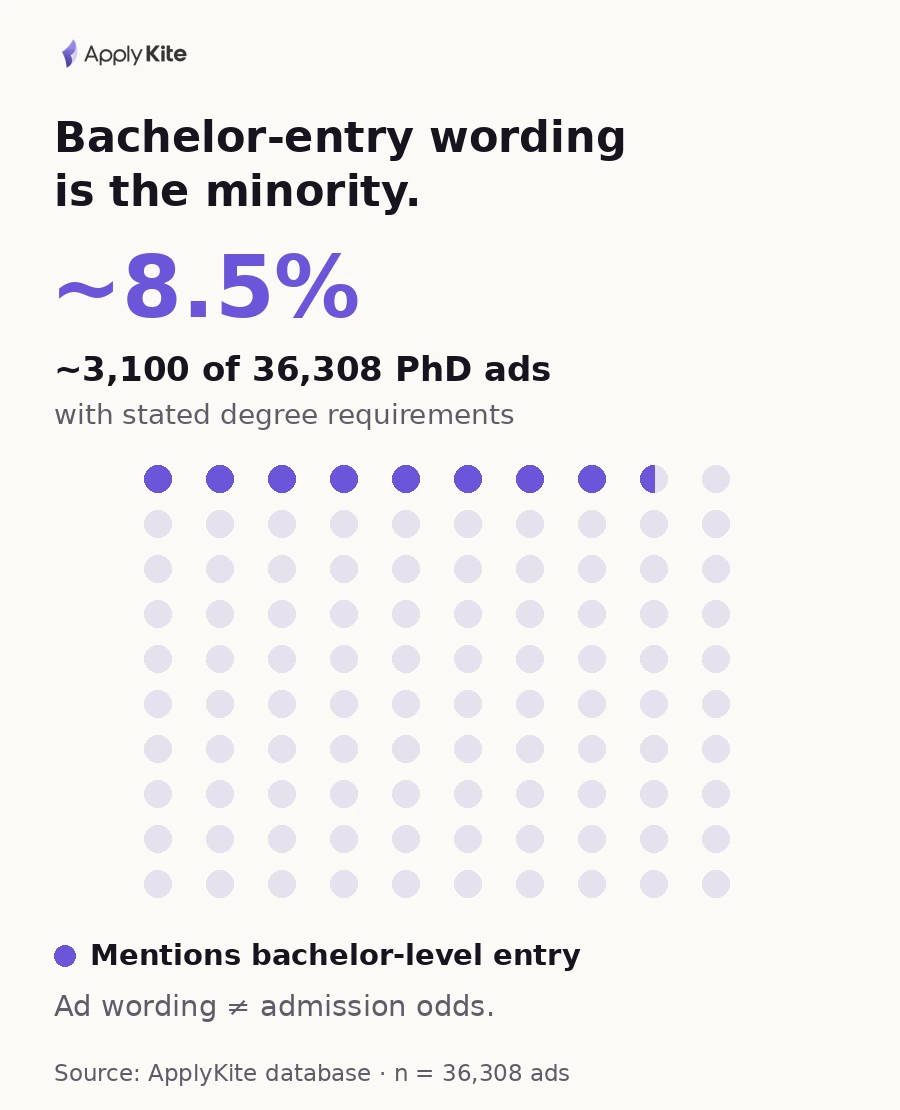
Bachelor-entry wording appears in a minority of the analyzed advertisements; this is not an admission success rate
Direct-entry PhDs exist. Thousands of funded openings take BTech graduates every cycle. They’re still a minority, though, at about 1 in 12 advertised positions worldwide.
The hard part is telling which ones accept a four-year bachelor’s. Explore Academic Positions Worldwide lets you filter by level (Master’s, PhD, Postdoc), field, and country, and each of its 100,000-plus positions links directly to the official university source.
The 3 Ways to Enter a PhD After BTech (Without a Separate MTech)
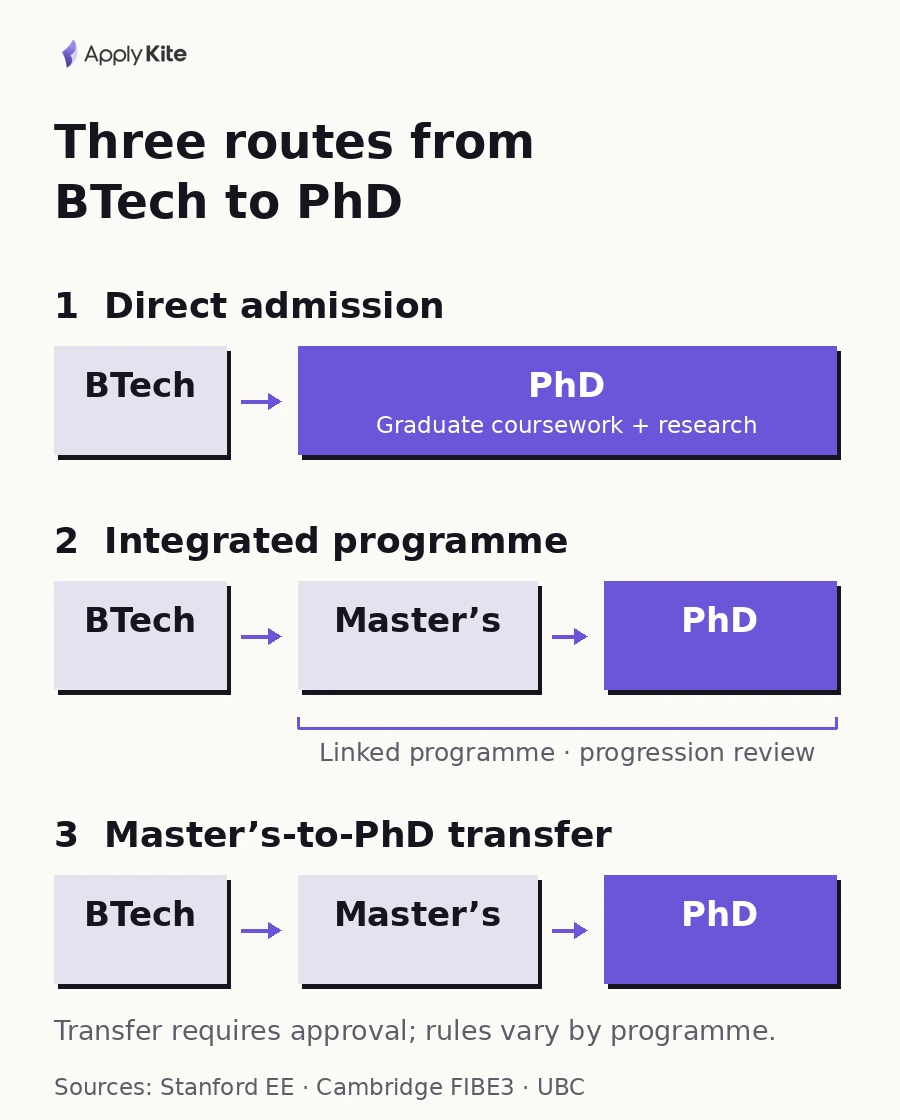
Universities use three different structures to take you from a BTech to a doctorate:
| Pathway | How It Works | Where It's Common | Typical Coursework Load |
| 1. Direct PhD Admission | You enroll straight as a PhD student and take extra graduate classes in Years 1–2 before full-time research. | USA, India (IISc, IITs, NITs), Singapore (SINGA), Australia | 20–56 credits in India; 1.5–2 years of classes + lab rotations in the US. |
| 2. Integrated MTech/MS–PhD (or 1+3 CDT) | One continuous admission combining a 1–2 year research master's with a 3–4 year PhD. Often awards both degrees. | India (IIT Madras, IIT Bombay, IISc), UK (1+3 EPSRC CDTs), Switzerland (ETH Zurich) | Structured Year 1–2 master's modules followed by doctoral thesis. |
| 3. Fast-Track Upgrade / MPhil Transfer | You start in a research master's (MASc/MSc) or probationary MPhil and transfer into the PhD after 12–18 months without writing a master's thesis. | Canada (UToronto, UBC, McGill, Waterloo), UK, Germany (TU Dresden, IMPRS) | 1 year of master's courses + a qualifying exam or transfer defense. |
Built-In Safety Nets: Dual Degrees and Master's Exit Options
Join a 5-year direct PhD at 21 and realize two years in that research isn’t for you? You have exits.
- US: After two years of coursework and the qualifying exam, most departments award an MS along the way, or let you “master out” and leave for industry.
- IISc Bengaluru: Direct PhD scholars earn a dual M.Tech. (Research) + Ph.D. if they finish the 24-credit Research Training Programme within 2 years and pass the comprehensive exam within 3.
- IIT Madras: Direct scholars earn both M.S. and Ph.D. by completing two extra 6-credit courses by the 4th semester.
- IIT Roorkee: Bachelor’s-entry students get the parent department’s master’s (e.g., M.Tech.) alongside the PhD if they complete the master’s course credits, excluding thesis, with a CGPA of 8.5 or higher.
- IIT Kanpur and IIT Bombay: Both offer dual degree provisions. IIT Kanpur requires 216 total credits for an additional M.Tech./M.Des./M.S. by Research/MBA alongside the PhD.
Direct PhD After BTech: Country-by-Country Breakdown
| Country / Scheme | Direct BTech Entry? | Main Entry Route | Minimum Grade Bar | GRE / GATE Needed? |
| USA | Yes (Standard norm) | 5–6 yr integrated PhD | 3.0–3.5+ GPA (Top 10% for elite labs) | GRE optional at most STEM depts |
| Germany | Via Fast-Track / IMPRS | IMPRS or university Fast-Track | First-Class / Outstanding BTech | No GRE; proposal + interview |
| Canada | Yes (Direct or Transfer) | Direct-Entry PhD or 12-mo MSc transfer | A- average (≥ 83% or 3.7/4.0 GPA) | Mostly optional |
| Australia | Yes (With research) | 3–4 yr Research Doctorate | First-Class Honours equivalent (≥ 75–80%) | No GRE |
| India (IITs/IISc/NITs) | Yes (UGC & CFTI rules) | Direct PhD or Integrated MS–PhD | 7.5 CGPA (UGC); 8.0+ for GATE waiver | GATE/NET (Waived for CFTI 8.0) |
| UK | Yes (Selective / CDT) | 1+3 CDT, MPhil upgrade, or Direct PhD | First-Class or strong 2:1 (7.5–8.5+ CGPA) | No GRE |
| Singapore (SINGA) | Yes (Standard for SINGA) | 4-yr direct PhD at A*STAR, NUS, NTU, SUTD, SMU, SIT | First-Class / High GPA BTech | No GRE; IELTS/TOEFL optional at entry |
For a full breakdown of how long each degree takes, read how long a PhD takes.
1. United States: Where Direct PhD After BTech Is the Norm
In the US, a four-year BTech is the standard prerequisite for a PhD. MIT, Stanford, Columbia, and Yale don’t expect you to arrive with a master’s.
You spend the first 1.5 to 2 years on graduate-level courses and lab rotations, where you test working styles with different Principal Investigators (PIs). Then you pass a candidacy or qualifying exam and focus full-time on your dissertation. Even students who arrive with an outside master’s often repeat most of that coursework anyway.
2. Germany: Fast-Track Doctoral Routes vs. Traditional Master's Rules
Standard German PhD regulations (the Promotionsordnung) usually require a master’s so that your prior studies total 300 ECTS credits. Apply to a regular university job post with only a BTech and you’ll usually be filtered out.
Two official fast-track channels get around that:
- International Max Planck Research Schools (IMPRS): Joint doctoral programs run by Max Planck Institutes and partner universities admit exceptional BSc/BTech graduates into a 4-to-5-year fast-track. Year 1 covers master’s coursework.
- University fast-track programs: Some German faculties run bachelor-entry tracks. TU Dresden’s Fast Track to PhD in Computer Science takes students with at least 180 ECTS and a grade of 1.9 or better, who move into the doctorate after two semesters of master’s modules. LMU Munich’s Graduate School of Systemic Neurosciences (GSN) and TUM’s TopMath program are two others.
3. Canada: Direct-Entry PhDs and the 12-Month Master's Fast-Track
Major Canadian research universities, including the University of Toronto, University of British Columbia (UBC), McGill University, and the University of Waterloo, offer two paths for BTech graduates:
- Five-year direct-entry PhD: Reserved for graduates with an A- average (≥ 83% or 3.7/4.0 GPA) in their final two undergraduate years, plus strong independent research proof: an undergraduate thesis, a peer-reviewed publication, or scientific software development.
- Accelerated master’s-to-PhD transfer (fast-track): The more common route in Canada. You enroll in a funded, thesis-based master’s (MASc or MSc), spend 12 to 18 months on classes and initial lab work with high grades, then pass a transfer exam to roll straight into the PhD without writing a master’s thesis.
4. Australia (Plus Singapore's SINGA Route)
- Australia: Universities such as the University of Melbourne offer 3-to-4-year research doctorates directly to four-year engineering graduates. Because a four-year BTech includes a final-year research project or thesis, Australian admissions committees frequently assess a high-CGPA BTech as equivalent to an Australian Bachelor's with First-Class Honours.
- Singapore (SINGA): The Singapore International Graduate Award is a joint 4-year, bond-free PhD fellowship run by A*STAR, NUS, NTU, SUTD, SMU, and SIT. It accepts BTech graduates with strong academic results and two academic references. No GRE is required.
5. India: The IIT, IISc, and NIT Route (UGC Rules & GATE Waivers)
Under the UGC (Minimum Standards and Procedures for Award of Ph.D. Degree) Regulations, 2022, and current 2026 norms, anyone with a four-year undergraduate degree and at least 7.5 CGPA on a 10-point scale (or 75% aggregate) can apply for direct PhD admission. SC, ST, OBC-NCL, EWS, and PwD candidates get a relaxation of 0.5 CGPA or 5%, down to 7.0 CGPA or 70%. At IITs and IISc, about 10% to 15% of science and engineering PhD seats go to BTech graduates through the direct route.
Each of India’s 13 major technical institutes sets its own floors, GATE waivers, and coursework load. Their official pages:
| Institute | Minimum CGPA / % Floor (General) | Who Gets a Direct PhD GATE Waiver? | Coursework Credits for BTech Entrants |
| IISc Bengaluru | Minimum Second Class (8.5+ typical for direct interview) | CFTI 4-yr BTech graduates with CGPA 8.0 | 24 credits (max 2 yrs for RTP; min 7.0 CGPA) |
| IIT Bombay | 60% or 6.0 CPI (55% SC/ST/PwD) | IIT BTech graduates with CGPA/CPI 8.00 | 44 to 56 PhD credits including a seminar |
| IIT Delhi | 70% or 7.0 CGPA (typically 7.5–8.0+ for direct shortlisting) | CFTI BTech graduates with CGPA 8.0 | At least 20 pre-PhD course credits |
| IIT Madras | Standard dept cutoff (final-yr BTech can apply) | IIT/CFTI BTech graduates with CGPA 8.0 | Expected within 3 semesters (+two 6-credit courses for MS+PhD) |
| IIT Kanpur | 75% or 7.5 CPI (provisional admission open in 7th/8th sem) | CFTI grads with 7.5 CPI; or IIT 4-yr BTech/BS with 6.5 CPI overall + 8.0 in last 2 yrs | Up to 216 total credits (if taking additional master's + PhD) |
| IIT Kharagpur | 60% marks or 6.5 CGPA | IIT/CFTI grads OR Top 25 NIRF Overall institute grads with CGPA 8.0 | Dept-prescribed; registration seminar within 3 yrs |
| IIT Roorkee | 7.5 CGPA (7.0 for reserved) | IIT/CFTI graduates with CGPA 8.0 | Minimum 24 credits of PG theory courses (min 7.0 CGPA) |
| IIT Guwahati | 6.0 CPI / 60% (one page prints 7.5 CPI / 70%) | On-campus regular IIT BTech in relevant field with CPI 8.0 | Comprehensive exam within 24 months (vs 18 mos for MTech) |
| IIT Hyderabad | 6.0 CGPA floor (depts raise cutoffs by volume) | IIT/CFTI/CFI BTech grads with 8.0 CGPA (7.2 OBC-NCL; 6.8 SC/ST in CSE) | 24 credits (EE and Chemical Engg Direct PhD) |
| IIT (ISM) Dhanbad | 60% or 6.0 CGPA | CFTI grads OR Top 100 NIRF Overall grads with CGPA 8.0 | At least 6 courses within 2 yrs (vs 4 for MTech; min 6.5 CGPA) |
| IIEST Shibpur | 80% or 8.5 CGPA | Requires valid GATE/NET (Fellowship age cap: 32 OC male, 35 OBC, 37 SC/ST/PwD/Female) | 24 PG credits in first 2 semesters (vs 12 for MTech; min 6.5 CGPA) |
| Jadavpur University | 55% or 6.25/10 in coursework | GATE/NET fellowship holders exempted from written entrance test | At least 20 coursework credits (vs 12 for MTech) |
| NIT Durgapur | Standard NIT floor + valid GATE/NET | Requires GATE/NET for Category A fellowship (8 hrs/wk TA duty) | 16 credits + Research Methodology in first 4 semesters (vs 9 for MTech) |
6. United Kingdom: Direct Entry, 1+3 CDTs, and the MPhil Upgrade Route
A UK PhD takes 3 to 4 years because you start your research project on day one without American-style general classes. BTech graduates enter the UK system in three ways:
MPhil / probationary upgrade route: At most UK universities, every new doctoral student is registered as a probationary PhD or MPhil candidate in Year 1. After 9 to 12 months, you submit a transfer report and pass an oral viva to upgrade to full PhD status.
1+3 Centres for Doctoral Training (CDTs): These are funded 4-year cohorts. Examples include the EPSRC CDT in Future Infrastructure and Built Environment (FIBE3) at Cambridge, which awards an MRes + PhD, the Oxford CDT in Gas Turbine Aerodynamics, and the Imperial College Chemical Biology CDT. They accept applicants with a First-Class or strong Upper Second-Class (2:1) four-year BTech.
Direct 3-year entry: UCL, Edinburgh, Manchester, Birmingham, and select STEM labs at Imperial, Oxford, and Cambridge take direct applications with a First-Class BTech. Oxford and Cambridge rarely admit without a master’s unless you already have strong research output.
Eligibility Criteria for a PhD After BTech (GPA, Exams & Research)
1. CGPA and GPA Expectations (Minimum Floors vs. Real Shortlisting Cutoffs)
As our 36,308-ad dataset shows, the median stated GPA floor for international PhDs is 3.0/4.0 (roughly 7.5 to 8.0 on a 10-point Indian scale, you can check your exact score using our CGPA-to-GPA converter).
However, department shortlisting cutoffs move up based on how many people apply in a given semester:
- 7.5 to 7.9 CGPA: Clears the UGC 7.5 minimum and qualifies you for regular GATE-backed PhD seats at IITs/NITs and many US state universities, especially if you have a publication or a strong GATE rank.
- 8.0 to 8.4 CGPA: The magic number in India, unlocks GATE waivers for CFTI graduates, makes you eligible for the Prime Minister's Research Fellowship (PMRF) (if paired with GATE 650 for non-CFTI graduates), and clears the UK 2:1 / First-Class border.
- 8.5+ CGPA (or Top 10% class rank): Expected for direct PhD entry at IISc, MIT, Stanford, ETH Zurich, and Canadian Direct-Entry tracks (≥ 83% / 3.7 GPA).
Before spending hours on an application, you can open any listing on ApplyKite and select Eligibility check inside ApplyKite Twin; it compares the opening's exact degree, grade, English, and fee-status rules against your profile and marks each one Met, Partly met, or To settle.
2. Entrance Exams: GATE, GRE, and English Proficiency Tests
- In India: If you graduated from a non-CFTI college (outside the NIRF Top 25/100 exemptions at IIT Kharagpur and IIT ISM Dhanbad), you need a valid score in GATE, including the GATE DA (Data Science and Artificial Intelligence) paper, or a national fellowship test like CSIR-UGC NET JRF, JEST, NBHM, or INSPIRE. Some institutes also run their own written entrance tests.
- GRE (Abroad): Optional or not required at all in the UK, Germany, Australia, Singapore (SINGA), and the majority of US and Canadian STEM departments. A high GRE Quantitative score (320+ combined) is still useful if your undergraduate college is less known internationally.
- English Proficiency (Abroad): Almost all international universities require IELTS Academic (typically 6.5 to 7.0 overall, with no band below 6.0 or 6.5), TOEFL iBT (90–100+), PTE Academic, or the Duolingo English Test. Note that SINGA does not mandate IELTS/TOEFL at the initial SINGA portal stage, though partner universities (NUS/NTU/SUTD/SMU/SIT) may ask for it during formal admission.
3. Research Experience and Switching Fields (CS, AI, Biotech, Physics & Management)
When you skip an MTech, your undergraduate research has to prove you can handle a 4-to-6-year lab project. Admissions panels look for a substantial final-year BTech thesis, summer research internships (such as US REUs or IIT/IISc fellowships), or a co-authored paper in a peer-reviewed venue.

Can you switch fields after BTech? Yes:
- Computer Science, AI/ML & Quantum Computing: Non-CS engineers (ECE, EE, Mechanical, Civil) regularly enter AI and CS PhDs by qualifying through the GATE DA paper or showing strong Python/ML project output; for example, IIT Guwahati's CSE department explicitly permitted any-discipline BTech applicants to apply for its July 2026 PhD cycle.
- Biotechnology & Bioinformatics: BTech Biotechnology graduates can apply directly to PhDs at IITs, IISc, IISERs, and abroad with an 8.0+ CGPA (or 75%+).
- Physics, Astrophysics & Mathematics: BTech graduates enter physics and math doctorates in India by clearing JEST, GATE (Physics/Math), or NBHM, and in the US via integrated 5-year physics PhDs.
- Management & Economics (PhD After BTech / BTech + MBA): A BTech (or a BTech + MBA combination) is highly favored for quantitative PhDs in Economics, Finance, and Operations, as well as Fellow Programmes in Management (FPM) at the IIMs.
Funding: Assistantships vs. Scholarships (Is a PhD After BTech Fully Funded?)
Never pay out of pocket for a full-time STEM PhD. In most major research countries, a PhD is treated as paid research employment or a fully funded fellowship; except in the UK, where admission and funding are separate competitions.
Here is how funding works across the main direct-PhD destinations:
| Country / Scheme | Funded by Default? | Primary Funding Mechanism | Stipend / Fellowship Overview | Tuition & Extras Covered |
| USA (TA / RA / Fellowship) | Yes (81%+ of STEM PhDs) | Departmental Graduate Assistantships | $25,000 – $52,046+ / year (Yale GSAS) | 100% tuition waiver + health insurance |
| India: PMRF | By nomination after PhD admission | Ministry of Education National Fellowship | ₹70,000/mo (Yrs 1–2) ₹75,000/mo (Yr 3) ₹80,000/mo (Yrs 4–5) | ₹2 Lakh/year research grant for 5 years (₹10L total) |
| India: Institute HTRA / JRF | Yes (for full-time GATE/CFTI admits) | MHRD / Institute Assistantship or Visvesvaraya Scheme | ₹37,000/mo (JRF, Yrs 1–2) ₹42,000/mo (SRF, Yrs 3–5) (IISc) | Low institute fees + ₹20k–₹30k/yr contingency + HRA |
| Canada | Yes (Standard for research PhDs) | Supervisor grant (RA) + TA + NSERC | CAD 1,500 – CAD 2,500 / month | Guaranteed minimum departmental funding package |
| Germany | Yes (For project/IMPRS seats) | Salaried TV-L / TVöD contract or Max Planck stipend | €1,500 – €2,500+ / month | Tuition-free (only nominal semester fee of ~€150–€350) |
| Singapore (SINGA) | Yes (100% funded) | A*STAR / NUS / NTU / SUTD / SMU / SIT | S2,700/mo(Pre-QE)S3,200/mo (Post-QE) | 4 yrs full tuition + S1,500airfare+S1,000 settling allowance |
| UK (UKRI / CDTs / Trusts) | No (Must win a scholarship) | UKRI studentships, Gates Cambridge, Imperial President's PhD | £19,237 – £27,036 / year where awarded | Full fee waiver + annual research grant (if funded) |
(For a full breakdown of take-home pay, taxes, and living costs by city, see our guides on PhD student salaries and fully funded PhD countries.)
How US, European, and SINGA Assistantships Work
In the US, your admission offer letter typically includes a 5-year funding guarantee combining a full tuition waiver, health insurance, and a monthly stipend in exchange for 15 to 20 hours per week as a Teaching Assistant (TA) or Research Assistant (RA). Indian BTech students on F-1 visas in the US also benefit from Article 21(2) of the US-India Income Tax Treaty, which lets them claim the standard deduction on student stipends and keep more take-home pay.
In Singapore, SINGA is completely bond-free and raises your monthly stipend from S2,700toS3,200 as soon as you pass your Qualifying Examination (QE). In the UK, international seats in UKRI-funded CDTs are capped at 30% of each cohort, so you should apply early (by October–December) and check whether you meet the six core scholarship rules, nationality, level, grades, English score, age, and deadline; using the Scholarship eligibility checker.
How India's PMRF and Institute Fellowships Work
In India, every regular full-time PhD scholar admitted to an IIT, IISc, or NIT receives an Institute Fellowship (HTRA) of ₹37,000/month for the first two years (JRF) and ₹42,000/month for years three to five (SRF), in exchange for up to 8 hours per week of lab or teaching assistance. Scholars in Electronics System Design & Manufacturing (ESDM) and IT/ITeS can also receive enhanced funding under the Visvesvaraya PhD Scheme.
If you want the Prime Minister's Research Fellowship (PMRF), which pays ₹70,000 to ₹80,000/month plus a ₹2 Lakh annual research grant, keep three strict rules in mind:
- You cannot apply to PMRF before getting PhD admission. You must first get admitted to a regular/direct PhD at one of the ~40 PMRF-granting institutes (IISc, IITs, IISERs, NITs, IIITs) and be nominated by that institute.
- Direct Entry vs. Lateral Entry: To enter via Direct Entry, you need a CGPA of 8.0+ from a CFTI, OR an 8.0+ CGPA plus a GATE score 650 (or CSIR/UGC NET JRF rank 100) if you graduated from a non-CFTI university, and you must apply at the start of your very first PhD semester (deferring your PhD offer disqualifies you from Direct Entry).
- The 18-Month Review Rule: Direct-entry PMRF fellows are reviewed within 18 months of joining and must complete at least four full-semester courses with a CGPA of 8.5 or higher before that review; falling short on PMRF teaching assistantship duties drops your stipend back to regular JRF/SRF levels.
Step-by-Step Application Plan and Timeline for the 2027 Intake
Peak application season for Fall 2027 (September/October 2027) international PhDs runs from November 2026 through January 2027, while Indian institutes recruit in two main cycles: March–May (for the July/August semester) and September–November (for the January semester).
(You can pair this checklist with our full PhD application timeline guide to map your test dates.)
| Timeframe | International Track (Fall 2027 Intake) | Domestic India Track (Jan / July 2027 Intakes) |
| Aug – Oct 2026 | Take IELTS/TOEFL; shortlist 8–12 labs; read 2 recent papers per professor. | Prepare for February GATE / NET / JEST; apply for Oct–Nov (Winter) PhD ads at IITs. |
| Nov – Dec 2026 | Email potential supervisors; submit US, SINGA (Dec 1 deadline), and UK CDT applications. | Sit for Winter-session written tests and interviews at IITs/NITs. |
| Jan – Feb 2027 | Attend Zoom interviews with PIs/admissions committees; submit remaining UK/EU applications. | Sit for GATE (February); finalize BTech 7th/8th-semester project report. |
| Mar – May 2027 | Compare written funding offers (US April 15 deadline); apply for UK ATAS certificate (takes up to 6 months). | Apply to IISc, IITs, and NITs for July 2027 intake; attend May–June interviews. |
| Jun – Sep 2027 | Complete student visa (US F-1, UK Student Visa, or Singapore IPA) and book travel. | Join July/August semester; get nominated for PMRF in your first semester. |
Step 1: Shortlist Supervisors and Send a Focused First Email
Always pick a supervisor for research fit first and university brand name second. In the UK, Germany, Canada, Australia, and Singapore's SINGA, contacting a supervisor before you submit your formal application is essential; in the US and at IITs/IISc, a committee handles initial shortlisting, but an email still tells you whether a professor is taking students that year.
If you don't know which professors work on your problem, you can search over 800,000 researcher profiles by meaning on Explore Professors and Research Supervisors. Once you pick a professor, Email a professor inside ApplyKite Twin reads their recent papers alongside your CV and drafts a personalized email for you to review and send yourself.

Step 2: Prepare Your Academic CV, SOP, Research Proposal, and LORs
You can draft and edit your academic CV, SOP, and a 7-section research proposal backed by real paper citations using ApplyKite Twin (SOP & Proposal Generators), or book one-on-one CV/SOP feedback and email-response evaluation through Mentoring and Application Support.
Step 3: Ace the Written Entrance Test and PhD Interview
Under UGC PhD Regulations, Indian universities that run an entrance test weight the written exam at 70% and the interview at 30% (with 50% required to qualify for the interview, or 45% for reserved categories). Before your interview at an IIT or IISc, you'll choose a broad subdomain (for example, Theory, Systems, or Intelligent Systems in Computer Science) and defend both your core undergraduate fundamentals and your proposed research topic.
To rehearse before the real panel, you can use Interview practice in ApplyKite Twin to answer questions out loud against a two-minute timer under Friendly, Professional, or Challenging interviewer modes.
Regulatory warning: India doesn’t recognize online PhDs. Regulation 13(3) of the UGC PhD Regulations excludes doctorates offered online or by distance mode, so an “online PhD” or edtech-brokered online DBA won’t carry academic equivalence. Working BTech professionals should apply to approved Part-Time or Executive PhD tracks at IITs, NITs, or IIMs, which keep on-campus coursework and supervision mandatory.
Direct PhD vs. MTech First: Pros, Cons, and How to Decide
Still torn between jumping straight into a PhD or doing an MTech/MS first? Compare the real trade-offs side by side:
| Factor | Direct PhD After BTech | MS by Research / MTech (Research) | Regular MTech / Coursework MS |
| Total Time to PhD | 4 – 6 years total (Saves 1–2 years) | 2–2.5 yrs MS + 3–4 yrs PhD (unless upgraded early) | 2 yrs MTech + 4–5 yrs PhD (6–7 years total) |
| First-Year Learning Curve | Steep: Heavy coursework + learning how to read and implement papers from scratch. | Moderate: Fewer classes than MTech; focused on one thesis problem. | Gentle: Classroom-heavy in Year 1; research starts in Year 2. |
| Academic Career Advantage | High: Finishes PhD + 2–3 yr postdoc well before the 35-year age cap for Assistant Professor posts at IITs/NITs. | High: Builds publications for top global PhD applications. | Moderate: Best if targeting immediate corporate placement. |
| Best For Students Who... | Already did a BTech research project/internship and know their broad research domain. | Want to test research for 1.5–2 years with a stipend before committing to a full PhD. | Want a 2-year industry placement credential or aren't sure if they like research yet. |
Frequently Asked Questions (FAQs)
Can I do a PhD after BTech without an MTech?
Yes. A four-year BTech qualifies you for direct PhD admission in the US, India (under UGC 2022/2026 rules at IISc, IITs, and NITs), Canada, Australia, the UK, Singapore (SINGA), and Germany’s fast-track schools (IMPRS and TU Dresden).
Is GATE required for a PhD after BTech?
Not always. In India, non-CFTI BTech graduates usually need a valid GATE, CSIR-UGC NET JRF, or JEST score, unless they pass an institute’s own entrance test. IISc Bengaluru and most IITs waive GATE for CFTI graduates with a CGPA of 8.0 or higher. IIT Kharagpur and IIT (ISM) Dhanbad extend that waiver to graduates of Top 25 and Top 100 NIRF-ranked institutes. The US, UK, Canada, and Australia don’t require GATE.
Which countries allow a direct PhD after BTech?
The US is the largest, and direct entry is standard there. You can also enter directly or by fast-track in India (IISc, IITs, NITs, IIEST), Canada (direct-entry PhD or 12-month MSc fast-track), the UK (direct entry, MPhil upgrade, 1+3 CDTs), Germany (IMPRS and university fast-tracks), Australia (with Honours-equivalent research), Switzerland (ETH Zurich direct doctorate), and Singapore (SINGA).
Is a PhD after BTech fully funded?
Mostly, in STEM. Full-time PhDs in the US, Canada, Singapore (SINGA), and India (HTRA/JRF or PMRF) come with tuition waivers or low fees plus a monthly stipend. German candidates on institute projects get salaried TV-L/TVöD contracts or stipends and pay no tuition. The UK is the exception: admission and funding are separate, so you apply for a UKRI studentship, CDT place, or scholarship alongside your offer. For figures, see fully funded PhD countries and PhD student salaries.
BTech to PhD: how many years?
5 to 6 in the US. 4 to 5 in Canada, Germany (fast-track), Singapore, and India. 3 to 4 in the UK and Australia (4 for UK 1+3 CDTs). You skip the two-year MTech, so you usually finish 1 to 2 years sooner overall. See how long a PhD takes.


