

Australian National University
Top university
3 months ago
This scholarship has expired. You can find similar scholarships from the section below or browse our scholarships listing pages.
Australian National University PhD Scholarship
Fully Funded PhD in Silicon-Based Tandem Photovoltaics and Top Cell Materials Australian National University in Australia
Degree Level
PhD
Field of study
Electrical Engineering
Funding
Fully funded PhD scholarship with an annual tax-free stipend of AUD $39,069 and a full tuition waiver. The project is supported through ongoing research grants within the PV group.

Country
Australia
University
Australian National University
 Ongoing program
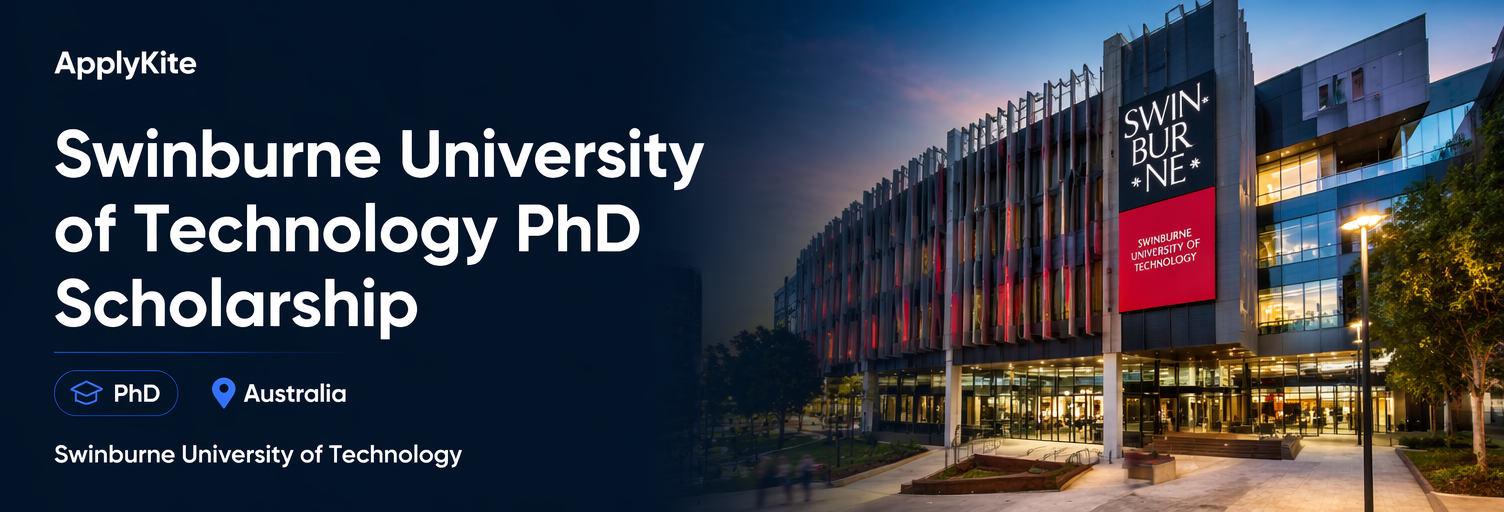
Swinburne University of Technology PhD Scholarship
by Swinburne University of Technology
A Swinburne University of Technology PhD scholarship supporting doctoral research at Swinburne in Australia. Referenced opportunities include tuition support and a competitive stipend, subject to eligibility and scholarship conditions.
Explore the programSuggested scholarships


University of Newcastle
Australia
3 weeks ago
PhD scholarship opportunity at The University of Newcastle in printed solar technology , photovoltaics , and solar energy . This iPhD project focuses on developing a technical framework for testing printed solar technologies , an emerging class of ultra-lightweight, flexible photovoltaics. The research aims to address the gap between current international standards and the unique degradation and performance characteristics of printed solar devices. The project will investigate how printed solar ...
3 weeks ago
University of Newcastle
Australia
2 months ago
PhD Scholarship in Stealth Integrated Sensing and Communications at the University of Newcastle, Australia. This PhD project focuses on stealth integrated sensing and communications (Stealth-ISAC) for UAVs and defence-oriented wireless systems. The research aims to develop communication and sensing methods that remain undetectable to adversaries while still enabling secure coordination and environmental sensing. Research themes include: integrated sensing and communication (ISAC), covert communi...
2 months ago

Griffith University
Australia
New Today
Griffith University Postdoctoral Fellowship Scheme (GUPF) supports early career researchers to develop and lead their own research projects at Griffith University. The scheme is organised through the university’s internal research grants process and is positioned as a recurring opportunity for researchers at an early stage after PhD completion. The program is managed across Griffith’s academic groups, including Arts, Education and Law , Griffith Business School , Griffith Health , Griffith Scien...
New Today

University of Melbourne
Australia
1 month ago
Fully funded research scholarship opportunity at the University of Melbourne in Australia : the RTP Scholarship 2026–27 supports international students pursuing a Master's by Research , MPhil , or PhD . This scholarship is especially relevant for students interested in chemical engineering , materials science , physics , and electrical engineering , with the post highlighting themes such as polymer thin films , advanced battery technologies , clean energy sources and storage , sustainable fuels ...
1 month ago

Deakin University
Australia
4 weeks ago
Two PhD scholarships are available for a 2027 start at Deakin University (Institute for Frontier Materials, Burwood Campus / Melbourne ) in research on polymer electrolytes for sodium batteries . The projects are supported by an Australian Research Council-funded project and focus on automated molecular dynamics (MD) simulations to screen poly(ionic liquid)-based materials . The research aims to identify molecular design strategies for highly conductive electrolytes with favourable mechanical pr...
4 weeks ago
Keywords
About this position
Fully funded PhD opportunity at the Australian National University in Canberra, Australia, focused on next-generation silicon-based tandem photovoltaics.
The project sits in the ANU Solar Energy Group and combines theoretical modelling and experimental solar cell research. The successful PhD candidate will work on developing and characterising top cell materials for tandem architectures that pair with high-efficiency crystalline silicon. The research emphasis includes halide perovskite solar cells, with other inorganic thin-film technologies also possible depending on the candidate’s background and interests.
Research activities may include light absorption modelling, charge transport, electrical operation of single-junction and tandem solar cells, materials synthesis, device fabrication, and characterisation. The group highlights access to state-of-the-art infrastructure, including perovskite deposition tools, silicon bottom cells, ALD/CVD/sputter facilities, hyperspectral imaging, PL decay, PL/EL imaging, ANFF microscopy and AFM, and simulation software such as Quokka3 and COMSOL with HPC support.
Funding: the position is fully funded, with an annual tax-free stipend of AUD $39,069 plus a full tuition waiver.
Eligibility: applicants should have a strong background in solid state physics, materials science, or photovoltaics; an equivalent first-class Honours or Master’s degree in engineering, chemistry, physics, or a related field; relevant research experience; and strong academic performance. A first-authored publication is highly desirable.
How to apply: email Dr Daniel Walter with a CV, academic transcripts, master’s thesis, publication links if applicable, and at least three referees with institutional emails. Applications are accepted all year round.
Funding details
Fully funded PhD scholarship with an annual tax-free stipend of AUD $39,069 and a full tuition waiver. The project is supported through ongoing research grants within the PV group.
What's required
Applicants should have a strong background in at least one of solid state physics, materials science, or photovoltaics in inorganic or organic PV materials such as silicon, III-V, chalcogenides, or perovskites. Candidates must hold the equivalent of a first-class Honours or Master's degree in engineering, chemistry, physics, or a related field from a globally recognised tertiary institution. The application is highly competitive and requires relevant research experience, outstanding academic achievement, and preferably at least one first-authored publication in a well-regarded journal; awarded patents in relevant disciplines are also considered. International applicants should rank within the top 5% of their graduating class, while Australian and New Zealand applicants should have at least an Upper Second-Class Honours (H2A) or equivalent.
 ApplyKite TwinLearns as you apply
Make your next move.
Prepare your application
Review drafts and confirm requirements with the provider.
ApplyKite TwinLearns as you applyMake your next move.
Prepare your application
Review drafts and confirm requirements with the provider.